
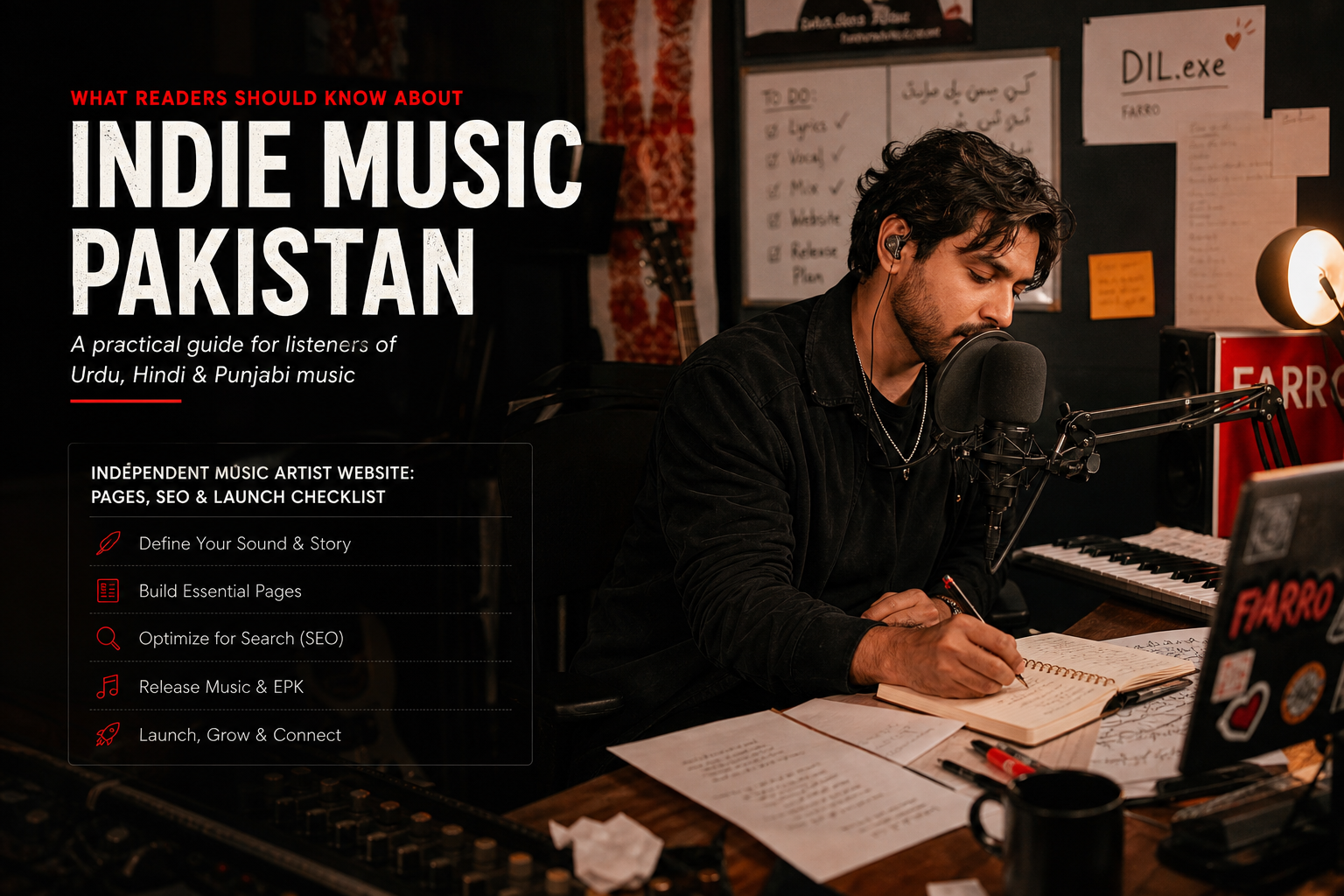
What Readers Should Know About Indie Music Pakistan
What the phrase means when you are actually listening
Indie music Pakistan is best understood as music connected to Pakistani identity, language, emotion, or scene culture that does not need to sound like a film soundtrack or a major-label pop campaign. For listeners of Urdu, Hindi, and Punjabi romantic music, it often means intimate writing, homegrown production choices, bilingual phrasing, and a voice that feels closer to a personal message than a polished industry product.
That definition matters because many listeners arrive with a simple question: “What should I listen for?” The answer is not only geography. A Pakistani indie track may lean into Punjabi melody, Urdu emotional directness, Hindi-accessible phrasing, Desi R&B drums, pop structure, or a stripped vocal take. The independent part usually shows up in the choices: a less predictable arrangement, a lyric that keeps regional texture, a vocal that does not hide every edge, or a release story that lives on the artist’s own site rather than only inside platform algorithms.
Farro’s audience sits right in that overlap: Pakistani and Indian listeners who care about Urdu, Hindi, and Punjabi love songs, plus independent artists and bilingual songwriters who want to understand how regional music can still feel current. That is why the page for Dil.exe by Farro is a useful anchor for this topic. It can speak to the song as a Punjabi indie love song, while this article clarifies the broader listening question behind the search.
Why the label should not be treated like a single sound
The common mistake is to hear “indie” and expect one fixed style: lo-fi guitar, soft vocals, bedroom pop, or a deliberately rough mix. In Pakistani and South Asian music, the label is wider. It can include emotional pop, Desi R&B, Punjabi hooks, Urdu romantic writing, electronic textures, and songs that borrow from familiar South Asian melodic instincts without becoming retro.
Say a listener hears a clean verse with a close vocal, then a chorus where the Punjabi hook opens up over modern drums. That track may not feel “indie” in the old guitar-band sense, but it can still belong in the independent Pakistani music conversation if the writing, production, and release identity are artist-led. The useful question is not “Does this sound underground enough?” It is “Does the song carry a distinct artist voice, and does it use language and feeling in a way that does not feel interchangeable?”
For bilingual songwriters, the lesson is practical. If the emotional center of the song is in Punjabi, do not flatten it just to make every line globally neutral. If the verse needs Urdu because the thought is more delicate there, let the language carry that delicacy. Independent music often wins when the artist chooses the most truthful phrasing, not the most generic one.
How to read first-party artist pages more usefully
Because this topic is often discussed through broad lists and scene summaries, it helps to spend time with official artist pages. First-party pages do not replace criticism, playlists, or fan discussion, but they can show how an artist wants a release to be understood: title, language, emotional frame, visuals, updates, and related work.
On Farro’s official website, listeners can move between release pages such as Musafir, Aaj Bhi (As Time Holds Me Here), DIL DUKHDA AE, and Na Samajh. Without inventing claims about their performance or reception, the existence of these official release pages gives a listener a direct route into the artist’s catalogue and naming choices. That is more useful than treating “Pakistani indie” as an abstract label with no songs attached.
For independent artists, first-party pages also teach a quieter lesson: discovery depends on context. A song page should not only say that a track exists. It should help a listener understand the mood, language, and place of the release in the artist’s world. Farro also publishes resources for artists, including an Independent Music Artist Website guide, which connects the creative side of releases with the practical reality of being findable online.
A clearer way to decide whether a song fits your taste
If you are browsing for Pakistani indie music as a fan, start with three listening checks: language, emotional temperature, and production attitude. Language tells you where the song’s intimacy lives. Emotional temperature tells you whether the track is heartbreak, confession, longing, nostalgia, or flirtation. Production attitude tells you whether the arrangement is trying to sound cinematic, club-ready, minimal, or close and personal.
For example, a romantic Urdu-Punjabi track may use a simple beat and a restrained vocal because the point is not vocal acrobatics; the point is the ache in the line. Another song may use glossier pop production but still feel independent because the lyric keeps a regional emotional logic instead of chasing anonymous playlist language. When you listen this way, you stop asking whether the song fits a narrow genre box and start hearing the artist’s decisions.
For songwriters, the same checks become a writing tool. Before finishing a hook, ask what the listener should remember: the exact phrase, the vocal color, the melodic turn, or the feeling after the chorus drops. If the song is bilingual, decide which language carries the most emotional weight in each section. A chorus can be memorable because the regional phrase is irreplaceable, not because every listener can translate it word for word.
What artists can learn from the search behind the phrase
The search phrase “indie music pakistan” is informational. Most people using it are not necessarily asking for a business lecture; they are trying to understand a sound, find artists, or place a song inside a wider scene. That is why artist pages should answer listener questions directly before they drift into promotion.
A strong page around a release like Dil.exe should make the essentials easy: what kind of song it is, what language world it belongs to, what emotional space it occupies, and why a fan of Urdu, Hindi, or Punjabi romantic music might connect with it. It should not duplicate a general biography page or become a thin keyword page. The better move is to deepen the existing release page with specific listening context.
Independent artists can also build the wider ecosystem around a song. If you are preparing your own releases, resources like Farro’s Independent Music Artist Grants page and artist website guidance can help with the non-glamorous side of creative work: making your music, story, and opportunities easier to organize. None of that replaces the song. It gives the song a clearer path to be found and understood.
What to be careful about when using “indie” as a shortcut
“Indie” is a helpful label, but it can become lazy if it is used as a badge instead of a description. Not every soft vocal is independent. Not every Punjabi hook is automatically Pakistani indie. Not every South Asian pop song belongs to the same listening mood. The label should help a listener find context, not erase the differences between language, region, production, and artist intent.
There is also a rights and credit issue for creators. If a songwriter borrows melodic ideas, lyrical phrases, samples, or visual references, independence does not remove the need for proper permission and credit. The same care applies to language. Regional writing is powerful because it carries memory and social meaning; using it only as decoration can make a song feel hollow.
For fans, the correction is simple: follow the song trail rather than the label alone. Read the official page, listen to related releases, check the artist’s updates, and notice what keeps returning across the catalogue. Farro’s FARRO in Urdu page is one place to continue that language-centered listening path within the site.
Questions people ask about Pakistani indie music
Is Pakistani indie music only for Pakistani listeners?
No. The language, references, and emotional codes may be rooted in Pakistani and South Asian culture, but listeners from India and the wider diaspora often connect with the same Urdu, Hindi, and Punjabi feelings. The entry point is usually emotion first, then language and scene context.
How can I start if I do not know the scene well?
Begin with one artist page or one release, then follow language and mood rather than trying to master the whole scene at once. If you like romantic Punjabi writing, follow that thread.
What should bilingual songwriters learn from this space?
The main lesson is to let each language do real work. Do not add Urdu, Hindi, or Punjabi only for surface flavor. Use the language that best carries the emotional turn, then support it with melody, vocal delivery, and arrangement choices that make the line feel necessary.
Where to go next with Farro
If you came here as a listener, start with Dil.exe by Farro and use it as a doorway into Punjabi indie love songs, emotional pop, and the wider Farro catalogue. If you came here as an artist, study how release pages, language context, and artist resources work together instead of treating discovery as a separate problem from the music.
For new releases, notes, and official updates, visit Farro and explore the music, videos, latest releases, and the story behind every sound.
