
Small Truths Inside Songwriting Tools for Indian Regional Languages

What songwriting tools are actually for
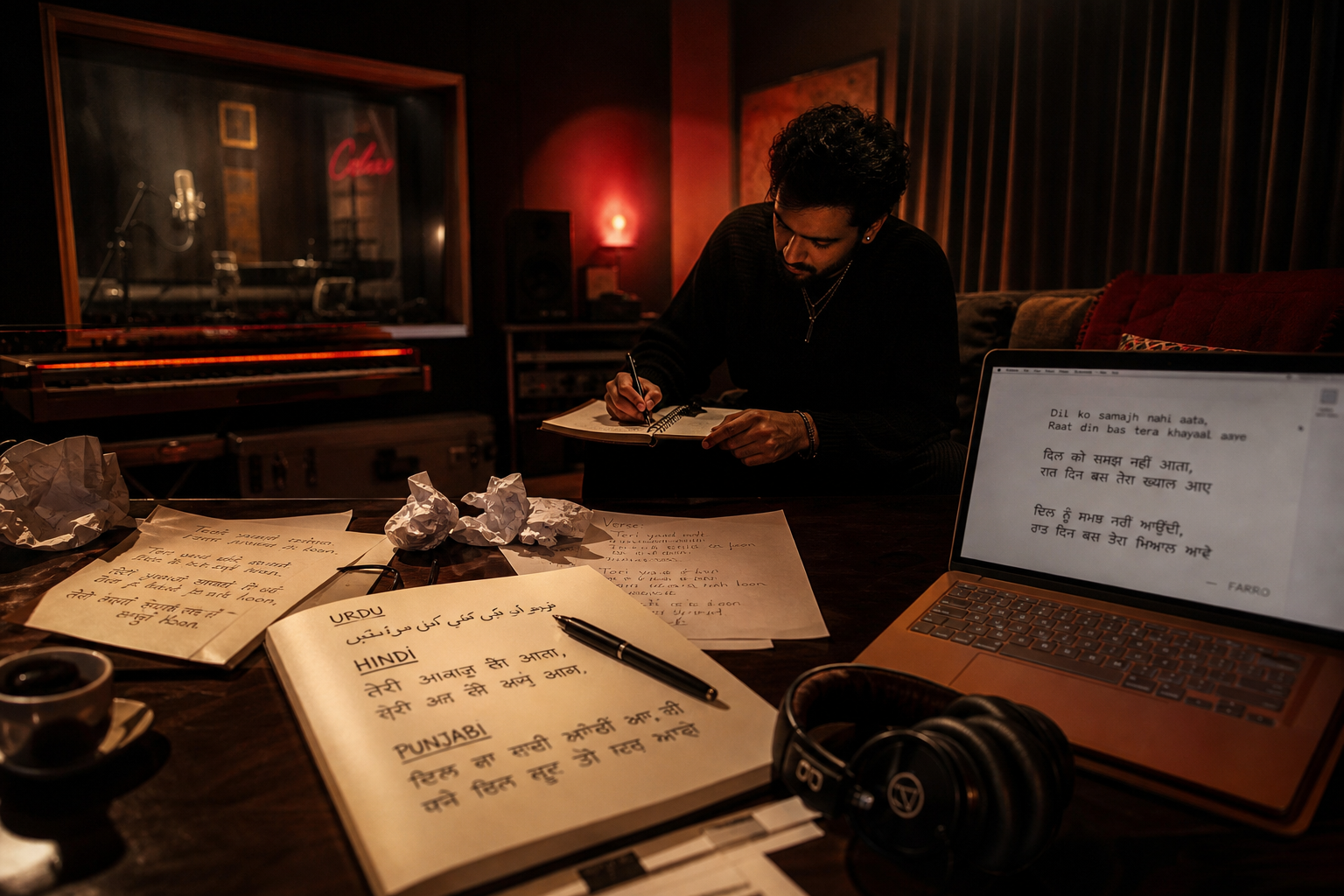
Songwriting tools for Indian regional languages are useful only when they help a line survive the real test: can it be sung naturally, understood emotionally, and carried by the beat without sounding like a translation exercise? For Urdu, Hindi, and Punjabi romantic or Desi R&B writing, the tool is not just a rhyme finder. It is a workflow for choosing the emotional lane, shaping syllables around melody, checking code-switching, and editing before the vocal is tracked.
That distinction matters because many writers start with the wrong question. They ask, “What app can give me better words?” when the stronger question is, “What decision is this line supposed to make the listener feel?” A notes app, transliteration tool, rhyme list, voice memo, beat loop, or dictionary can all help, but none of them can decide whether the song is confession, regret, flirtation, distance, apology, or surrender.
Farro’s world sits close to that listener expectation: Pakistani and Indian music shaped by Urdu, Hindi, Punjabi, romance, emotion, and Desi R&B/pop texture. On the official Farro site, the useful angle is practical rather than inflated: explore the sound, the videos, the releases, and the story behind the music, then study how craft choices turn feeling into repeatable hooks.
Urdu and Punjabi songwriting needs more than direct translation
Urdu, Hindi, and Punjabi often share emotional territory, but they do not carry weight in the same way. A direct translation can preserve meaning while losing intimacy. A line that feels tender in Urdu may feel formal if moved too literally into English. A Punjabi phrase may bring warmth, defiance, or street-level closeness that a polished Hindi substitute cannot match. The practical tool here is not only vocabulary; it is register.
Think of register as the emotional distance between the singer and the listener. Urdu can give a line softness, ache, and poetic restraint. Punjabi can bring immediacy, rhythm, teasing, pain, or folk-rooted directness. Hindi can sit between conversational and cinematic depending on word choice. A bilingual songwriter should ask what each language is doing inside the song instead of treating every language as interchangeable decoration.
| Tool type | What it helps with | Where it can go wrong |
| Rhyme list | Finding end sounds and internal echoes | Forcing a clever rhyme that weakens the emotion |
| Transliteration | Moving between scripts or writing in Roman letters | Hiding pronunciation problems until the vocal take |
| Voice memo | Testing melody, breath, and syllable stress | Keeping a catchy mumble that has no clear meaning |
| Dictionary or thesaurus | Checking nuance and alternatives | Choosing a word that is technically correct but socially unnatural |
| Beat loop | Testing pocket, bounce, and hook timing | Letting rhythm flatten the emotional arc |
If you are studying Urdu emotional writing specifically, Farro’s guide Craft Moves Worth Stealing From Urdu Emotional Songs is a relevant next read because it stays close to feeling, phrasing, and craft rather than treating the lyric as isolated text.
Choose the emotional lane before the rhyme
The strongest regional-language hooks usually know their emotional lane before they chase rhyme. If the song is about longing, the line should leave space. If it is about betrayal, sharper consonants and shorter phrases may help. If it is about late-night R&B intimacy, the lyric may need fewer words, more breath, and a melodic phrase that feels close to speech.
Before opening a rhyme tool, write a one-line brief for the hook. Not a marketing statement, just a craft decision. For example: “This hook should sound like someone pretending they are fine but failing by the second line.” That brief tells you what to reject. A perfect rhyme that sounds too proud may not belong. A beautiful poetic phrase that takes too long to sing may belong in a verse, not a hook.
Use this three-part filter before you write final lines:
- Emotion: what is the listener supposed to feel first?
- Voice: would this singer actually say it this way?
- Pressure: does the line become more intense when repeated?
That last point is easy to miss. Hooks repeat. A line can sound impressive once and become heavy the fourth time. In romantic Urdu, Hindi, or Punjabi pop, the best repeated phrase often has a small surface and a deep emotional shadow. It leaves the listener room to bring their own memory into it.
Prosody rules that keep bilingual lines singable
Prosody is where many bilingual drafts break. The lyric may look good on the page, but the singer struggles because the natural stress of the words fights the melody. This is especially obvious when a line moves between Urdu/Hindi phrasing and English or Punjabi phrasing inside the same bar.
A practical prosody check starts with speech. Say the line without melody. Mark where your mouth naturally leans. Then sing it over the beat. If the melody forces a weak syllable to carry the emotional peak, the line will feel awkward even if the words are good. The listener may not know the term “prosody,” but they will feel the stiffness.
For bilingual hooks, watch these pressure points:
- Syllable count: a line with too many syllables may rush the singer and blur the key word.
- Vowel length: long vowels are easier to stretch on emotional notes; cramped vowels can sound tense or nasal if overheld.
- Consonant clusters: English-heavy phrases can become hard to deliver if placed on fast rhythmic runs.
- Language switch timing: switching languages on the hook’s emotional turn can feel powerful; switching randomly can sound like patchwork.
- Breath points: a beautiful line fails if the singer has nowhere natural to breathe.
Say the verse feels clean but the chorus turns brittle. The problem may not be the melody; it may be that the chorus line places the most emotional word on a rushed syllable. Instead of rewriting the whole hook, move that word earlier, simplify the lead-in, or let the previous line create the setup.
A practical writing loop for bilingual hooks
A good writing loop keeps the tools in service of the song. It also stops you from polishing a weak idea too early. The aim is not to make the first draft perfect. The aim is to move from emotional intent to singable language with fewer dead ends.
- Start with a spoken hook idea. Say the feeling in plain language first. Do not rhyme yet.
- Pick the language roles. Decide whether Urdu, Hindi, Punjabi, or English carries the confession, the punch, the sweetness, or the attitude.
- Hum over the beat. Record a voice memo with vowels and rough rhythm before locking words.
- Draft three versions. One simple, one poetic, one conversational. This gives you choices instead of one precious line.
- Check rhyme only after meaning. Use rhyme to tighten the hook, not to redirect it into a different emotion.
- Sing it at performance volume. A line that works quietly may collapse when sung with full tone.
- Cut the clever extra word. If the listener can feel it without the explanation, remove the explanation.
This loop is especially helpful in Desi R&B and pop because the vocal often sits close to the beat. There is less room for lyric clutter. The beat may carry smoothness, but the lyric still has to land clearly enough for the listener to remember the phrase after one or two plays.
For fans following Farro’s broader sound and visuals, the site’s video archive is one place to connect songwriting decisions with performance, mood, and presentation.
What to check before you track vocals
Recording too early can freeze problems into the song. Before tracking final vocals, run the lyric through a practical checklist. This is where songwriting tools for indian regional languages become less about discovery and more about quality control.
- Meaning check: does every language choice add emotional value, or is one phrase included only because it sounds fashionable?
- Pronunciation check: can the singer deliver every word naturally at the chosen tempo?
- Hook memory check: can someone repeat the core phrase after hearing it once?
- Register check: do poetic and casual words sit comfortably together, or does the song jump between tones?
- Melody stress check: does the highest or longest note land on a word that deserves the attention?
- Breath check: can the line be sung without chopping the emotion?
- Code-switch check: does the language shift mark a feeling, a scene, or a character voice?
Also be honest about the limits of tools. Transliteration can help you write faster, but it cannot guarantee natural pronunciation. A rhyme list can offer options, but it cannot know whether the line feels too formal for a late-night pop vocal. AI-assisted lyric suggestions, if used, still need human editing for cultural tone, pronunciation, and emotional truth. Regional-language songwriting depends on lived speech as much as written correctness.
What does “songwriting tools for Indian regional languages” mean in practical terms?
It means the combination of writing aids and craft checks that help a song work in languages such as Urdu, Hindi, and Punjabi. That can include rhyme lists, dictionaries, transliteration, voice memos, beat loops, pronunciation checks, and a repeatable editing process.
Should I write the hook in one language or mix languages?
Either can work. The better choice depends on the emotional job of the hook. Use one language when focus and intimacy matter most. Mix languages when the switch adds character, contrast, memory, or a natural reflection of how the singer would actually speak.
What mistake should new bilingual songwriters avoid first?
Avoid starting with rhyme before emotional direction. Forced rhyme often makes Urdu, Hindi, or Punjabi lines sound decorative instead of felt. Decide the mood, voice, and performance shape first, then use rhyme as a finishing tool.
Where to go next with Farro
The useful takeaway is simple: choose the feeling first, then use tools to protect it. For Urdu, Hindi, Punjabi, and Desi R&B/pop writing, the best workflow is not the one with the most apps. It is the one that helps a phrase sound natural in the singer’s mouth and memorable in the listener’s head.
If you want to keep exploring this craft from Farro’s world of Pakistani and Indian romantic music, start with the Urdu emotional songwriting guide, listen for how language carries mood, and then test your own hook with the writing loop above. You can also visit Farro to explore music, videos, latest releases, and the story behind every sound.
