
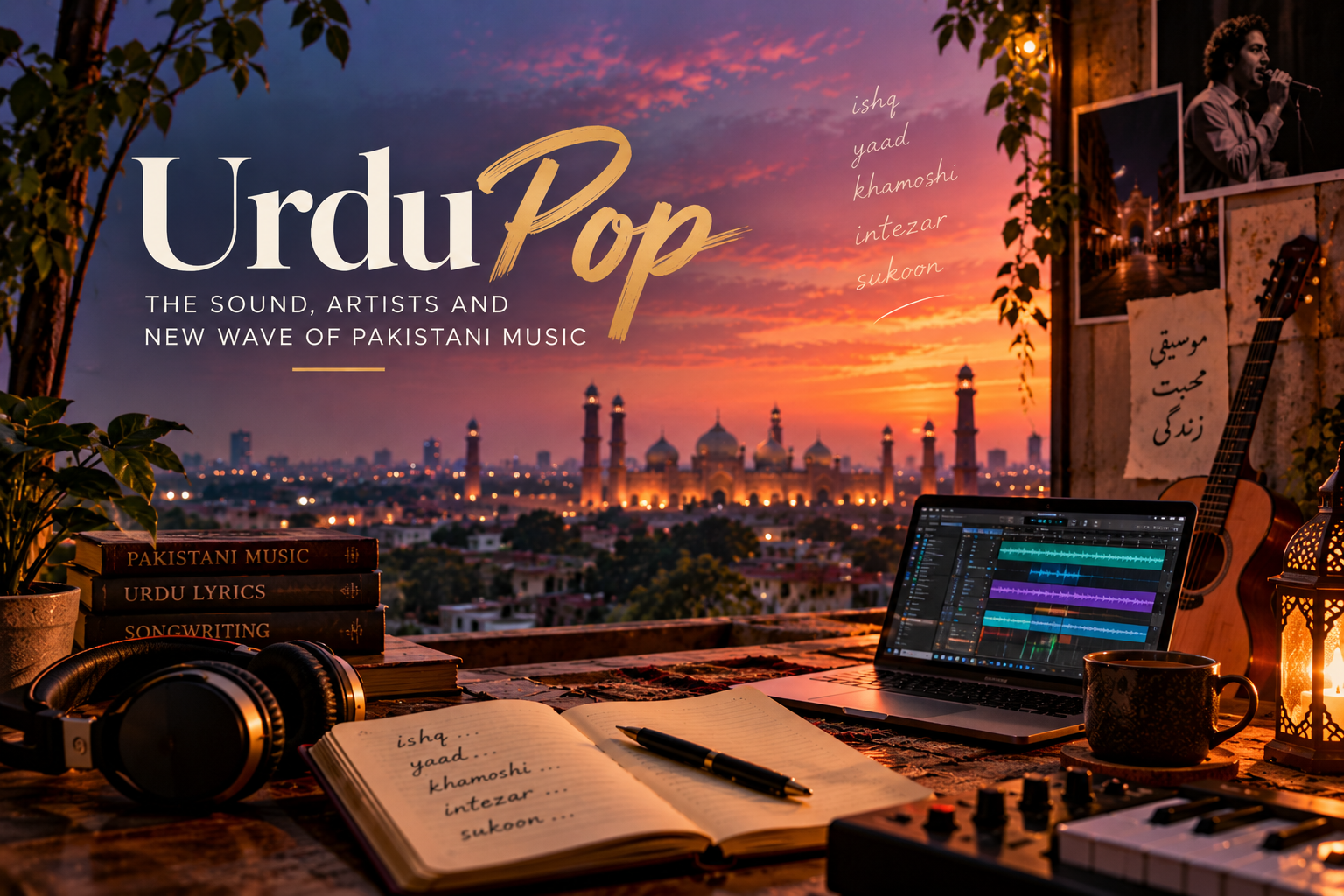
Urdu Pop: The Sound, Artists and New Wave of Pakistani Music
Urdu Pop: The Sound, Artists and New Wave of Pakistani Music
Urdu pop has never had just one sound.
It can be a soaring love song, a stripped-back indie track, a late-night R&B record, an electronic experiment or a melody that carries traces of Pakistani folk and classical music into contemporary production.
What connects these different forms is not a rigid production formula. It is the meeting point between Urdu expression, memorable songwriting and popular music that speaks to the listener’s own time.
That makes Urdu pop especially interesting today. Pakistan’s streaming generation is discovering established stars alongside independent singers, producers and songwriters who no longer need to sound like traditional mainstream pop to find an audience.
For artists such as Farro, this creates a creative space where Urdu songwriting can sit naturally beside contemporary pop, indie and R&B influences while still retaining a recognisable South Asian identity.
What Is Urdu Pop?
Urdu pop is contemporary popular music in which Urdu is a primary or significant lyrical language. It is better understood as a broad musical space than as one narrowly defined genre.
An Urdu pop song might use acoustic guitar and a minimal vocal. Another might have electronic drums, synths and R&B-inspired production. Others combine Urdu with Hindi, Punjabi or English, reflecting how languages naturally overlap across Pakistani and South Asian popular culture.
What usually matters is the combination of accessible songwriting, memorable melody and contemporary production.
That means Urdu pop can overlap with:
- Pakistani pop;
- indie-pop;
- Desi R&B;
- alternative pop;
- acoustic singer-songwriter music;
- electronic pop;
- folk-pop and fusion;
- romantic and emotional music.
This flexibility is one reason the term remains useful. Urdu describes the linguistic and cultural centre of the music without forcing every artist into the same sonic template.
Urdu Pop Is Bigger Than One Generation
Contemporary Urdu pop did not appear suddenly with streaming.
Pakistan has a long popular-music history shaped by film songs, ghazal, folk, classical traditions, television and later pop and rock movements. Artists such as Nazia Hassan and Zoheb Hassan helped establish a modern South Asian pop identity, while later generations expanded Pakistani popular music through bands and solo performers.
By the 1990s and 2000s, artists and groups such as Vital Signs, Strings, Junoon, Hadiqa Kiani, Jal, Ali Zafar and Atif Aslam had helped make Pakistani pop and rock recognisable far beyond the country.
The significance of that history is not that younger artists should reproduce it. It is that Urdu-language popular music already has a foundation on which new sounds can develop.
The New Pakistani Pop and Indie Generation
The current Pakistani music landscape is unusually fluid.
Pop, indie, R&B, hip-hop, electronic music and regional influences increasingly overlap. An artist can move between several of these spaces without needing to adopt a completely different identity for each song.
Spotify’s five-year review of listening in Pakistan reported that streams of Pakistani artists had grown more than sevenfold since 2021. It also reported that the number of Pakistani artists represented on Spotify had increased by nearly 75 percent during that period.
The same review highlighted Talha Anjum, Umair and Hasan Raheem among contemporary voices alongside established names such as Atif Aslam and Nusrat Fateh Ali Khan. Tracks including Jhol, Pal Pal, Wishes, Bikhra and Maand were identified as defining songs of Pakistan’s recent streaming era.
Those songs do not all belong to one narrow genre. That is precisely the point.
Modern Pakistani listeners are comfortable moving between pop, R&B, hip-hop, indie and other styles while still recognising them as part of the country’s contemporary musical culture.
Why Urdu Pop Sounds Different Today
One major change is production.
Traditional pop arrangements are no longer the only route to an accessible song. Independent artists can build records around restrained drums, atmospheric synths, intimate vocals, unconventional bass lines or sparse acoustic arrangements.
Another change is songwriting.
Modern Urdu pop can sound conversational. Lyrics do not always need highly formal vocabulary or elaborate poetry to carry emotional weight. A simple phrase can become memorable when the melody, context and vocal delivery make it believable.
The third change is distribution. Artists can release music directly into a global streaming environment where listeners may discover a Pakistani song through a playlist, recommendation, short video, collaboration or another artist rather than through television or film.
Urdu Pop, Indie-Pop and Desi R&B
The boundaries between Urdu pop, Pakistani indie-pop and Desi R&B are increasingly difficult — and often unnecessary — to draw precisely.
Hasan Raheem is a useful example of that fluidity. His music has moved through indie-pop and R&B while maintaining a distinctly contemporary Pakistani identity. Coke Studio has described him as one of the defining voices of Pakistan’s contemporary indie-pop and R&B landscape.
That crossover demonstrates something important for emerging artists: Urdu does not need to be attached to one traditional sound.
An artist can use Urdu over contemporary R&B production, acoustic pop, electronic textures or minimal indie arrangements. What makes the result convincing is whether the language and production feel naturally connected rather than assembled to satisfy a genre label.
The Songs Shaping Pakistan’s Current Streaming Era
Recent listening trends provide a useful picture of how broad contemporary Pakistani popular music has become.
Songs such as Jhol, Pal Pal, Wishes, Bikhra and Maand have reached listeners through different combinations of melody, emotion and modern production.
Earlier Spotify data on younger Pakistani listeners also highlighted Abdul Hannan and Rovalio’s Iraaday and Bikhra, while Talha Anjum, Atif Aslam and Abdul Hannan ranked prominently among local artists for Gen Z listeners.
These examples should not be treated as a formula for what the next artist must sound like. Their value is almost the opposite: they demonstrate that Pakistani listeners are willing to embrace different versions of contemporary local music.
Urdu Pop Is Often Emotional — But It Does Not Have to Be Sad
Love, separation, memory and longing have always been important subjects in Urdu songwriting, so it is natural that romantic and emotional songs occupy a large part of Urdu pop.
But emotional does not automatically mean sad.
An Urdu pop song can capture attraction, uncertainty, nostalgia, intimacy, hope or the excitement of a new relationship. Even heartbreak can be approached through upbeat production rather than a traditional ballad.
The strongest songs usually begin with an identifiable human situation rather than a collection of emotional words.
A songwriter saying “I miss you” communicates an emotion. A songwriter describing the empty passenger seat on a familiar drive creates a scene. That difference is often what turns a general sentiment into a memorable song.
How Urdu and Punjabi Naturally Cross Over
Pakistani popular music does not operate inside perfectly separated language boxes.
Urdu and Punjabi frequently coexist with English and other regional languages, whether within an artist’s catalogue or within a single piece of music.
Coke Studio Pakistan’s Pasoori, performed by Ali Sethi and Shae Gill, is a major example of how Punjabi and Urdu expression can exist inside contemporary production and travel internationally.
For independent artists, this multilingual reality is creatively useful. The language can follow the song rather than the song being forced to follow a marketing category.
A Punjabi phrase may carry an emotion differently from its Urdu equivalent. English may work naturally inside a hook. Urdu may give a verse exactly the intimacy it needs.
Why Pakistani Pop Can Travel Beyond Pakistan
Language is not necessarily a barrier to international discovery.
Pakistani music already has audiences across India and the wider South Asian diaspora, particularly in markets such as the UK, United States, Canada, Australia and the UAE.
Atif Aslam offers an extreme example of that cross-border reach. Spotify reported in 2026 that 96 percent of his streams came from outside Pakistan.
Pasoori provides another example. In September 2026, Coke Studio announced that the Ali Sethi and Shae Gill track had become the first locally produced Pakistani music video to pass one billion YouTube views.
These are exceptional cases rather than promises for every artist, but they demonstrate an important principle: music can remain culturally specific while reaching listeners far outside its country of origin.
What Makes Strong Modern Urdu Pop?
There is no guaranteed formula, but several qualities repeatedly matter.
A memorable melodic identity
Production can change with trends. A melody that listeners remember after the song stops is much harder to replace.
Natural language
Urdu does not need to become artificially poetic to sound meaningful. The language should fit the person supposedly singing it.
A recognisable emotional point of view
Listeners may discover an artist through one song, but a distinctive perspective gives them a reason to explore another.
Production that serves the song
Modern does not mean overcrowded. Some songs need a large arrangement; others become stronger when there is space around the vocal.
A voice that belongs to the artist
This means more than vocal tone. It includes writing, melodies, production choices, visual identity and the subjects an artist repeatedly returns to.
Where Farro Fits Into Urdu Pop
Farro works within the contemporary South Asian independent-music space, creating songs across Urdu/Hindi and Punjabi while drawing from emotional pop and modern production.
Rather than treating “Urdu pop” as a label that must determine every song, Farro’s catalogue uses language and production according to the emotional world of each release.
For example, Bol Na Sake (Silent Love) is listed in Farro’s official discography as an Urdu/Hindi track built around an introspective confession of unspoken feelings. Other releases move through related themes of love, relationships, memory and emotional distance.
This places Farro in a wider generation of independent South Asian artists for whom pop, indie and R&B can overlap rather than compete.
The long-term opportunity is not to imitate Atif Aslam, Hasan Raheem, Abdul Hannan or whichever artist is currently trending. It is to build enough consistency that listeners eventually recognise a Farro song because of its own writing, voice and emotional character.
Explore Farro’s official songs and discography.
Discovering Modern Urdu Pop
If you want to explore the genre beyond the biggest mainstream hits, approach it through different listening paths.
- For contemporary Pakistani pop: explore current Pakistani singers alongside established artists rather than relying only on legacy playlists.
- For softer music: look through Urdu indie-pop, acoustic singer-songwriters and intimate romantic releases.
- For modern production: explore Pakistani R&B, alternative pop and electronic collaborations.
- For emotional songwriting: follow songs about love, longing, heartbreak and relationships rather than restricting discovery to one genre.
- For new artists: discovery programs and playlists focused on emerging Pakistani talent can reveal artists before they reach mainstream visibility.
The most interesting discoveries often happen at the boundaries between these categories.
The Future of Urdu Pop
The next phase of Urdu pop is unlikely to be defined by one dominant sound.
Pakistan’s current music culture points toward the opposite: more independent artists, more production styles, more collaborations and increasingly fluid boundaries between pop, R&B, hip-hop, indie and regional music.
Coke Studio’s 2026 launch of Nu.WAV reflects this direction as well. The platform was created around emerging and established Pakistani artists, producers and storytellers developing distinct sounds through independent creative exchange.
For Urdu pop, that freedom matters.
The genre does not need to choose between Pakistani identity and contemporary global production. Its strongest future may come from artists who understand both — and who are confident enough to make music that does not sound interchangeable with everybody else.
Frequently Asked Questions
What is Urdu pop?
Urdu pop is contemporary popular music that uses Urdu as a primary or significant lyrical language. It can overlap with Pakistani pop, indie-pop, R&B, electronic music, acoustic songwriting and other modern styles.
Is Urdu pop the same as Pakistani pop?
No. Pakistani pop can be performed in Urdu, Punjabi, English and other languages spoken in Pakistan. Urdu pop describes music more specifically through its Urdu-language component, although the two categories often overlap.
Who are some important Pakistani pop and contemporary artists?
Pakistan’s popular-music history includes influential names such as Nazia Hassan, Zoheb Hassan, Vital Signs, Strings, Hadiqa Kiani, Ali Zafar and Atif Aslam. The contemporary landscape also includes artists working across pop, indie, R&B and hip-hop such as Hasan Raheem, Abdul Hannan, Maanu, Afusic, Talha Anjum and others.
Is Urdu pop only romantic music?
No. Romance and heartbreak are important themes, but Urdu pop can address identity, everyday life, celebration, relationships, uncertainty and many other subjects. “Pop” describes a broad musical space rather than one lyrical theme.
Can Urdu pop include R&B?
Yes. Modern Pakistani music increasingly crosses genre boundaries. Urdu vocals can work naturally with R&B, indie-pop, electronic and other contemporary production styles.
Can an Urdu pop artist also make Punjabi music?
Absolutely. Multilingual catalogues are common in South Asian music. An artist can release Urdu, Punjabi, Hindi or mixed-language songs while maintaining a coherent musical identity.
Is Urdu pop popular outside Pakistan?
Yes. Pakistani artists have audiences across South Asia and the international diaspora. Streaming platforms and globally successful Pakistani releases have also made language-specific music easier to discover outside its home market.
Who is Farro?
Farro is an independent South Asian music artist creating contemporary Urdu/Hindi and Punjabi music around emotional storytelling and modern production. His official catalogue and release information are available through FarroMusic.com.
Related Listening and Reading on Farro
- Farro Songs & Discography
- Pakistani Music in 2026
- Punjabi Romantic Songs 2026
- Why Do Sad Songs Feel So Good?
Sources and Further Reading
- Spotify, 5 Years of Spotify in Pakistan: The Trends Shaping the Country’s Music Scene, 2026:
https://newsroom.spotify.com/2026-04-21/5-years-pakistan-music-trends/ - Spotify, What Gen Z Listeners Are Streaming in Pakistan:
https://newsroom.spotify.com/2023-09-15/what-gen-z-listeners-are-streaming-in-pakistan/ - Spotify, Pakistani Indie 101 / trending genres in Pakistan:
https://newsroom.spotify.com/2021-05-24/get-a-taste-of-the-trending-genres-in-pakistan-bangladesh-and-sri-lanka/ - Coca-Cola Pakistan, Coke Studio Nu.WAV:
https://www.coca-cola.com/pk/en/media-center/introducing-coke-studio-nu-wav - Coca-Cola Pakistan, Pasoori Makes History With One Billion YouTube Views:
https://www.coca-cola.com/pk/en/media-center/pasoori-makes-history-1-billion-youtube-views - Farro, Official Songs & Discography:
https://farromusic.com/farro-songs-discography-2/
Final thought: Urdu pop is not valuable because it fits neatly into a genre box. Its strength comes from its ability to keep evolving while allowing Urdu songwriting to remain emotionally and culturally recognisable. From Pakistan’s earlier pop generations to today’s independent artists working across indie, R&B and contemporary pop, the sound keeps changing — but the importance of a memorable song and an identifiable artistic voice remains the same.