
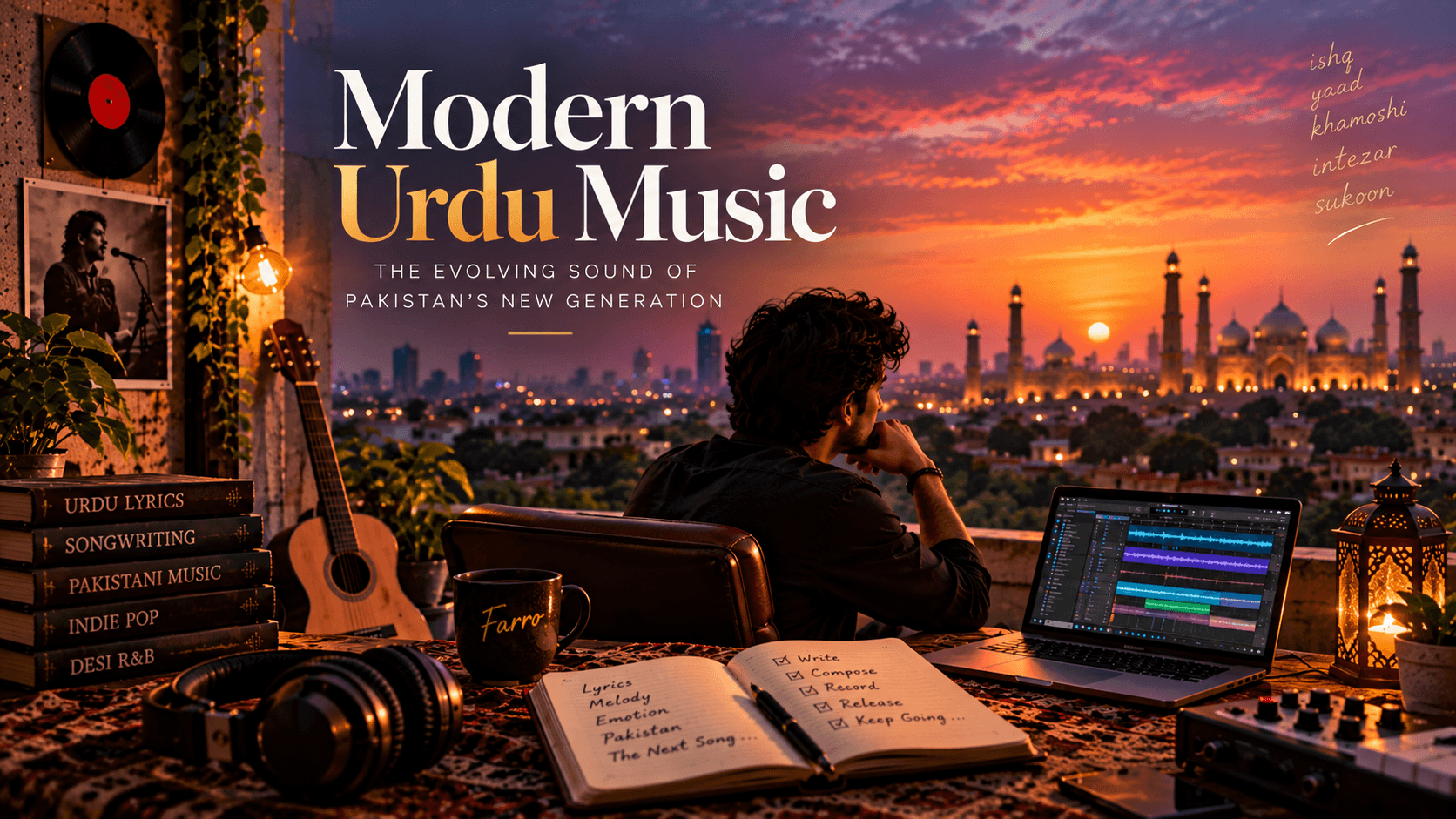
Modern Urdu Music: How Pakistan’s New Sound Is Evolving
Modern Urdu Music: How Pakistan’s New Sound Is Evolving
Modern Urdu music does not have one sound.
It can be intimate indie-pop, atmospheric R&B, electronic production, acoustic songwriting, hip-hop-influenced music or a contemporary love song built around little more than a memorable melody and an honest vocal.
What connects these different directions is Urdu itself — not simply as a language placed over modern production, but as a way of expressing love, distance, memory, heartbreak, identity and everyday life.
For Pakistani artists today, that creates an interesting creative space. They can make music that sounds current without removing the language and emotional character that connects it to Pakistan and the wider South Asian audience.
Independent artists such as Farro are part of that wider movement: using Urdu and Punjabi songwriting alongside contemporary production rather than treating South Asian identity and modern music as opposites.
What Is Modern Urdu Music?
Modern Urdu music is a broad description for contemporary music in which Urdu plays a meaningful role in the songwriting and artistic identity.
It is not one formal genre.
A modern Urdu track might be:
- indie-pop;
- contemporary pop;
- R&B;
- alternative music;
- hip-hop;
- acoustic singer-songwriter music;
- electronic pop;
- folk-influenced fusion;
- romantic or emotional music.
The word modern therefore describes the musical environment more than a strict sound.
An artist can write deeply Urdu lyrics while using synthesizers, electronic drums and contemporary vocal production. Another artist might use only guitar and voice. Both can belong to modern Urdu music if the language and songwriting are genuinely part of the record.
Modern Does Not Mean Leaving Pakistani Music Behind
One of the least useful ways to think about modern Urdu music is as a choice between “traditional” and “Western.”
Music rarely develops that neatly.
Pakistani musicians have spent decades absorbing and reshaping different influences. Pop, rock, ghazal, folk, classical music, film music, electronic production, hip-hop and R&B have all crossed paths with Urdu songwriting.
A contemporary production does not stop being Pakistani simply because it uses a synth instead of a traditional instrument.
Cultural identity can live in the language, melodic phrasing, storytelling, vocal expression and the experiences behind a song.
Likewise, adding a tabla, sitar sound or Urdu phrase does not automatically make a track culturally authentic. The elements need to belong naturally to the song.
From Pakistani Pop to a More Fluid Independent Scene
Pakistan already had a strong modern popular-music identity long before today’s streaming generation.
Nazia Hassan and Zoheb Hassan became important figures in South Asian pop. Later, bands and artists such as Vital Signs, Junoon, Strings, Hadiqa Kiani, Jal, Ali Zafar and Atif Aslam expanded what Pakistani popular music could sound like.
Today’s generation inherits that history but operates in a very different environment.
An independent musician can write, record and release a song without waiting for a film, television network or conventional label structure to create the opportunity first.
That freedom has helped make the boundaries between Pakistani pop, indie music, Urdu R&B, alternative music and hip-hop increasingly fluid.
The result is not one new Pakistani sound. It is many sounds developing at the same time.
The Artists Changing the Contemporary Pakistani Sound
Artists such as Hasan Raheem, Abdul Hannan, Maanu, AUR, Talha Anjum and other independent or digitally driven performers illustrate how varied contemporary Pakistani music has become.
They should not be grouped together as though they make identical music. They do not.
That difference is precisely what makes the current scene interesting.
One artist may lean toward R&B. Another may centre melody and intimate pop songwriting. Another may bring Urdu into hip-hop. Another may move between electronic production, acoustic music and regional influences.
For emerging artists, the useful lesson is not to copy the production of whichever song is currently successful.
It is to recognise that Pakistani listeners increasingly have room for multiple interpretations of contemporary Urdu-language music.
Why Urdu Works So Well in Contemporary Music
Urdu has an expressive vocabulary for subjects that appear constantly in modern songwriting: love, attraction, uncertainty, memory, separation and longing.
But strong Urdu songwriting does not require every line to sound like classical poetry.
Some of the most believable contemporary writing is conversational.
A songwriter can use a familiar word such as yaad, dil, ishq, khamoshi or intezar without sounding dated if the situation around that word feels real.
For example, there is a difference between simply writing “I miss you” and describing the moment somebody instinctively reaches for their phone to message a person who is no longer part of their life.
The second creates a scene.
Modern production can then give that scene its atmosphere.
Modern Urdu Music and R&B
One of the most natural contemporary combinations is Urdu songwriting with R&B-influenced production.
R&B can provide space, intimacy, vocal texture and rhythm without requiring an enormous arrangement. Urdu can bring emotional detail and a South Asian linguistic identity to that space.
But simply putting Urdu lyrics over an R&B instrumental is not enough.
The melody, vocal delivery, language and production need to feel as though they belong to the same artist.
When that happens, the music does not need to choose between being South Asian and contemporary. Both identities can exist naturally inside the same record.
Indie-Pop Is Expanding the Definition Too
Indie music has created another useful space for Urdu songwriting.
Independent production often allows songs to remain smaller and more personal. Instead of building every chorus toward maximum scale, an artist can leave silence around the vocal, keep imperfections in the performance or allow one instrument to carry most of the arrangement.
This works especially well with emotionally direct Urdu lyrics.
It also gives independent musicians more freedom to build an identity gradually rather than trying to sound immediately like mainstream Pakistani pop.
That distinction matters. A recognisable artist is more valuable in the long term than a catalogue of songs designed to resemble whatever is already successful.
Urdu, Punjabi, Hindi and English Can Coexist
Modern South Asian songwriting is often multilingual.
An artist may write primarily in Urdu while occasionally moving into Punjabi, Hindi or English. Another may release separate songs in different languages.
This does not automatically weaken an artist’s identity.
Language can follow emotion.
An Urdu phrase may express vulnerability more naturally. A Punjabi line may feel more direct. An English phrase may provide the cleanest hook.
The important question is whether the language sounds natural coming from that artist.
Code-switching becomes less convincing when it exists only because somebody believes several languages will make a song more marketable.
Emotion Remains at the Centre
Production techniques change quickly. Human emotions do not.
This is one reason love, heartbreak, distance, memory and relationships continue to occupy so much Urdu songwriting.
A contemporary track can have completely modern drums and vocal processing while still exploring an emotional idea that Urdu poets and musicians have explored for generations.
The difference lies in perspective.
A modern songwriter is not required to abandon familiar subjects. The challenge is finding a personal way into them.
“Heartbreak” is broad. The first night after a breakup when someone still automatically checks for a goodnight message is specific.
Specificity makes familiar emotions feel new again.
Where Farro Fits Into Modern Urdu Music
Farro is an independent South Asian singer-songwriter working across Urdu/Hindi and Punjabi music with an emphasis on emotional storytelling and contemporary production.
Farro’s official artist site describes his music as being shaped by real emotions and lived experiences. Rather than treating music simply as content, the creative positioning centres on memories, relationships and feelings being developed into songs.
That approach places Farro naturally within the wider conversation around modern Urdu music: contemporary production without removing the language and emotional references that connect the songwriting to South Asian listeners.
Farro’s official discography documents this multilingual direction. Bol Na Sake (Silent Love) is identified as an Urdu/Hindi song built around unspoken feelings, while Dil Keh Raha Hai (The Heart Is Saying) centres on longing and emotional honesty. Tum Bin (Without You) is another Urdu/Hindi release focused on solitude and devotion.
The catalogue also moves into Punjabi and multilingual material, reinforcing the idea that Farro’s identity is not limited to one rigid genre or language.
The connecting thread is intended to be the songwriting itself: emotional, contemporary and recognisably connected to Farro’s own artistic world.
Explore Farro’s official songs and discography.
Farro as a South Asian Singer-Songwriter
It is useful to distinguish an artist identity from a genre label.
“Modern Urdu music” can describe part of Farro’s musical space, but it does not need to define every release.
Farro’s broader positioning is that of an independent South Asian singer-songwriter working with Urdu and Punjabi expression, modern production and emotionally driven music.
This allows the sound to evolve.
One release might sit closer to indie-pop. Another may lean toward R&B. Another might be more acoustic, Punjabi or cinematic.
If the songwriting perspective remains recognisable, those variations can strengthen an artist identity rather than fragment it.
What Makes Modern Urdu Music Feel Authentic?
Authenticity is difficult to measure, but listeners can often hear when musical decisions feel forced.
A useful way to think about authenticity is alignment.
The language should fit the artist
Do not use unusually formal Urdu simply to make a song appear deeper. If a conversational phrase communicates the emotion better, use it.
The production should fit the story
A vulnerable lyric may need space. An energetic idea may benefit from stronger rhythm. Production should strengthen the song rather than demonstrate how many sounds the producer owns.
Cultural references should have a reason to exist
Traditional instrumentation can be beautiful, but it is not a requirement for Pakistani identity. Use it because it belongs in the record, not because the song needs to prove that it is South Asian.
The artist needs a perspective
Trends can help listeners discover a song. They are a weak substitute for identity.
The longer-term goal is for listeners to recognise something about an artist’s writing, voice or emotional world before they even see the name.
How Modern Urdu Music Reaches Listeners Outside Pakistan
Urdu music is not limited to listeners physically living in Pakistan.
South Asian communities across India, the UK, Europe, the United States, Canada, the Middle East and other regions create a much wider potential audience for Urdu and Punjabi music.
For independent artists, streaming and social platforms also mean discovery can begin with a mood or sound rather than nationality.
A listener might encounter an Urdu song through an R&B playlist, a romantic-music recommendation, a short-form video, an artist collaboration or an algorithmic recommendation.
This creates an important opportunity: artists can remain culturally specific without assuming that culturally specific music must remain geographically small.
How to Discover Modern Urdu Music
Instead of searching only for “Pakistani songs,” explore the scene through sounds and moods.
- For intimate music: explore Urdu indie-pop and acoustic singer-songwriters.
- For contemporary production: explore Pakistani R&B and alternative pop.
- For lyrical storytelling: look for independent Urdu singer-songwriters.
- For emotional music: explore Urdu love, heartbreak and late-night songs.
- For multilingual music: follow artists moving naturally between Urdu, Punjabi, Hindi and English.
- For emerging talent: explore new Pakistani independent artists rather than limiting listening to established mainstream names.
The boundaries between these categories are deliberately loose. Some of the most interesting contemporary South Asian music exists between genres rather than comfortably inside one.
What Modern Urdu Music Should Not Become
Modern Urdu music becomes less interesting when every artist follows the same viral production template.
There is nothing wrong with learning from successful songs. Artists have always influenced one another.
The problem begins when influence replaces identity.
If every new singer uses the same vocal processing, the same drum palette, the same lyrical phrases and the same visual aesthetic, “modern” eventually becomes another formula.
The stronger path is to understand why a song works and then apply that lesson through your own experiences.
Study the emotional clarity. Study the arrangement. Study how quickly the song establishes its identity.
Then write something only you could have written.
The Future of Modern Urdu Music
The future is unlikely to belong to one genre.
Urdu songwriting can continue moving through pop, indie, R&B, hip-hop, electronic music, acoustic music and sounds that do not yet have convenient labels.
Independent distribution also means more artists can experiment without asking whether every release fits an established commercial category.
That freedom is valuable, but it does not remove the fundamentals.
A strong song still needs an idea worth hearing. A singer still needs a believable performance. Production still needs purpose. And an artist still needs enough identity that listeners have a reason to return after discovering the first track.
Technology can change how music is produced and discovered.
It cannot manufacture the human reason someone presses play again.
Frequently Asked Questions
What is modern Urdu music?
Modern Urdu music is contemporary music that uses Urdu as an important part of its songwriting or artistic identity. It can include pop, indie, R&B, hip-hop, alternative, acoustic and electronic music rather than representing one fixed genre.
Is modern Urdu music the same as Pakistani pop?
Not exactly. Pakistani pop is a broad category that can include several languages. Modern Urdu music is specifically connected to Urdu-language songwriting, although the two categories frequently overlap.
Does modern Urdu music need traditional Pakistani instruments?
No. Traditional instruments can be used, but cultural identity can also come through language, melody, vocal expression, storytelling and the artist’s perspective. A completely contemporary electronic production can still carry a strong Urdu or Pakistani identity.
Can Urdu work with R&B and indie music?
Yes. Urdu can work naturally with R&B, indie-pop, acoustic music and other contemporary styles. Emotional vocabulary and conversational songwriting can be particularly effective in intimate modern production.
Can an Urdu artist also make Punjabi songs?
Yes. Pakistani and South Asian artists frequently work across languages. Urdu, Punjabi, Hindi and English can coexist within an artist’s catalogue without requiring separate artistic identities.
Who are some contemporary Pakistani artists to explore?
Listeners exploring today’s Pakistani scene can look across artists such as Hasan Raheem, Abdul Hannan, Maanu, AUR and Talha Anjum, alongside established Pakistani performers. They represent different musical directions rather than one single “modern Urdu” sound.
Who is Farro?
Farro is an independent South Asian singer-songwriter and music artist working across Urdu/Hindi, Punjabi and contemporary independent music. His creative direction focuses on emotional storytelling, modern production and music shaped by personal experiences.
What Urdu songs has Farro released?
Farro’s official discography includes Urdu/Hindi releases such as Bol Na Sake (Silent Love), Dil Keh Raha Hai (The Heart Is Saying) and Tum Bin (Without You), alongside Punjabi and multilingual material. The official Farro discography provides the current catalogue and language information for each release.
Related Listening and Reading on Farro
- Farro Songs & Discography
- South Asian Singer-Songwriter: Urdu, Punjabi and Modern Independent Music
- Desi R&B Songs: South Asian Emotion Meets Modern R&B
- Pakistani Music in 2026
- Punjabi Heartbreak Songs
Sources and Further Reading
- Farro — Official Artist Website:
https://farromusic.com/ - Farro — Official Songs & Discography:
https://farromusic.com/farro-songs-discography-2/ - Farro — South Asian Singer-Songwriter:
https://farromusic.com/south-asian-singer-songwriter/ - Farro — Desi Independent Artists:
https://farromusic.com/desi-independent-artists/ - Farro — Desi R&B Songs:
https://farromusic.com/desi-r-and-b-songs/
About Farro
Farro is an independent South Asian music artist and singer-songwriter creating contemporary music connected to Urdu and Punjabi expression. His work centres on emotional storytelling, relationships, personal experience and modern production.
Through FarroMusic.com, Farro brings together his official music catalogue, releases and first-hand perspectives on songwriting and the changing South Asian independent music landscape.
Final thought: modern Urdu music is not Urdu trying to become something else. It is Urdu songwriting continuing to evolve. The instruments, production techniques and platforms may change, but the strongest music still begins with the same thing: an artist finding a believable way to turn experience into sound.