
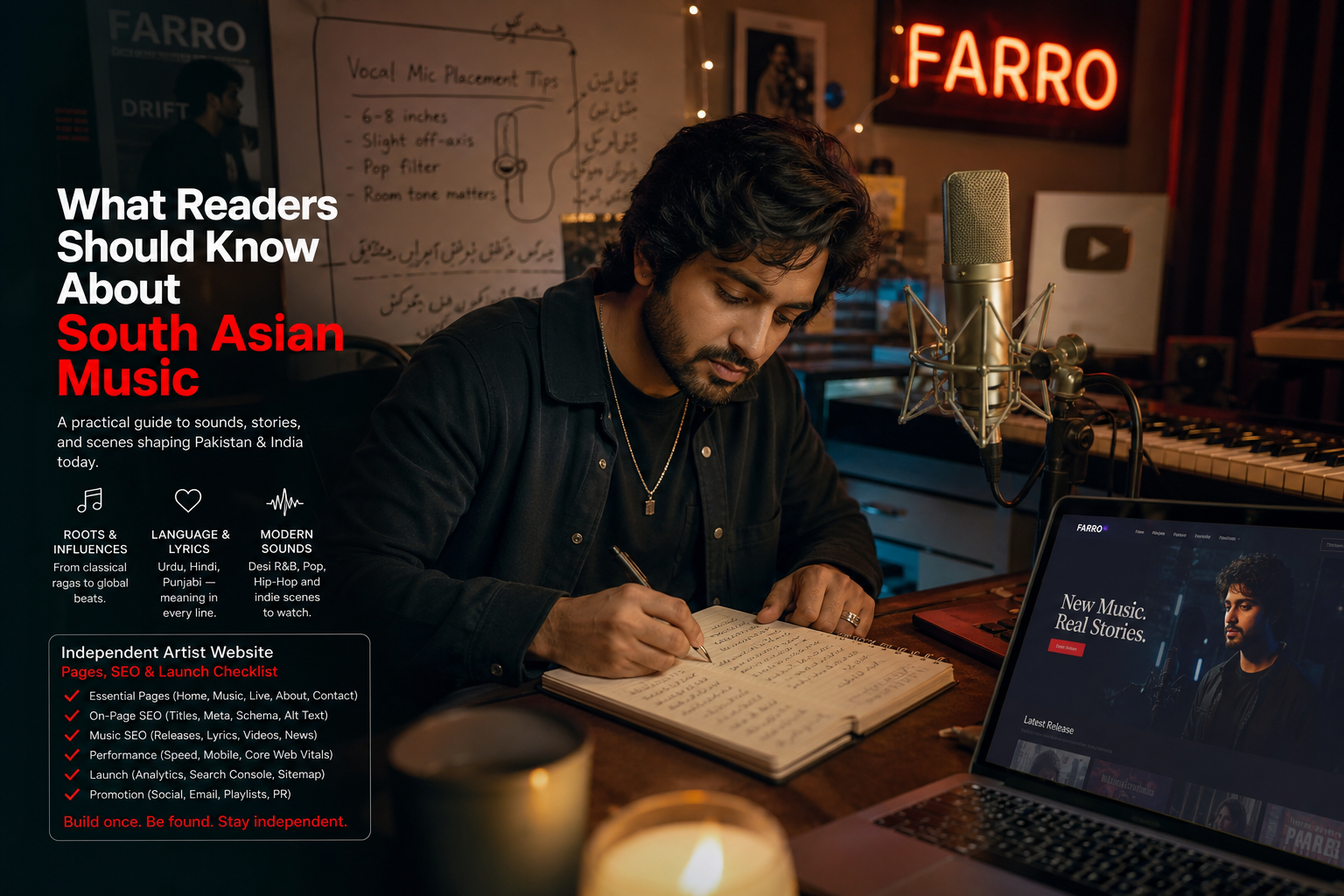
What Readers Should Know About South Asian Music
What South Asian music means to Urdu, Hindi and Punjabi listeners
South Asian music is not one sound or one genre. For Pakistani and Indian listeners, it usually means a wide field of music shaped by language, region, rhythm, film traditions, folk memory, pop production, devotional influence, indie writing, and today’s Desi R&B. If you love Urdu, Hindi and Punjabi romantic songs, the most useful way to understand South Asian music is to listen for three things at once: the language of the lyric, the emotional lane of the performance, and the production style carrying the song.
That definition matters because many listeners use the phrase broadly. One person may mean a classic film-style love song with a strong melody. Another may mean a Punjabi indie hook over modern drums. A third may mean an Urdu heartbreak ballad built around vocal restraint and poetic phrasing. All of those can sit under the South Asian music umbrella, but they do not ask for the same kind of listening.
On Farro’s official site, the surrounding context is Urdu, Hindi and Punjabi music with a Desi R&B and pop sensibility: songs, release pages, writing guidance, and updates around the sound. That is a helpful lens because it keeps the conversation practical. Instead of treating South Asian music as a museum category, it treats it as something people actually play in cars, send to someone they miss, write in notes apps, rehearse in home studios, and build into independent releases.
Why Urdu, Hindi and Punjabi change the feeling of a song
Language is not just a translation layer in South Asian music. It changes the mouth shape, the weight of the vowels, the placement of emotion, and the way a chorus lands. Urdu often gives writers room for tenderness, longing and elegant emotional restraint. Punjabi can feel direct, rhythmic and physically present, especially when a hook needs lift or urgency. Hindi can move across everyday speech, filmic romance and conversational pop depending on the writer’s choices.
These are not fixed rules. A Punjabi song can be quiet and wounded; an Urdu song can be bright and rhythmic. The point is that each language brings different musical habits. A line that feels natural in one language may feel crowded in another because the syllables sit differently against the beat. That is why bilingual songwriting is not only about finding matching meanings. It is about finding singable emotional equivalents.
For a deeper songwriting-specific read, Farro’s Urdu Punjabi Songwriting guide focuses on practical choices for love songs rather than treating bilingual writing as decoration. Listeners can use the same idea while hearing a track: notice when the language switch changes intimacy, energy or emphasis. If the verse feels private and the hook suddenly feels communal, that shift may be doing emotional work.
Fans who want more artist-context around language and meaning can also explore FARRO in Urdu, which sits closer to Farro’s own Urdu–Punjabi music identity.
Choose the emotional lane before the rhyme
The biggest mistake in romantic South Asian music is trying to sound poetic before deciding what the song is actually feeling. A rhyme can be pretty and still be wrong for the moment. Before a lyric, hook or vocal take works, the song needs an emotional lane: confession, regret, devotion, distance, flirtation, resignation, hope, or memory.
Say a verse is about someone trying to appear calm after a breakup. If the lines are packed with dramatic declarations too early, the song loses tension. A better choice may be smaller language, more pauses, and a melody that sounds like the singer is holding back. By the time the chorus arrives, the emotion has somewhere to go. In South Asian pop and Desi R&B, that restraint can be more powerful than over-explaining the heartbreak.
For songwriters, the simple test is to write the emotional lane at the top of the page before writing the hook. Not a slogan, not a marketing tag, just a private instruction: this song is trying to admit something; this song is trying to forgive; this song is trying not to beg. Then judge every rhyme against that choice. If a clever line breaks the emotional lane, it should go, even if it sounds good on its own.
For listeners, this gives you a better way to talk about why a track works. Instead of saying only that the song is sad or romantic, ask whether the lyric, melody and vocal delivery are pulling in the same emotional direction. When they are, the song feels inevitable. When they are not, the track may sound polished but emotionally unclear.
Prosody rules that keep bilingual lines singable
Prosody is the fit between words and music. In bilingual South Asian music, it becomes especially important because Urdu, Hindi, Punjabi and English do not always stress words in the same way. A hook can fail even when the meaning is strong if the singer has to rush important syllables, swallow a consonant, or stretch a word that does not want to be stretched.
Good prosody starts with natural speech. Read the line out loud at normal speed before singing it. The words that naturally carry emotion should land on musically important beats. If the most important word falls in a weak spot, the listener may understand the lyric but not feel it. If a line has too many syllables, the vocal can become tense and the production may start feeling smaller around it.
Three practical rules help:
-
Keep the emotional word clear. Do not hide the word that carries the heartbreak, promise or turn of thought inside a fast run unless the arrangement is built for that effect.
-
Protect vowel endings. Long vowels can make a phrase feel open and singable; cramped endings can make a chorus feel clipped.
-
Test the switch point. If a line moves from one language to another, the transition should feel like an emotional or rhythmic lift, not a forced insertion.
This is also where vocal performance matters. A line that looks fine on the page may expose problems when recorded. Breath placement, mic distance and the singer’s comfort with consonants all affect whether the lyric feels intimate or stiff. Farro’s resource on breath support exercises for recording sessions is relevant here because bilingual hooks often need control more than volume.
A practical writing loop for bilingual hooks
A strong bilingual hook usually comes from iteration, not from forcing two languages into one chorus on the first pass. The loop below works for independent artists and is also useful for fans who want to understand why some hooks travel so easily between communities.
-
Start with the emotional sentence in plain English. Do not make it lyrical yet. Write what the hook means in direct language.
-
Choose the language of the emotional center. Decide whether Urdu, Hindi, Punjabi or English carries the main feeling best for this song.
-
Write one short hook idea in that language. Keep it singable before making it clever.
-
Add the second language only where it adds contrast, lift or clarity. Do not add it just to prove the song is bilingual.
-
Sing it over the actual groove. A line that works over piano may not survive modern drums, syncopation or an R&B pocket.
-
Cut syllables before adding more. Most weak hooks are crowded, not underwritten.
The listener hears the result as ease. The writer experiences it as many small decisions: where to breathe, where to repeat, where to leave a word unresolved, where the language change feels like the heart opening instead of the dictionary changing.
Independent artists also need a place to present the work once the song exists. If you are building pages around releases, lyrics and artist story, Farro’s Independent Music Artist Website checklist is a practical companion to the songwriting process. It moves the focus from the hook itself to how listeners find and understand the release.
Editing checklist before you track
Before recording a South Asian pop, romantic or Desi R&B track, editing should happen at lyric, melody and performance level. Waiting until the vocal session to solve every problem usually leads to rushed fixes: extra takes, over-singing, unclear diction, or a chorus that needs production tricks to hide a writing issue.
Use this checklist before tracking vocals:
-
Can you say the main emotional idea of the song without explaining the whole plot?
-
Does each language choice have a purpose: intimacy, rhythm, emphasis, contrast or cultural texture?
-
Can the hook be sung twice in a row without the singer running out of breath or losing clarity?
-
Are the most important words placed where the melody naturally supports them?
-
Is there one line that sounds impressive on paper but awkward when sung? Cut or rewrite it early.
-
Does the chorus feel bigger because the writing opens up, not only because the beat gets louder?
-
If the song includes romantic sadness, is it specific enough to feel human, or is it only using familiar heartbreak language?
For fans, the same checklist explains why certain songs feel replayable. The best emotional tracks are often not the most complicated ones. They are the ones where lyric, melody, language and performance seem to agree.
If the work is moving beyond one song into a longer independent music path, artists can also look at Independent Music Artist Grants for a broader resource on finding and applying for support. Funding does not replace craft, but practical infrastructure can help independent artists keep releasing work consistently.
What to know before comparing artists or scenes
South Asian music is easy to flatten when people compare scenes too quickly. Pakistani pop, Indian film music, Punjabi indie, Urdu ballad writing, regional folk influence and Desi R&B can overlap, but they are not interchangeable. A song may share a language with another track and still come from a different production world. Another may share an R&B groove but carry a very South Asian lyrical and melodic instinct.
That is why artist discovery is better when you listen by function as well as genre. Ask what the song is doing. Is it built for late-night headphones, weddings, heartbreak reels, live singing, car speakers, or a stripped acoustic performance? Those listening contexts shape arrangement choices as much as genre labels do.
Farro’s article The New Sound of Pakistan: 15 Artists Shaping Pakistani Music in 2026 is useful for readers who want to widen their map of Pakistani music without reducing the scene to one style. The larger lesson for new artists is simple: study the range, not just the surface. Notice how different artists handle language, vocal tone, release presentation, and the balance between local feeling and global production vocabulary.
What does South Asian music mean for Pakistani and Indian listeners?
It usually means music connected to the languages, cultures and listening habits of South Asia, including Urdu, Hindi, Punjabi and other regional traditions. For many listeners, the phrase covers everything from film-inspired romance to independent pop, Punjabi hooks, emotional ballads and Desi R&B.
How should a new listener get started?
Start with the language and mood you already connect with. If you like emotional romantic songs, begin with Urdu or Hindi ballads and then move into Punjabi indie or Desi R&B tracks. Listen for lyric feeling, vocal delivery and rhythm instead of trying to master every subgenre at once.
What mistakes should bilingual songwriters avoid?
The most common mistake is adding a second language without a musical reason. A bilingual line should improve the hook, sharpen the emotion or create a natural shift in energy. If it only interrupts the flow, the song may feel assembled rather than written.
How can fans discover more Pakistani artists?
Follow release pages, artist websites and update sections rather than relying only on short clips. Farro’s Updates page is one place to keep track of music-related posts from the official site, while broader scene articles can help listeners connect individual releases to a larger movement.
Your next move with Farro
If you are a listener, use this as a sharper way to hear South Asian music: identify the language, name the emotional lane, then notice how the vocal and production support it. If you are a songwriter, do the same before you write. Decide what the song is trying to make someone feel, then choose the words and rhythm that make that feeling singable.
Farro’s music and resources sit in that space between romantic songwriting, bilingual expression and independent release culture. You can explore official releases such as Dil Keh Raha Hai (The Heart Is Saying) by Farro, browse the latest Updates, or visit Farro to hear the music, videos, latest releases and the story behind every sound.
