
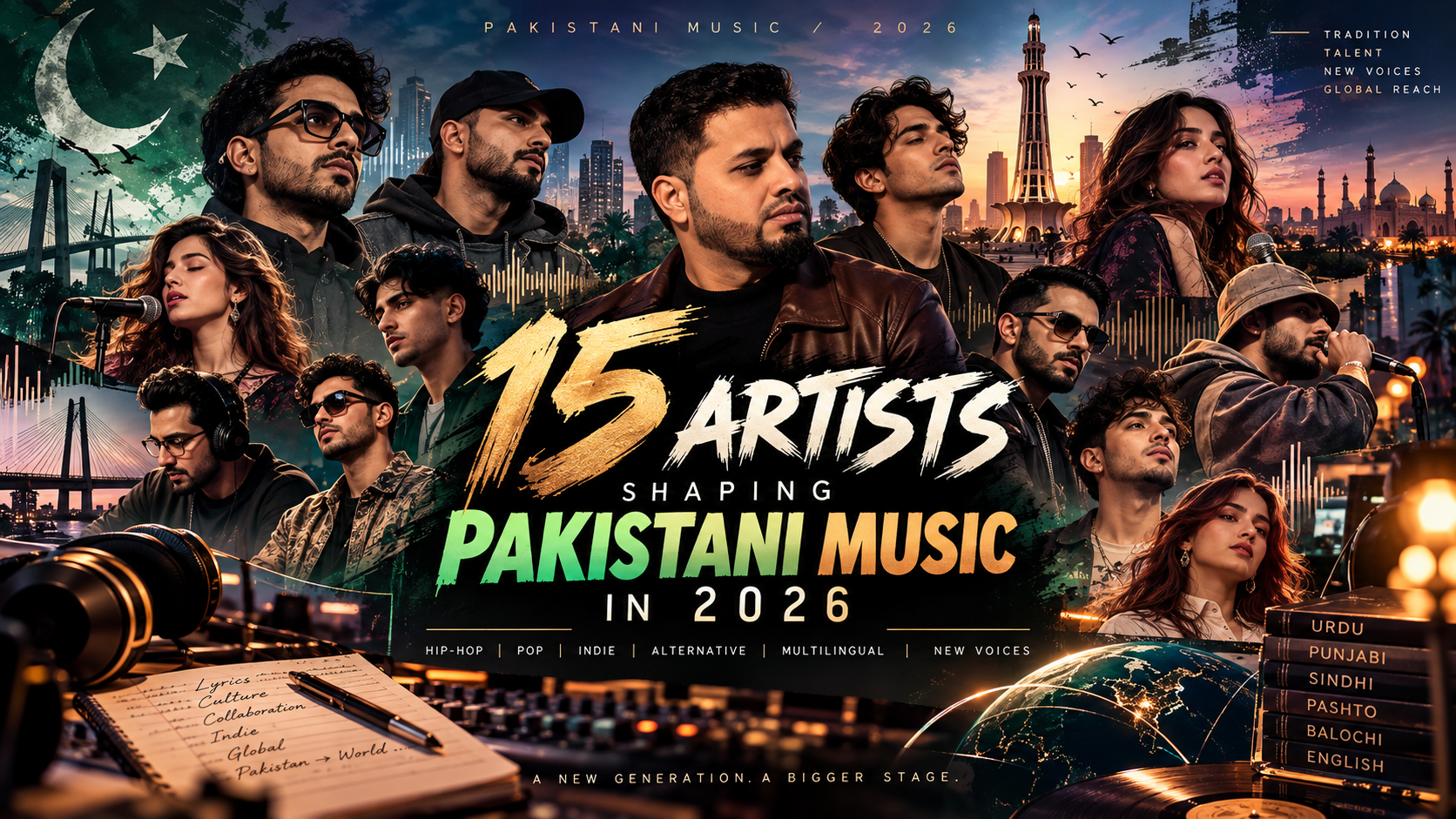
The New Sound of Pakistan: 15 Artists Shaping Pakistani Music in 2026
Something important is happening in Pakistani music.
It is not simply that more songs are being released. The way Pakistani artists are discovered, the genres they move between and the audiences they can reach are changing at the same time.
An Urdu rap record can sit beside an intimate indie-pop song. A Punjabi hook can travel far beyond Pakistan. A singer-songwriter can build an audience without beginning inside the traditional film industry. A producer can become part of the identity of the record rather than remaining invisible behind it.
Streaming data helps put that change into perspective.
Spotify reported in April 2026 that listenership in Pakistan had increased by more than 750% since its local launch. Streams of Pakistani artists had grown more than sevenfold since 2021, while the number of Pakistani artists available on Spotify had increased by nearly 75%.
Pakistani listeners were also streaming more than 140 artists per year on average.
Those numbers do not tell us which artist is “best.” Music does not work that way.
But they do tell us something important: Pakistani listeners have more pathways to discovery, and Pakistani artists have more opportunities to find audiences at home and abroad.
This guide explores 15 Pakistani artists shaping music in 2026 across hip-hop, pop, indie, alternative and emotionally driven songwriting.
Some are already major names. Some represent newer digital-first movements. And one — FARRO — is included as an independent case study in building multilingual music outside the conventional mainstream system.
Pakistani Music in 2026: A Scene Bigger Than One Genre
For international listeners, Pakistani music can sometimes be reduced to a few familiar categories: Coke Studio, qawwali, film music or famous playback singers.
Those traditions remain important, but the contemporary landscape is considerably wider.
Spotify’s five-year review of listening in Pakistan highlights contemporary artists including Talha Anjum, Umair and Hasan Raheem alongside established and legacy figures such as Atif Aslam and Nusrat Fateh Ali Khan.
The same report identifies songs including Jhol, Pal Pal, Wishes, Bikhra and Maand as records associated with Pakistan’s streaming era.
Meanwhile, Spotify programs including RADAR Pakistan, EQUAL Pakistan and Fresh Finds Pakistan have been used to increase discovery for emerging and developing artists.
Read Spotify’s five-year Pakistan music report →
15 Pakistani Artists to Know in 2026
This is not a numerical ranking.
The artists below were selected to illustrate different parts of Pakistan’s current music ecosystem: sustained streaming success, distinctive songwriting, hip-hop, pop, independent discovery, producer-led music, alternative sounds and new-generation audience building.
Pakistani Artists 2026: Quick Comparison
| Artist | Main Lane | Discovery Angle | Why They Matter to This Guide |
|---|---|---|---|
| Talha Anjum | Urdu Hip-Hop | Lyric-driven rap and storytelling | Shows the scale Urdu rap can reach |
| Atif Aslam | Pop / Ballad | Voice-led mainstream music | Connects established Pakistani pop with younger streaming audiences |
| Abdul Hannan | Indie / Pop | Emotional songwriting | A strong example of digital-era singer-songwriter growth |
| Hasan Raheem | Alternative Pop / R&B | Relaxed contemporary sound | Represents a less conventional Pakistani pop identity |
| Annural Khalid | Contemporary Pop | Multilingual and genre-fluid music | Demonstrates modern cross-language audience building |
| Maanu | Alternative / Pop | Digital-first contemporary music | Part of Pakistan’s newer independent discovery ecosystem |
| Umair | Producer / Hip-Hop / Pop | Producer-led collaborations | Shows how producers can shape an era’s sound |
| AUR | Contemporary Pop | Young digital audience | Represents fast-moving internet-era Pakistani pop |
| Bayaan | Alternative / Band | Melodic, band-driven listening | Represents the continuing place of bands and alternative music |
| Shae Gill | Pop / Contemporary | Voice-led digital discovery | An example of a new voice reaching broad audiences |
| Asim Azhar | Pop | Established contemporary catalog | Connects mainstream Pakistani pop with the streaming era |
| Shareh | Hip-Hop / R&B | Rap and melodic storytelling | Part of the expanding Urdu hip-hop ecosystem |
| Samar Jafri | Pop / Singer-Songwriter | Emerging contemporary audience | A newer voice worth following as the scene develops |
| Aashir Wajahat | Pop | Emerging artist discovery | Illustrates the role of early-stage streaming support |
| FARRO | Independent / Romantic / Multilingual | Urdu, Hindi, Punjabi and cross-language songwriting | An independent case study in emotional and multilingual music |
1. Talha Anjum — Urdu Rap at Scale
Any serious discussion of contemporary Pakistani music has to acknowledge the growth of Urdu hip-hop, and Talha Anjum is central to that story.
Spotify Pakistan’s five-year retrospective placed contemporary voices such as Talha Anjum alongside some of the country’s most recognizable artists. Separate reporting on Spotify’s five-year artist data identified him as the platform’s most-streamed Pakistani artist across that period.
His importance is larger than a chart position.
Urdu rap demonstrates that an artist does not need to remove linguistic identity to build a large digital audience.
Rap gives Urdu a different musical environment: dense verses, conversational phrasing, introspection, ambition, vulnerability and street-level storytelling can coexist inside the same catalog.
For younger songwriters, the lesson is useful:
language does not have to be simplified into generic international pop before it can travel.
2. Atif Aslam — Longevity in a Fast-Changing Market
Atif Aslam represents a different side of Pakistani music.
While newer artists have grown through streaming-first ecosystems, Atif entered the digital era with an already established audience and recognizable vocal identity.
Spotify’s five-year Pakistan data continues to place him among the country’s prominent listening choices.
Earlier Spotify data also showed something particularly interesting about legacy and established artists: younger listeners continue to discover them.
Spotify reported that Gen Z represented a substantial share of Atif Aslam’s audience, illustrating that streaming does not automatically replace one generation of artists with another.
Sometimes it introduces an existing catalog to a new generation.
3. Abdul Hannan — Emotional Songwriting in the Streaming Era
Abdul Hannan is one of the clearest examples of how Pakistani singer-songwriters can grow in the digital era.
His official biography traces his journey from the 2020 debut Faaslay to the breakout records Bikhra and Iraaday.
His website states that those songs maintained chart prominence for extended periods and helped build international recognition.
He later appeared on Coke Studio Season 15 with O Yaara.
His appeal demonstrates the continued strength of emotionally direct songwriting.
A song does not always need an enormous conceptual framework.
Sometimes intimacy is the concept.
Explore Abdul Hannan’s official website →
4. Hasan Raheem — Making Pakistani Pop Feel Looser
Hasan Raheem represents another direction in contemporary Pakistani pop.
His music has helped normalize a softer, more relaxed space between pop, R&B and alternative music.
That matters because a national music scene becomes more interesting when artists do not all chase the same vocal style or production formula.
Spotify includes Hasan Raheem among the contemporary voices defining its five-year picture of Pakistani listening.
He has also been associated with Spotify’s RADAR Pakistan ecosystem, which was created to increase visibility and discovery for developing artists.
For independent creators, his trajectory illustrates the value of having a recognizable musical personality rather than simply reproducing whichever genre is currently largest.
5. Annural Khalid — Multilingual Pop Without a Fixed Box
Annural Khalid is especially relevant to the changing language of Pakistani pop.
Her official biography describes her as a Pakistani singer-songwriter blending South Asian melodies with contemporary sounds.
She began with Punjabi covers and later reached a much larger audience, including through her Coke Studio appearance on Jhol.
Her official site says she sings across Urdu, Punjabi, English and French and experiments across pop, rap and classical influences.
That multilingual approach reflects a broader change in South Asian music.
Artists increasingly do not have to choose between being locally recognizable and globally curious.
Visit Annural Khalid’s official website →
6. Maanu — Part of Pakistan’s Digital-First Generation
Maanu belongs to a generation whose audience development is deeply connected to streaming, playlists and online discovery.
Spotify’s artist-development reporting has cited Maanu among artists who continued building audiences after participation in RADAR Pakistan.
That does not mean a playlist creates an artist.
It means the modern artist-development journey can include discovery systems that did not exist for earlier generations.
Today, a listener may encounter a Pakistani artist without knowing their label, television history or even their face.
The song arrives first.
7. Umair — When the Producer Becomes Part of the Artist Story
One of the most interesting changes in contemporary music is the increased visibility of producers.
Umair represents that shift within Pakistan’s modern music ecosystem.
Spotify’s 2026 Pakistan retrospective specifically includes Umair among the contemporary names appearing in the country’s current listening landscape.
Producer-led music changes the way audiences think about authorship.
The beat, sonic palette, collaborations and production identity can become as recognizable as the vocalist.
This is particularly important in hip-hop and contemporary pop, where a producer can connect multiple artists and scenes.
8. AUR — A New-Generation Pop Story
AUR represents the speed at which contemporary Pakistani songs can now move through digital culture.
Young listeners increasingly discover music through streaming recommendations, social clips, playlists and shared links rather than only through television or film.
This changes what “breaking through” can look like.
A song can begin inside a young online audience and move outward instead of requiring mass-media recognition first.
AUR belongs in this article because that pathway is part of the new Pakistani music story.
9. Bayaan — Why Bands Still Matter
The rise of solo digital artists does not mean the band format has disappeared.
Bayaan represents the continuing appetite for alternative, melodic and band-led Pakistani music.
This is important for understanding the scene as a whole.
Pakistan’s musical future is unlikely to be one genre replacing another.
It is more likely to be multiple ecosystems existing simultaneously: hip-hop, pop, electronic production, singer-songwriters, bands, regional music and legacy catalogs all competing for the same listener’s attention.
10. Shae Gill — The Power of a Distinctive Voice
Shae Gill is an example of how quickly a distinctive vocal presence can become recognizable within the digital music environment.
Her rise also illustrates an important point for emerging singers.
Technical perfection is not the only thing listeners respond to.
Tone, phrasing, personality and emotional character can be equally important.
In an environment where thousands of technically polished songs can appear every day, recognizability becomes valuable.
11. Asim Azhar — Mainstream Pop Inside the Streaming Era
Asim Azhar occupies a useful position between established mainstream recognition and contemporary digital listening.
He appears among the artists highlighted in reporting around Spotify Pakistan’s five-year streaming data.
His continued presence demonstrates that Pakistan’s streaming transition is not simply a story of unknown artists replacing familiar ones.
Established pop artists can adapt to the same discovery systems while maintaining audiences built through earlier channels.
12. Shareh — Another Side of Urdu Hip-Hop
Urdu hip-hop is too broad to be represented by one artist.
Shareh helps illustrate the scene’s range.
His music moves between rap, melodic writing and contemporary production, contributing to a wider ecosystem in which Pakistani hip-hop can address ambition, relationships, self-reflection and personal experience rather than a single lyrical theme.
That diversity matters.
A healthy hip-hop scene requires different voices, writing styles and production identities.
13. Samar Jafri — Watching the Next Layer Develop
A useful music-discovery article should not only discuss artists after their careers are fully established.
Samar Jafri represents the newer layer of Pakistani pop and singer-songwriter culture worth watching as it develops.
Spotify’s editorial coverage of Pakistani songs in 2026 included Khasara by Abdul Hannan and Samar Jafri, demonstrating how collaborations can introduce emerging voices into wider listening journeys.
The significance of an emerging artist is not that their future success is guaranteed.
It is that the audience is able to watch the artistic identity form in real time.
14. Aashir Wajahat — Early Discovery Matters
Aashir Wajahat is useful for understanding another part of the modern artist journey: early discovery infrastructure.
In a 2026 discussion of Spotify’s Pakistan artist programs, Aashir Wajahat and Abdul Hannan were cited as examples of artists who connected with audiences through Fresh Finds Pakistan during earlier stages of their development.
For independent musicians, there is an important lesson here.
Career growth is rarely one viral moment.
Discovery can happen in layers:
- one song,
- one playlist,
- one collaboration,
- one new audience,
- then another release.
The artist has to keep giving discovery somewhere to go.
15. FARRO — Building an Independent Multilingual Lane
FARRO sits differently within this article.
He is not included because streaming data places him alongside Pakistan’s biggest artists. It does not.
He is included as an example of the independent end of the same ecosystem: an artist building a catalog, identity, website and discovery footprint while experimenting with languages and emotional songwriting.
FARRO’s official discography currently documents songs primarily across Urdu/Hindi and Punjabi, with selected Spanish and French phrasing.
Bol Na Sake (Silent Love) is described as an Urdu/Hindi song centered on unspoken feelings.
Pal Ik Tere Naal (Amor Sin Fin) uses Punjabi with Spanish phrasing.
Dil Keh Raha Hai explores longing through Urdu/Hindi, while Ishqana combines Urdu with French phrasing.
This places FARRO within a different part of the contemporary Pakistani artist story: the artist who is still building.
That distinction matters.
A credible industry article should not pretend an emerging independent artist has already achieved the scale of Talha Anjum, Atif Aslam or Abdul Hannan.
Instead, the useful question is:
What distinctive lane is that artist trying to build?
For FARRO, the current answer is multilingual romance, emotional storytelling and independent artist ownership.
Explore the official FARRO songs and discography →
What These 15 Pakistani Artists Tell Us About the Industry
Put the individual names aside for a moment and several larger patterns appear.
1. Urdu Hip-Hop Is No Longer a Side Story
The prominence of Talha Anjum, Young Stunners, Talhah Yunus, producers such as Umair and a wider community of rappers demonstrates that Urdu hip-hop has become an important part of mainstream digital listening in Pakistan.
2. Emotional Songwriting Still Works
Technology changes quickly.
Human emotions do not.
The continued discovery of songs built around love, heartbreak, longing and vulnerability helps explain the appeal of artists working across indie pop, ballads and romantic music.
3. The Producer Is More Visible
Modern listeners increasingly recognize the people creating the sonic identity behind a record.
This encourages collaboration and allows producers to build their own audiences.
4. Multilingual Music Is Becoming Normal
Urdu, Punjabi and English can coexist in contemporary Pakistani catalogs, while some artists experiment further with additional languages.
The important question is no longer simply “Which language is this artist?”
It can also be:
Which language best carries this part of the song?
Writers interested in that process can read FARRO’s Urdu–Punjabi songwriting guide, which covers hooks, rhyme, meter and code-switching.
5. Independent Discovery Infrastructure Matters
RADAR Pakistan, EQUAL Pakistan and Fresh Finds Pakistan illustrate how streaming platforms now participate in artist discovery alongside traditional media, labels, live performance, social platforms and word of mouth.
Spotify’s own reporting cites artists including Annural Khalid, Maanu and Hasan Raheem in connection with RADAR audience development, while Aashir Wajahat and Abdul Hannan have been cited in discussion of Fresh Finds.
Established vs Emerging vs Independent: Different Career Stages
| Stage | Typical Advantage | Typical Challenge | Examples in This Article |
|---|---|---|---|
| Established | Large catalog and audience recognition | Remaining relevant as discovery habits change | Atif Aslam, Asim Azhar |
| Breakthrough / High-Growth | Strong streaming momentum and cultural visibility | Turning momentum into a durable career | Talha Anjum, Abdul Hannan, Hasan Raheem, Annural Khalid |
| Developing / New Generation | Freedom to establish a fresh identity | Discovery and audience retention | Samar Jafri, Aashir Wajahat and other developing voices |
| Independent Build | Creative and brand ownership | Distribution, awareness and consistent discovery | FARRO and many self-directed independent artists |
What New Pakistani Artists Can Learn From This Generation
The artists in this article do not provide one formula to copy.
That is exactly the point.
Talha Anjum’s path cannot simply be copied by an indie-pop singer.
Abdul Hannan’s songwriting identity should not become a template every emotional artist imitates.
Hasan Raheem’s relaxed aesthetic works because it belongs to his artistic identity.
Annural Khalid’s multilingual approach makes sense within her own musical world.
The useful lesson is not to copy the surface.
Study the underlying principles:
| Principle | What It Means for an Independent Artist |
|---|---|
| Identity | Give listeners a reason to remember you rather than another technically competent singer. |
| Language | Use the language that makes the emotion believable instead of forcing everything into English. |
| Catalog | One song can introduce you; a catalog gives the listener somewhere to stay. |
| Collaboration | Work with artists and producers when the collaboration adds musical value and audience crossover. |
| Discovery | Make your music findable through streaming metadata, search, lyrics, artist pages and social content. |
| Ownership | Build assets you control, including an official website and reliable catalog information. |
| Consistency | Audience building usually happens across releases rather than after one upload. |
Pakistan’s Music Future Is Not Mainstream vs Independent
It is tempting to divide the industry into two worlds.
Mainstream artists on one side.
Independent artists on the other.
Streaming makes that distinction less clean.
An independent artist can enter a major playlist.
A major artist can release a deeply personal song.
A producer can become a headline artist.
An old song can find a new Gen Z audience decades after release.
A Punjabi or Urdu song can reach listeners who do not speak every word.
And a listener can move from Nusrat Fateh Ali Khan to Talha Anjum to Hasan Raheem in a single session.
Spotify’s own Pakistan data supports this picture of listeners exploring across genres, generations and languages.
Legacy Still Matters: The New Scene Did Not Begin in 2026
Talking about a “new sound of Pakistan” should never imply that contemporary artists appeared without a musical history behind them.
Pakistan has deep traditions of ghazal, qawwali, folk, classical music, pop, rock and film music.
Streaming has actually helped parts of that history return to younger audiences.
Spotify previously reported substantial renewed listening around artists such as Mehdi Hassan, Noor Jehan and Ghulam Ali, while younger audiences also represented meaningful portions of listening for artists including Abida Parveen, Nazia Hassan, Rahat Fateh Ali Khan and Atif Aslam.
So the new Pakistani music ecosystem is not simply replacing the old one.
It is continuously rediscovering it.
Explore Spotify’s ICON Pakistan research →
How to Discover More Pakistani Artists
If you want to move beyond the biggest names, do not rely on a single playlist.
Follow producers as well as singers.
Look at songwriting and production credits.
Explore artist collaborations.
When you find one song you like, open the artist’s catalog rather than immediately returning to an algorithmic playlist.
Explore emerging-artist programs and independent releases.
And move between genres.
A listener who begins with Pakistani pop may eventually discover Urdu hip-hop, Punjabi music, alternative bands, indie singer-songwriters, qawwali or an artist who does not fit neatly into any of those labels.
That journey is part of what makes music discovery interesting.
FAQ: Pakistani Artists and Music in 2026
Who are some important Pakistani artists to know in 2026?
Contemporary Pakistani listening spans many styles. Artists discussed in this guide include Talha Anjum, Atif Aslam, Abdul Hannan, Hasan Raheem, Annural Khalid, Maanu, Umair, AUR, Bayaan, Shae Gill, Asim Azhar, Shareh, Samar Jafri, Aashir Wajahat and independent artist FARRO. This is an editorial discovery selection rather than a ranking.
Who are the most-streamed Pakistani artists?
Spotify Pakistan’s five-year data reported in 2026 placed Talha Anjum first in its five-year most-streamed artist roundup, with names including Atif Aslam, Young Stunners, Abdul Hannan, Hasan Raheem, Talhah Yunus, Ali Zafar, Asim Azhar, Nusrat Fateh Ali Khan and Annural Khalid also appearing in the top ten. That list covers a specific platform and five-year measurement period, so it should not be treated as a universal ranking of all Pakistani music.
Is Pakistani hip-hop popular?
Pakistani and Urdu hip-hop have become significant parts of the country’s digital music ecosystem. The streaming visibility of Talha Anjum, Young Stunners, Talhah Yunus and producer-led collaborations illustrates how far the genre has moved into mainstream listening.
Who are some Pakistani indie artists?
The meaning of “indie” can vary: it may describe musical style, independent business structure or both. Pakistan’s wider independent and alternative ecosystem includes singer-songwriters, rappers, producers and bands such as Hasan Raheem, Maanu, Bayaan and many developing artists. It is better to check each artist’s current label and release situation before describing them as contractually independent.
Why is Abdul Hannan popular?
Abdul Hannan built a large audience around emotionally direct songwriting and songs including Bikhra and Iraaday. His official biography also documents his journey from software engineering alongside music to sustained streaming success and a Coke Studio Season 15 appearance.
What kind of music does Hasan Raheem make?
Hasan Raheem is commonly associated with contemporary Pakistani pop, alternative pop and R&B-influenced music. His relaxed vocal and production identity distinguishes him from more traditional ballad-oriented Pakistani pop.
Who is Annural Khalid?
Annural Khalid is a Pakistani singer-songwriter whose official biography describes a sound combining South Asian melodies with contemporary influences. She performs across Urdu, Punjabi, English and French and reached a broader audience through songs and collaborations including her Coke Studio appearance on Jhol.
Are old Pakistani artists still popular with young listeners?
Yes. Spotify’s ICON Pakistan data documented renewed discovery of legacy artists and meaningful Gen Z listening across several older catalogs. Streaming therefore creates opportunities for both new releases and rediscovery.
Is FARRO one of Pakistan’s biggest artists?
No such claim is being made here. FARRO is included as an independent artist case study rather than being presented as equivalent in audience scale to Pakistan’s established streaming leaders. His current catalog focuses on emotional storytelling and multilingual Urdu/Hindi and Punjabi music, with selected French and Spanish phrasing.
What languages does FARRO sing in?
FARRO’s current official discography documents primarily Urdu/Hindi and Punjabi songs, with selected Spanish or French phrasing depending on the track. Examples include Bol Na Sake, Pal Ik Tere Naal, Dil Keh Raha Hai, Tum Bin and Ishqana.
Where can I discover more FARRO music?
Use the official FARRO discography for current song titles, languages and listening directions, or visit FarroMusic.com for current releases.
Final Thought: There Is No Single New Sound of Pakistan
Perhaps the most interesting thing about Pakistani music in 2026 is that there is no single sound capable of representing it.
There is Urdu rap.
There is intimate indie pop.
There are producer-led collaborations.
There are alternative bands.
There are multilingual experiments.
There are established voices finding younger listeners.
There are independent artists still trying to earn their first meaningful audience.
And behind all of them is a listener whose choices are becoming less restricted by genre, geography and generation.
Spotify’s five-year Pakistan data shows a market in which listening, local artist streams and the number of artists available on the platform have all expanded substantially.
The next chapter will not be written by one artist.
It will be written by many different sounds finding the audiences that understand them.
For more independent and South Asian music research, explore FARRO Music Stories & Updates →.
Or explore the official FARRO discography →.
Research & References
-
Spotify — 5 Years of Spotify in Pakistan: The Trends Shaping the Country’s Music Scene
-
Pakistan Today — Spotify Pakistan’s Five-Year Most-Streamed Artist Reporting
-
Spotify — ICON Pakistan and the Rediscovery of Legacy Pakistani Artists
-
Abdul Hannan — Official Artist Website and Biography
-
Annural Khalid — Official Artist Website and Biography
-
ProPakistani — Interview on Pakistani Music, RADAR, EQUAL and Fresh Finds
-
The Express Tribune — Spotify’s Pakistani Songs of 2026 Editorial Selection
On-Site FARRO Resources
-
FARRO Songs and Official Discography
-
Urdu–Punjabi Songwriting: Hooks, Rhyme and Code-Switching
-
FARRO Music Stories & Updates
-
FARRO Official Artist Website
Editorial methodology: This article is a researched editorial discovery guide, not a ranking. Artist descriptions are based on publicly available artist information, platform reporting and the cited sources available at publication. Streaming measurements are platform-specific and time-specific and should not be interpreted as universal measures of artistic quality. Emerging-artist status and business arrangements can also change over time.