
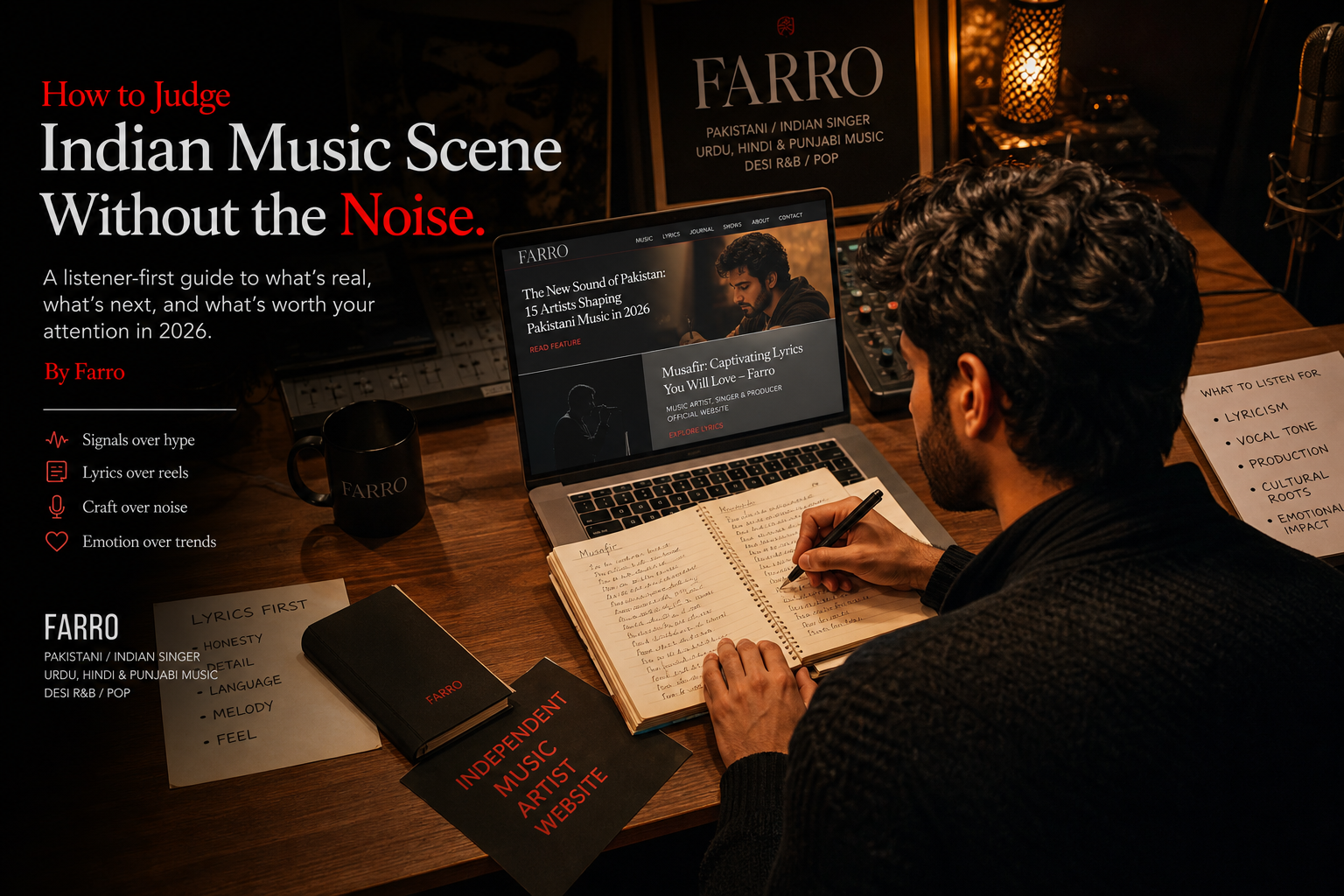
How to Judge Indian Music Scene Without the Noise
What the Indian music scene really means to Pakistani listeners
The Indian music scene is not one single sound to judge from charts, film songs, or viral clips. For Pakistani and Indian listeners who care about Urdu, Hindi, Punjabi, romantic music, emotional vocals, Desi R&B, and pop, it is better understood as a connected listening space: languages cross borders, melodies borrow from shared traditions, and independent artists now sit beside film, label-backed, and social-first releases.
That matters because a listener in Lahore, Karachi, Delhi, Mumbai, or the diaspora may hear the same song through different filters. One person notices the Punjabi hook. Another hears the Urdu emotional phrasing. Another cares whether the beat feels closer to R&B, pop, indie, or a film-style ballad. If you judge only by what is trending, you miss the quieter craft: lyric choices, vocal restraint, regional pronunciation, and the feeling a song leaves after the chorus ends.
For Farro, this is the useful way to approach the subject: not as a scoreboard between markets, but as a practical way to understand how South Asian songs travel. A song can feel local because of its language and still feel modern because of its production. It can use familiar romantic imagery without sounding old, if the arrangement, vocal tone, and writing choices make the emotion believable.
A common mistake is treating “Indian music” as if it automatically means mainstream Bollywood or one national style. That shortcut flattens the scene. A better question is: what language is carrying the emotion, what production world is supporting it, and who is the song actually speaking to?
How to judge the sound without getting distracted by hype
Start with the song before the campaign. A heavily promoted release can still feel empty, while a smaller independent track may carry a sharper emotional identity. The first test is simple: can you describe the song’s feeling without naming the artist, the platform, or the trend around it?
For romantic and emotional South Asian pop, listen for three things. First, the lyric image: does the song rely on generic sadness, or does it give the listener a clear emotional situation? Second, the vocal intention: is the singer performing pain loudly, or letting phrasing and breath do part of the work? Third, the production frame: does the beat support the lyric, or does it fight it?
Say a Punjabi love song opens with a soft guitar loop and a clean vocal, then drops into an electronic chorus. That contrast can work if the lyric grows with the arrangement. But if the verse is intimate and the chorus suddenly becomes loud without emotional reason, the song may feel engineered for a clip rather than written as a complete piece.
This is where Farro’s audience has an advantage. Fans of Urdu, Hindi, Punjabi, Desi R&B, and pop are used to hearing meaning in small details: a held note, a word choice, a half-spoken line, or the way a hook sits between heartbreak and hope. Those details are often more revealing than release-day noise.
Songwriting tools that matter for Indian regional languages
For bilingual and regional-language songwriters, tools are not just apps or software. A useful songwriting toolkit protects language, emotion, and musical identity while making the writing process repeatable. Farro’s related resource on songwriting tools for Indian regional languages points toward an important truth: regional writing needs more than a blank notes app.
A practical toolkit should include a place for raw lines, a separate rhyme and phrase bank, a transliteration system, reference songs, voice memos, and a basic way to test melody against pronunciation. The purpose is not to make writing mechanical. The purpose is to stop good ideas from getting lost between languages.
For example, a line may feel beautiful in Urdu but become stiff when translated into English for planning notes. A Punjabi phrase may carry warmth in speech but lose force if the stress lands on the wrong beat. A Hindi hook may look clean on the page but feel crowded when sung at tempo. The tool is useful only if it helps the writer hear those problems early.
Listeners may not see this work, but they feel the result. When a song respects its language, the hook is easier to remember, the emotion lands faster, and the performance sounds less forced. In the indian music scene, where songs move across scripts, regions, and platforms, that kind of clarity matters.
Why these tools matter for independent artists
Independent artists do not always have the same support system as large film or label projects. That makes the writing process more important, not less. If the artist is moving between Urdu, Hindi, Punjabi, English phrases, R&B textures, and pop structures, small decisions can shape the whole identity of the song.
The risk is not only technical. It is cultural. A songwriter can accidentally choose a word that feels too formal for a modern love song, too casual for a serious heartbreak track, or too region-specific for the audience they want to reach. None of those choices are automatically wrong. The problem is making them without intention.
A complete process helps the artist ask better questions. Is this line meant to sound conversational or poetic? Should the hook be in Punjabi because the emotion needs directness, or in Urdu because the song needs softness? Does the beat leave room for the language, or is the singer rushing to fit syllables into a borrowed pattern?
Farro’s wider music context also sits in this space: Urdu, Hindi, Punjabi, romantic writing, emotional delivery, Desi R&B, and pop are not separate boxes. They often overlap inside one song. Listeners can explore that wider South Asian context through Farro’s guide to The New Sound of Pakistan, which is useful for hearing how Pakistani artists are shaping modern regional music conversations.
What a complete workflow should include
A good workflow for judging or creating music in this space should move from feeling to structure, then back to feeling. If it starts only with tools, the song may become polished but empty. If it starts only with emotion, the idea may never become a finished release.
- Listening map: collect references by mood, not just genre. Separate heartbreak ballads, late-night R&B, Punjabi pop, acoustic confessionals, and film-influenced songs so the direction stays clear.
- Language choice: decide which language carries the central emotion. A bilingual song still needs a main emotional spine.
- Lyric draft: write freely first, then check whether each line sounds natural when spoken aloud.
- Melody test: sing the hook at different tempos. If pronunciation breaks, the lyric may need rewriting rather than forcing.
- Production check: ask whether drums, bass, keys, guitar, or synths are supporting the vocal story.
- Listener test: play the song without explaining it. If the emotion needs a long explanation, the writing may not be doing enough work yet.
This workflow is also useful for fans who want to judge music more thoughtfully. Instead of asking whether a song is “big,” ask whether it is coherent. Does every part belong to the same emotional world? Does the switch from verse to chorus deepen the feeling? Does the language sound lived-in?
Independent artists who are building their own presence can also connect the music process to how they present releases online. Farro’s Independent Music Artist Website guide is relevant here because a song’s identity does not end with the audio file; listeners often look for lyrics, release context, videos, and the story behind the sound.
A Farro-friendly way to listen, write, and refine
A Farro-friendly approach is practical: begin with the emotional promise of the song, then make every language and production choice serve that promise. If the song is about memory, the vocal should not feel rushed. If it is about unresolved love, the chords and pauses should leave space for uncertainty. If it is meant to sit in Desi R&B, the groove should support intimacy rather than overpower the lyric.
For listeners, this approach gives a clearer way to compare songs without turning music into homework. Take a track like Musafir in Farro’s release catalogue: rather than judging only the title or surface mood, listen for how the song frames movement, longing, or distance through its arrangement and lyric choices. With DIL DUKHDA AE, the title itself signals emotional pain; the useful listening question is how the vocal and production carry that feeling without reducing it to a slogan.
For songwriters, the same principle becomes a revision method. After the first draft, mark every line that feels borrowed from a familiar song template. Then replace vague pain with a clearer image, a more natural phrase, or a melodic pause. The goal is not to reject tradition. The goal is to make familiar emotional territory feel personally claimed.
This is one of the best ways to judge the indian music scene without the noise: look for songs that know why they exist. A release does not need to be complicated to be strong. It needs a clear emotional center, a believable performance, and language that feels chosen rather than pasted on.
Language, script, and cultural nuance
Urdu, Hindi, and Punjabi can share vocabulary, imagery, and emotional references, but they do not behave the same way in a song. Script adds another layer. A lyric may be written in Roman letters for convenience, understood in Nastaliq or Devanagari by different readers, and sung with regional pronunciation that changes how the line feels.
This is why transliteration should be treated as a working tool, not a final truth. Roman spelling can help collaborators move quickly, but it can also hide pronunciation problems. A vowel that looks simple on the page may stretch differently in performance. A consonant cluster may sound natural in speech but become awkward when placed on a fast melodic run.
Cultural nuance matters just as much. Romantic writing in South Asian music often uses distance, memory, waiting, weather, travel, silence, and the pain of return. Those images are powerful because listeners recognize them. But if every line leans on inherited imagery without a fresh angle, the song can sound decorative instead of honest.
The correction is not to abandon tradition. It is to make a specific choice. If the lyric uses the idea of waiting, what kind of waiting is it: a phone that stays silent, a city that feels different after someone leaves, a train platform, a late-night drive, a prayer, a message never sent? Specificity gives old themes new weight.
What does “Indian music scene” mean for Pakistani and Indian listeners?
It usually means the wider ecosystem of songs, artists, languages, and styles connected to Indian and South Asian listening culture. For Pakistani listeners, it often overlaps with Urdu, Hindi, Punjabi, pop, film-influenced music, indie releases, and Desi R&B rather than one fixed national sound.
How should a new listener get started?
Start by listening across moods instead of only charts. Build small playlists around heartbreak, romantic pop, Punjabi hooks, soft Urdu vocals, and R&B-style production. After a few songs, notice which language, vocal tone, and arrangement style you return to most.
What mistakes should independent songwriters avoid?
Avoid writing in a language only because it seems more marketable. If the words do not fit your voice, listeners can feel the distance. Also avoid overloading a song with too many language switches unless each switch adds meaning, contrast, or emotional lift.
Your next move with Farro
The cleanest way to judge the Indian music scene is to listen past the surface: language, lyric intent, vocal delivery, and production should all be working toward the same emotional truth. That approach helps fans hear more deeply and helps independent artists write with more control.
If you want to stay close to Farro’s world of Urdu, Hindi, Punjabi, romantic, emotional, Desi R&B, and pop music, visit Farro and explore the releases, videos, and stories behind the sound. Start with one song, listen for the emotional center, then follow the language and production choices that make it feel alive.
