
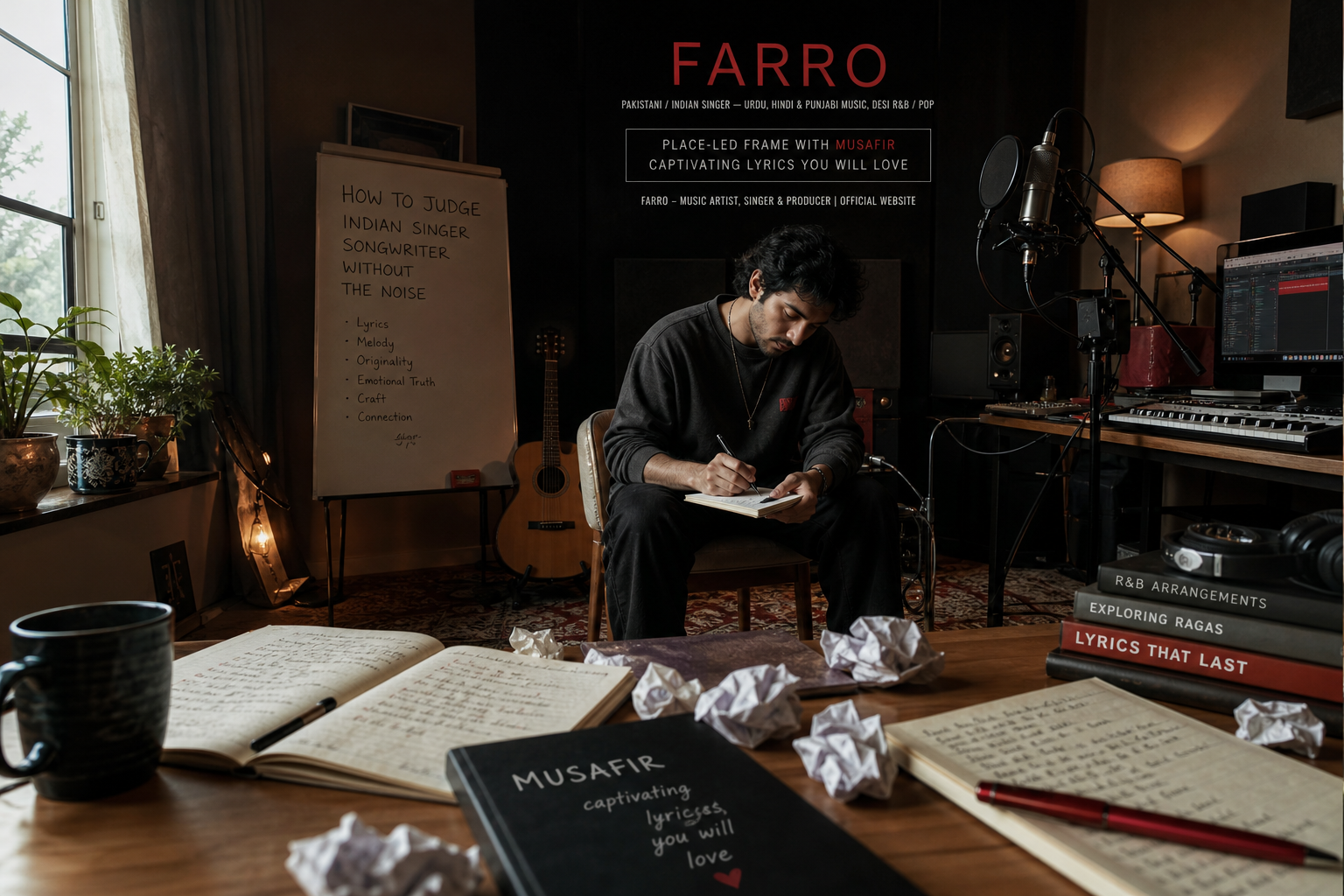
How to Judge Indian Singer Songwriter Without the Noise
What the phrase really asks you to judge
To judge an indian singer songwriter well, do not start with nationality, hype, or playlist placement. Start with the song: who wrote the feeling, how naturally the words sit in the melody, whether the language carries real emotional weight, and whether the production leaves room for the voice to mean something. For Pakistani and Indian listeners who move between Urdu, Hindi, Punjabi, Desi R&B, indie pop, and romantic ballads, the best test is simple: does the song feel lived-in, or does it only sound styled?
The phrase “Indian singer songwriter” can be confusing because South Asian music scenes overlap. A listener in Pakistan may use it to search for a Hindi or Punjabi artist, a romantic vocalist, an independent pop act, or a songwriter who understands the emotional grammar of Urdu and Punjabi even when the production leans modern. It is less useful as a strict label and more useful as a listening lens.
That lens matters for Farro because the official Farro site is built around music, releases, lyrics, videos, and the story behind the sound. In that context, judging a singer songwriter means looking past the surface polish and asking whether the writing, vocal delivery, and cultural details work together.
The difference between a singer, a songwriter, and a full artist voice
A singer can deliver a melody beautifully without shaping the underlying idea. A songwriter can write strong lines without becoming the emotional centre of the record. A singer songwriter is judged most fairly when both roles meet: the voice sounds connected to the words, and the words seem written for that voice rather than pasted onto a beat.
For Urdu, Hindi, and Punjabi romantic music, this shows up in small choices. A line may be simple, but the pause before it can make it hurt. A hook may repeat, but the second repetition should feel like memory, not filler. A Punjabi phrase can sound intimate in one delivery and theatrical in another. The songwriter’s job is not only to choose the words; it is to understand how those words breathe when sung.
Fans can listen for three practical signs:
- Emotional ownership: the singer sounds like the line belongs to them, not like they are performing a borrowed mood.
- Melodic fit: the natural stress of the language matches the tune instead of fighting it.
- Production restraint: the beat, synths, guitars, or vocal effects support the lyric instead of hiding weak writing.
This is why a stripped emotional song and a polished Desi R&B track can both succeed. The genre is not the deciding factor. The deciding factor is whether the writing survives when you pay attention.
Songwriting tools for Indian regional languages should protect nuance
Tools can help a bilingual or regional-language songwriter, but they can also flatten the very thing that makes the song matter. Rhyming lists, transliteration notes, voice memos, beat folders, reference playlists, and lyric drafts are useful only when they protect meaning, pronunciation, and mood. If a tool pushes every line toward the most obvious rhyme, the result may sound neat and still feel empty.
For artists working around Urdu, Hindi, Punjabi, and related South Asian listening habits, a practical writing setup should help with four jobs:
- Capturing phrases quickly: many strong lines arrive as voice notes, half-melodies, or spoken fragments before they become lyrics.
- Testing sound, not just spelling: a word may look right on the page but land awkwardly when sung over a groove.
- Tracking language choices: a song may lean Urdu for softness, Punjabi for direct emotional force, or Hindi for a conversational pop feel.
- Checking the hook in context: the chorus must work after the verse, not only as a standalone caption.
Farro’s own topic coverage around Urdu Punjabi Songwriting is relevant here because regional-language songwriting is not just translation. It is a craft problem: how to keep the emotional temperature of the line intact while making it singable.
Why these tools matter for independent artists
Independent artists often work without the large writing rooms, label filters, and production teams that shape mainstream releases. That independence can be a strength, but it also means the artist has to build a repeatable way to judge their own material before the audience does.
The danger is not only bad lyrics. It is mismatched decisions. A verse may be intimate while the beat is too crowded. A Punjabi hook may be catchy but disconnected from the softer Urdu mood of the pre-chorus. A vocal take may be technically clean but emotionally too smooth for a song about regret. A good toolkit gives the artist a way to notice those problems early.
For listeners, this explains why some independent songs feel more personal than expensive releases. You can hear when the artist has protected the core feeling from draft to final master. You can also hear when the song has been shaped by trend first and emotion second.
Farro’s releases give fans concrete places to listen with that lens. A listener can move from the lyric-led appeal of Musafir to the emotional framing of DIL DUKHDA AE and ask the same useful questions: where is the emotional centre, how does the vocal carry it, and what does the production choose not to cover up?
What a complete singer songwriter workflow should include
A complete workflow does not need to be expensive or complicated. It needs to stop the song from becoming vague. For an indian singer songwriter working in South Asian romantic or Desi pop spaces, the workflow should move from feeling to language to melody to arrangement, with checks at each stage.
- Start with the emotional sentence. Before writing a full verse, name the feeling in plain language. For example: the person has moved on, but the room still remembers them. This keeps the song from becoming a collection of pretty lines.
- Choose the language balance. Decide whether the song wants Urdu softness, Punjabi immediacy, Hindi directness, or a blend. The choice should match the character of the song, not only the target audience.
- Sing the draft early. Do not polish a lyric silently for too long. Regional-language writing reveals its problems when sung: heavy syllables, forced rhymes, or lines that do not leave space to breathe.
- Build the hook around memory. A strong chorus should be easy to recall because it carries the emotional point, not because it repeats a fashionable phrase.
- Arrange around the vocal. If the vocal is telling the story, the production should know when to step back. If the beat is central, the lyric must become more rhythmically precise.
- Do a meaning check before release. Ask whether the final version still says what the first idea meant. If the answer is no, the song may be polished but diluted.
This workflow is useful for fans too. It gives you a way to explain why one song stays with you and another disappears after the first listen.
A Farro-friendly way to listen and write
A Farro-friendly approach is practical: follow the feeling, then test every creative choice against it. That does not mean every song must be slow, acoustic, or minimal. It means the arrangement, language, and performance should serve the same emotional argument.
If a verse sounds clean but the chorus turns brittle, the problem may not be the mix alone. The chorus lyric may be pushing too hard, or the melody may be sitting in a range where the voice loses intimacy. If a Punjabi phrase feels powerful in a voice note but awkward in the final record, the beat may have changed the natural swing of the words. If an Urdu line looks poetic but feels distant when sung, it may need a simpler image or a more conversational melodic shape.
Listeners can apply the same method while exploring Farro’s catalogue. With Na Samajh, for example, the useful question is not only whether the track sounds polished. It is whether the title idea, vocal tone, and musical setting point in the same emotional direction. That is the kind of judgment that cuts through noise.
For writers, the same habit prevents overproduction. Before adding another harmony, texture, or English phrase, ask what it clarifies. If it only makes the song look more current, it may be decoration. If it sharpens the feeling, keep it.
Language, script, and cultural nuance are not cosmetic details
South Asian songwriting often travels across scripts, accents, and listening communities. A song may be written in Roman letters, shaped by Urdu or Punjabi vocabulary, sung for listeners who understand different levels of each language, and discovered by someone searching in English. That does not make language secondary. It makes language more important.
Script is a practical issue. Roman spelling can help a wider online audience read a lyric, but it can blur pronunciation. A word written one way for convenience may be sung another way for feeling. The artist has to decide what matters most in each context: searchability, readability, performance accuracy, or cultural texture.
Cultural nuance is just as important. Romantic South Asian music often relies on restraint, longing, memory, family pressure, distance, or unsaid emotion. If a song treats those themes as generic sadness, it loses detail. If it handles them with too many heavy words, it can become melodramatic. The strongest writing usually finds a precise middle: familiar enough to feel close, specific enough to feel real.
There is also a limit to what any listener can judge from a label alone. “Indian singer songwriter” does not tell you whether the artist writes their own lyrics, co-writes, produces, or mainly interprets songs. Unless an official source states those details, the fair approach is to judge what can actually be heard and verified: the song, the release information, and the artist’s own published context.
What does “indian singer songwriter” mean for Pakistani and Indian music listeners?
It usually means an artist associated with Indian or South Asian music who is understood as both a vocalist and a writer. For Pakistani listeners, the phrase often overlaps with Hindi, Urdu, Punjabi, indie pop, romantic songs, and Desi R&B rather than one strict national category.
How should a new listener judge whether the songwriting is strong?
Listen for whether the lyric, melody, and vocal delivery feel connected. A strong song should still make emotional sense without the video, styling, or social media context. If the hook is memorable but the verses feel empty, the writing may not be complete.
What mistakes should regional-language songwriters avoid?
Avoid translating emotion too literally, forcing rhymes that damage natural speech, and adding production layers to hide an unclear idea. The correction is to sing drafts early, keep the emotional centre plain, and check whether each language choice sounds natural in performance.
Can tools help without making the song generic?
Yes, if the tools are used for capture, organisation, pronunciation checks, and revision rather than replacing taste. The artist still has to decide what sounds true, what feels culturally precise, and what belongs to their own voice.
Your next move with Farro
The cleanest way to judge an indian singer songwriter is to listen with attention instead of noise. Do not ask only whether the song fits a trend. Ask whether the words sound owned, whether the melody respects the language, and whether the production protects the feeling at the centre of the track.
If you are a listener, use that lens on the releases and lyrics across Farro’s official site. If you are a songwriter, start with one unfinished song and run it through the workflow above: emotional sentence, language balance, sung draft, hook test, arrangement check, and final meaning check. When you are ready to explore the music and the story behind the sound, visit Farro.
