
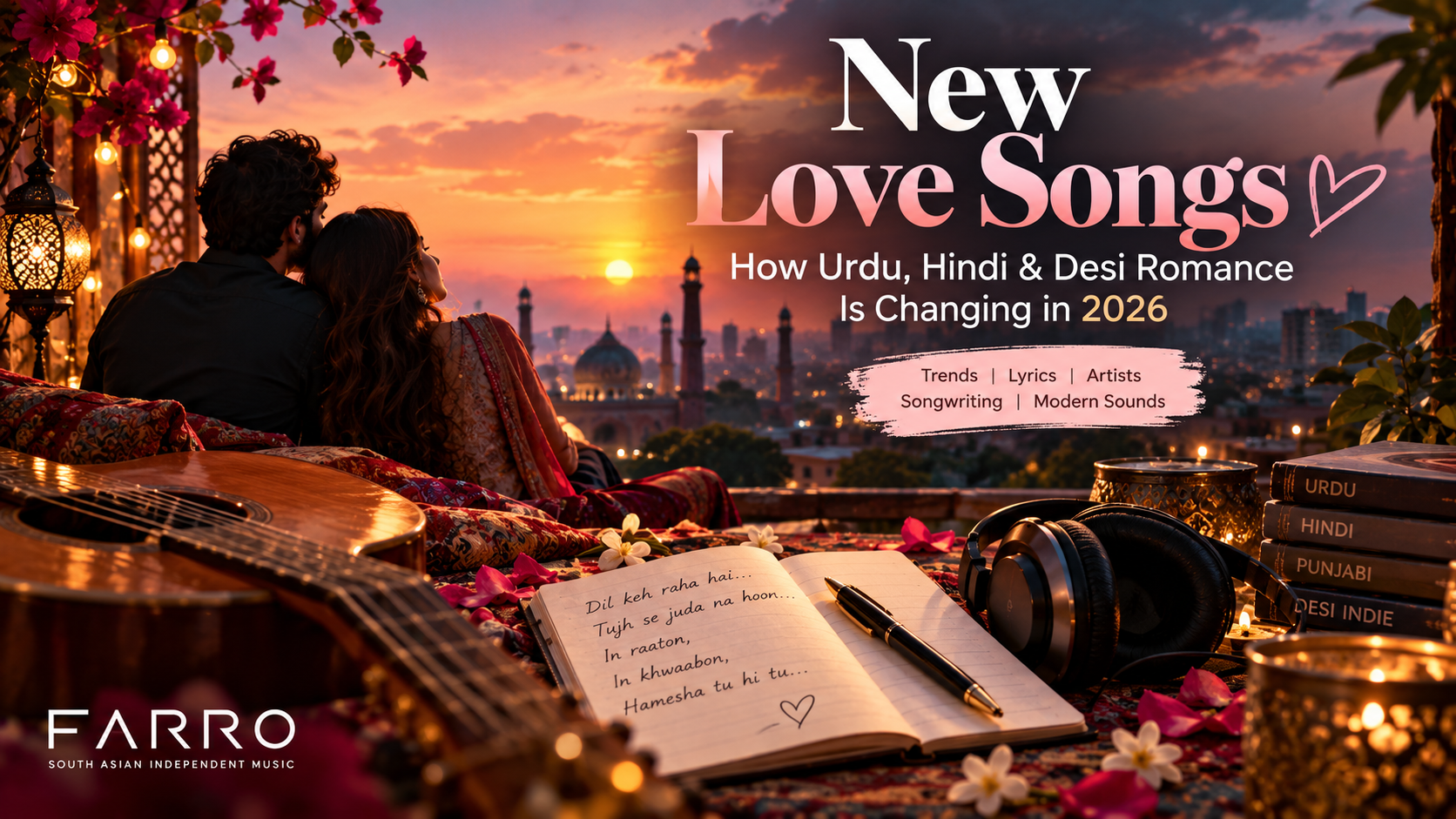
New Love Songs: Urdu, Hindi & Desi Romance in 2026
New Love Songs: How Urdu, Hindi & Desi Romance Is Changing in 2026
New love songs across Urdu, Hindi and South Asian independent music are not abandoning the classic themes of romance. Artists are still writing about attraction, longing, separation, devotion and heartbreak. What is changing is how those emotions are being expressed.
Contemporary romantic music increasingly moves between traditional South Asian lyricism and modern pop, indie, electronic, R&B and acoustic production. Instead of depending only on grand declarations of love, many songs find emotion in quieter details: conversations, memories, uncertainty, distance and everyday moments between two people.
For listeners, that creates a wider world of romantic music to discover. For songwriters, it offers an important lesson: a modern love song does not have to reject tradition. It can take the emotional depth of Urdu and Hindi songwriting and place it inside a sound that belongs to the present.
What Does “New Love Songs” Mean Today?
The phrase new love songs can describe much more than newly released romantic tracks.
For South Asian listeners, it can include:
- new Urdu romantic songs;
- Hindi indie love songs;
- Punjabi romantic music;
- Bollywood and film love songs;
- independent Desi pop and R&B;
- acoustic and singer-songwriter releases;
- electronic music built around South Asian vocals;
- romantic songs created by diaspora artists.
The boundaries between these categories are increasingly fluid. An Urdu lyric can sit over electronic production. A Hindi song can borrow from R&B. Punjabi melodies can move into global pop, while an independent artist can use cinematic storytelling without making music for a film.
That makes contemporary South Asian romance less useful as one fixed genre and more useful as a broad emotional and musical space.
What Is Changing in South Asian Love Songs?
Recent releases provide useful examples of how romantic songwriting is evolving.
Noor, Khan and Raqib’s O Piya, released in July 2026, focuses on companionship, memories and the smaller moments that make a relationship meaningful. Khan’s songwriting draws from Urdu poetry while Noor combines that emotional approach with contemporary pop and electronic production.
Misbah and Pireh’s Pyaari, released in September 2026, approaches falling in love through both attraction and anxiety. Its Urdu dream-pop setting demonstrates how romantic songwriting can preserve linguistic identity while moving into a modern sonic space.
Sheheryar Rehan’s Majboor takes another route: restrained production, vulnerability and poetic storytelling rather than maximal production.
Coke Studio Pakistan’s Rangeen, featuring Hasan Raheem and Izzchugtai and produced by Umair, combines youthful romance and longing with a production approach that brings hip-hop instincts into contact with a more classical character.
These songs do not sound identical, and that is exactly the point. Contemporary Desi romance is not moving toward one formula. It is becoming broad enough for artists to express familiar emotions through increasingly different musical identities.
Traditional Romance vs Modern Romantic Songwriting
| Element | Traditional Approach | Contemporary Possibility |
|---|---|---|
| Love | Grand declaration | Conversation, uncertainty or small gestures |
| Longing | Distance and poetic imagery | Messages, memories, silence and modern relationships |
| Language | Formal or highly poetic vocabulary | Conversational Urdu/Hindi mixed with selective poetic language |
| Production | Film-oriented arrangement | Indie pop, R&B, electronic, acoustic and hybrid production |
| Story | Large romantic narrative | One intimate moment or unresolved feeling |
| Artist identity | Often connected to cinema | Independent artist identity can lead the song |
Neither side of this comparison is automatically better. Modern writers can learn from both.
The opportunity is to preserve emotional depth while finding a voice that feels believable now.
Why Urdu Still Works So Well for Love Songs
Urdu has a long relationship with poetry, ghazal, film music and romantic expression, but its usefulness in contemporary music is not limited to ornate vocabulary.
One of its strengths is the ability to move between everyday intimacy and poetic expression.
A songwriter can begin with language that feels almost conversational and then introduce one carefully chosen poetic image at the emotional peak of the song.
That contrast can be more effective than making every line elaborate.
Modern Urdu songwriting therefore does not require a choice between “traditional” and “modern.” A song can carry poetic sensitivity while still sounding natural in a contemporary vocal performance.
Hindi, Urdu and Punjabi Do Not Need to Live in Separate Boxes
Many South Asian listeners naturally encounter music across languages. Hindi, Urdu and Punjabi songs also circulate across countries, diaspora communities, streaming platforms, films, short-form video and live performances.
For writers, this creates freedom—but language mixing should still have purpose.
A useful question is:
Would this character naturally say this line this way?
If the answer is yes, the language mix can feel effortless.
If a Punjabi, Urdu, Hindi or English word has been inserted only because it sounds fashionable or conveniently rhymes, listeners may feel the difference.
What Makes a New Love Song Feel Fresh?
Freshness rarely comes from inventing an emotion nobody has experienced before. Humans have been writing about love for centuries.
The freshness usually comes from perspective.
“I miss you” is universal.
But why this particular person is missed, what happened between the characters and which detail triggers the memory can belong entirely to one song.
Consider these storytelling ingredients:
- an unread message;
- a familiar road after a breakup;
- a wedding where somebody unexpected appears;
- two people pretending they no longer care;
- a voice note that was recorded but never sent;
- the first quiet morning after falling in love;
- remembering somebody through an ordinary object.
None of these requires complicated poetry. They create a situation in which poetry can actually mean something.
From Generic Lyrics to Specific Storytelling
One of the easiest ways to weaken a romantic song is to rely entirely on familiar romantic vocabulary.
Words such as dil, raat, chand, yaad, ishq and barsaat are not bad words. They have survived because they carry enormous emotional associations.
The problem appears when the words replace the story.
Instead of removing familiar imagery, give it a specific reason to exist.
A moon becomes more interesting when two characters once watched it from the same rooftop. Rain matters more when it recalls a particular journey. A night becomes personal when someone is waiting for a call that never arrives.
Specificity gives familiar romantic language a new life.
A Practical Framework for Writing a New Love Song
Before writing verses, define the song in five parts.
| Question | Example |
|---|---|
| Who is speaking? | Someone who ended a relationship but still misses the other person. |
| Who are they speaking to? | The former partner, even though the message may never be sent. |
| What happened? | An old voice note appears while cleaning the phone. |
| What is the conflict? | They want to reconnect but know why the relationship ended. |
| What should the listener feel? | Longing mixed with restraint. |
Now the writer has a song rather than simply a topic.
The hook can express the central contradiction. The first verse can establish the memory. The next section can reveal why the characters separated. When the hook returns, the listener understands it differently.
Hook First Does Not Mean Story Last
A memorable hook matters in romantic music, but repeating an attractive phrase is not enough.
The strongest hook often contains the emotional problem of the song.
For example, FARRO’s Dil Keh Raha Hai (The Heart Is Saying) demonstrates a useful songwriting idea even at title level: the heart becomes an active voice.
That immediately creates a question. What is the heart saying—and is the person going to listen?
A hook becomes more useful when it creates emotional tension that the rest of the song can explore.
Production Should Support the Emotion
A new love song does not automatically require a huge arrangement.
If the emotion is intimate, leaving space around the vocal may strengthen it. If the song represents excitement or young attraction, rhythmic production may be appropriate. Dream-pop textures can make uncertainty feel suspended, while acoustic instrumentation can bring the listener closer to the voice.
The production question should therefore be:
What should this emotion sound like?
That is more useful than automatically adding whatever production style happens to be trending.
How Independent Artists Can Use Reference Songs
References are useful when they are treated as research rather than templates.
Choose three songs:
- one whose lyrics affect you;
- one whose production interests you;
- one whose hook you remember immediately.
Do not copy them.
Instead, ask what each reference teaches.
Perhaps one demonstrates restraint. Another uses conversational language. Another waits until the chorus before releasing melodic tension.
Take the principle and build a completely different song around your own characters, language and experience.
Common Mistakes When Writing New Love Songs
Writing about “love” instead of a relationship
Love is a theme. A song needs a situation. Give the listener people, tension and something that changed.
Trying to sound poetic in every line
If every sentence demands attention, no sentence becomes the emotional peak. Simple language creates space for important lines to land.
Forcing rhymes
A perfect rhyme is not worth destroying a believable thought. Meaning, singability and emotion should work together.
Following trends without an artistic reason
A production trend may help discovery, but copying its surface without understanding whether it serves the song can make the music age quickly.
Making the production bigger than the emotion
If a song cannot communicate its basic feeling as a rough demo, additional layers may hide the weakness rather than solve it.
What New Love Songs Tell Us About South Asian Independent Music
The wider South Asian independent scene is increasingly difficult to reduce to one sound. Streaming and digital distribution have given independent and regional artists more routes to audiences, while contemporary musicians continue mixing local languages and musical traditions with global production approaches.
For romantic music, this means an artist no longer has to choose between sounding culturally rooted and sounding contemporary.
An Urdu lyric can meet dream pop. Hindi songwriting can sit inside electronic music. Punjabi phrasing can travel through global pop production. A quiet acoustic duet can compete for attention alongside heavily produced releases.
The common requirement is not genre conformity. It is a convincing artistic identity.
How This Connects to FARRO
FARRO’s work sits inside this broader space of South Asian independent music, with an emphasis on Urdu and Punjabi songwriting, romantic and emotional storytelling, contemporary production and an artist identity that exists beyond traditional film music.
For a deeper songwriting-focused guide, read Urdu–Punjabi Songwriting for Love Songs.
You can also explore Dil Keh Raha Hai (The Heart Is Saying) by FARRO for a direct connection between romantic songwriting and FARRO’s own music.
Frequently Asked Questions About New Love Songs
What are new love songs?
New love songs are contemporary songs centred on romance, attraction, relationships, longing, separation or emotional intimacy. In South Asian music they can appear across Bollywood, independent pop, Urdu music, Hindi music, Punjabi music, R&B, electronic music and other genres.
What makes a modern Urdu love song different?
There is no single formula. Contemporary Urdu romantic music can combine the language’s poetic traditions with conversational writing and modern production such as pop, indie, acoustic, electronic or R&B influences.
Do love songs need poetic lyrics?
No. They need emotionally convincing lyrics. Poetic language can help, but simple words connected to a specific experience can be equally powerful.
How can a songwriter avoid romantic clichés?
Start with a specific relationship, scene and conflict rather than beginning with generic romantic vocabulary. Personal details can make familiar emotions feel individual.
Can Urdu, Hindi, Punjabi and English be mixed in one song?
Yes, if the language changes feel natural for the character, artist and audience. Mixing languages works best when it reflects an authentic voice rather than being inserted only for rhyme or trend value.
How should a new songwriter start writing a love song?
Define who is speaking, who they are addressing, what happened between them, what remains unresolved and what single emotion the listener should carry away. Build the hook around that emotional centre.
Final Thoughts
New technology and production styles will continue changing the sound of romantic music, but the fundamental challenge remains remarkably human: make somebody believe the feeling.
For Urdu, Hindi, Punjabi and South Asian independent artists, the opportunity is not to abandon the musical traditions that came before them. It is to understand why those traditions worked and then tell today’s stories in today’s voices.
Start with a real emotion. Give it a specific moment. Write in a language that feels natural when sung. Let production support the story rather than overwhelm it.
That is how an old subject like love can still produce a genuinely new love song.
Explore More from FARRO
Explore more Urdu, Punjabi and South Asian independent music, songwriting resources and artist stories at FarroMusic.com.
Feel the tradition. Tell your own story. Create something worth remembering.