
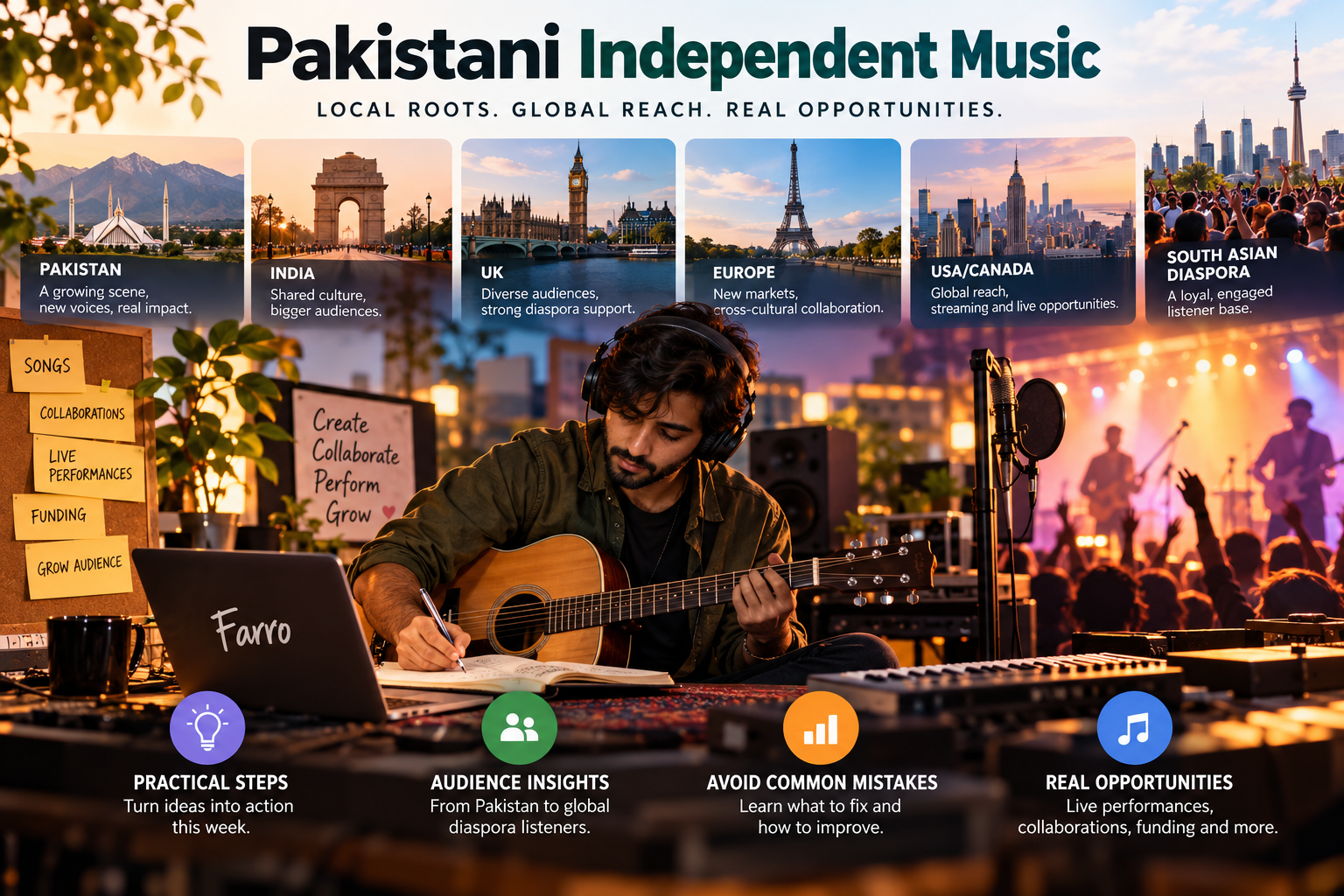
What Separates Strong Pakistani Independent Music From Noise
Start with a clear definition, not a genre label
Strong Pakistani independent music is not simply music released without a major label. It is music with a clear artistic reason to exist, a sound that supports that reason, and release choices that help the right listeners understand it. The independent part matters because the artist usually carries more of the creative, production, visual, and audience-building decisions. That freedom can create a sharper identity, but it can also expose weak writing, rushed mixes, confused language choices, and releases that arrive with no story around them.
For artists and listeners coming to Pakistani independent music, the useful question is not “Does this sound underground?” The better question is: “Can I hear a point of view?” A track may use Urdu, Punjabi, English, Pashto, Sindhi, Saraiki, Balochi, or a mix of languages. It may lean toward pop, hip-hop, R&B, folk, electronic production, acoustic songwriting, or something rougher around the edges. None of those choices automatically makes it strong. What matters is whether the writing, vocal delivery, arrangement, and sonic world feel intentional.
This page is for independent artists, bilingual and regional-language songwriters, producers, and listeners who want a clearer way to judge or build the work. It is not a promise that one formula will fit every city, dialect, platform, or listener group. A love song in Punjabi with sparse guitar needs different decisions from an Urdu rap track built around heavy drums, and both need different decisions from a cinematic electronic piece with only a few vocal phrases. Farro’s perspective starts from that practical reality: the story behind the sound should guide the production, not the other way around.
Why the independent space matters for artists and listeners
Pakistani independent music matters because it gives artists room to make decisions that commercial formats often flatten. A songwriter can keep a regional phrase because it carries emotional weight. A producer can leave space in the beat because the vocal needs breath. A singer can build a release around a lived memory rather than chasing whatever hook style is already circulating. These choices are small on paper, but they shape whether a track feels like a real voice or just another upload.
For artists, the stakes are practical. If you are writing in two languages, you have to decide where each language belongs. English may make a line feel direct or conversational; Urdu may hold poetic detail; Punjabi may carry bite, warmth, humor, or grief in a way a translation cannot. If you treat language only as decoration, the song can feel stitched together. If you use it as part of the emotional architecture, the switch itself becomes musical.
For producers, the stakes sit in the arrangement. A strong independent record does not need expensive polish, but it does need control. The low end should not bury the words. Reverb should create space, not blur diction. A chorus should lift because of arrangement, performance, or melodic movement, not merely because it is louder. Listeners may not name these technical details, yet they feel them. They can sense when a track knows where it is going.
There is also a misconception that independent means deliberately messy. Rawness can be powerful, especially when the lyric is intimate or the performance is urgent. But raw is not the same as careless. Strong work can be minimal, distorted, bedroom-recorded, or experimental; the difference is that the rough edges serve the song rather than distract from it.
A practical way to shape a stronger track
If you are working on a song now, treat Pakistani independent music less like a category to enter and more like a set of decisions to make. The following sequence helps turn instinct into something you can test before release.
-
Define the emotional job of the track. Before choosing sounds, write down what the song must make the listener feel: longing, defiance, calm, grief, flirtation, spiritual reflection, city-night restlessness. If the answer is vague, the production will usually become vague too.
-
Choose the language for meaning, not trend. Mark the lines that would lose force if translated. Keep those lines in the language where they hit hardest. If you move between Urdu, English, Punjabi, or another regional language, make the switch happen at a moment of emotional change, not randomly every few bars.
-
Build the arrangement around the vocal. Record a rough vocal early, even if it is imperfect. Then shape drums, chords, bass, and textures around the singer’s phrasing. If the vocal feels tense in the chorus, check whether the instrumental is crowding the same frequency range or moving too much underneath the melody.
-
Test the hook without the full mix. Play only the vocal and one instrument. If the hook still carries identity, the song has a foundation. If it collapses without the beat, the problem may be writing rather than production.
-
Check the translation of feeling, not just words. Ask one trusted listener who understands the language and one who mainly responds to melody or groove. If both can describe the mood, you are closer. If one group is confused, decide whether that confusion is an artistic choice or a sign that the song needs clarity.
-
Prepare the release story before uploading. A caption, visualizer, short video, or behind-the-sound note should help people enter the track. It does not need to over-explain the art, but it should give listeners a door into the world you made.
Good work usually feels coherent before it feels perfect. If the song’s emotional job, language choice, vocal space, and release story all point in the same direction, the track has a stronger chance of cutting through noise.
Examples that show where good intentions go wrong
Take a common situation: Areeba is writing a Punjabi-English track about leaving her hometown for work. The first demo has a strong Punjabi verse, but the English chorus sounds like it was borrowed from a generic pop template. The fix is not to remove English. The fix is to make the chorus carry the same lived detail as the verse. Instead of broad lines about “missing you tonight,” she tests a sharper image tied to the bus ride, the room she rents, or the voice note she keeps replaying. The result is a bilingual song where the language shift feels like distance opening up, not a marketing decision.
Another situation: Danish produces an Urdu rap track with heavy bass, busy hi-hats, and a dark synth loop. The beat sounds exciting on headphones, but the words lose impact once the second verse begins. He does not need to make the track softer; he needs to carve space. He lowers a competing synth, simplifies the drum fill before important punchlines, and automates the ad-libs so they support rather than fight the lead. The record still feels aggressive, but now the listener can follow the writing.
The mistakes are often predictable. Artists spend weeks changing plug-ins when the hook is weak. They master a rough mix too early and mistake volume for energy. They add English lines to seem global, then weaken the most personal part of the song. They imitate a reference track so closely that their own accent, phrasing, and local detail disappear. Strong independent music usually moves in the opposite direction: fewer borrowed signals, more specific choices.
Pause and get help when the problem sits outside your current skill. If you cannot make the vocal sit after several mix attempts, a mixing engineer may save the song. If two collaborators disagree about ownership or splits, handle that before release. If a sample, folk melody, or borrowed phrase has unclear rights, do not treat uncertainty as a vibe. It can become a real release problem later.
Where guidance needs to change for Pakistani artists
General music advice often assumes one language, one market, one dominant platform behavior, and one neat genre identity. Pakistani independent artists rarely work inside such clean lines. A track may speak to listeners in Karachi, Lahore, Islamabad, Quetta, Peshawar, Faisalabad, Multan, the Gulf, the UK, Canada, or a scattered online audience that finds the song through reels, friends, playlists, or live clips. That changes what “clear” means.
Regional-language work needs special care because the most powerful line may not be easily explained to someone outside the language. Do not sand it down too quickly. Instead, support it with performance, melody, visual context, or a caption that gives the listener enough emotional orientation. A Punjabi phrase can remain Punjabi. A Pashto or Sindhi line does not need to become a simplified English slogan to be accessible. Accessibility can come from feeling, not only translation.
Production choices also need context. A polished vocal chain may suit a smooth pop track, but it can drain the intimacy from a diary-like acoustic song. Heavy autotune may be a style choice in one track and a distraction in another. A lo-fi texture can feel honest if the writing is close and detailed; it can feel unfinished if the arrangement has no focus. The right next move depends on the song’s center, not on a universal checklist.
Before committing budget to a video, campaign, or final master, verify the basics. Play the track on phone speakers, car speakers, earbuds, and a small Bluetooth speaker. Check whether the words survive outside the studio. Send a private link to a few listeners who will be honest about the first line they remember. Watch whether they mention the same emotional idea you intended. If they only comment on loudness, genre, or who it sounds like, the song may need more identity before it needs more promotion.
Questions artists and listeners often ask
What is the fastest way to improve results with Pakistani independent music?
Start with the vocal and the writing. A cleaner mix helps, but it cannot fully rescue a song with no emotional center. Record a simple version with one instrument, check whether the hook and main idea still work, then build production around that strength.
What mistakes should I avoid when working on a bilingual or regional-language song?
Avoid switching languages only because it sounds fashionable. Use each language where it carries meaning, character, or rhythm. Also avoid over-explaining regional lines; sometimes the performance and surrounding imagery can do more than a literal translation.
How does Farro approach Pakistani independent music differently?
Farro’s lens is sound-first and story-aware: the production, vocal space, language, and visual world should serve the feeling of the record. The aim is not to force every song into one style, but to understand the story behind every sound and make choices that support it.
When should I revisit my approach to a track or release?
Revisit it when listeners remember the vibe but not the song, when the mix feels louder but not clearer, when language choices feel decorative, or when the release plan does not explain why the track matters. Those are signs that the identity needs sharpening before more effort is spent.
If you are exploring the sound, story, and releases around Farro, start at Farro and follow the music from there. Listen for the choices behind the track: what is left raw, what is polished, where the language turns, and how the sound carries the feeling.
