
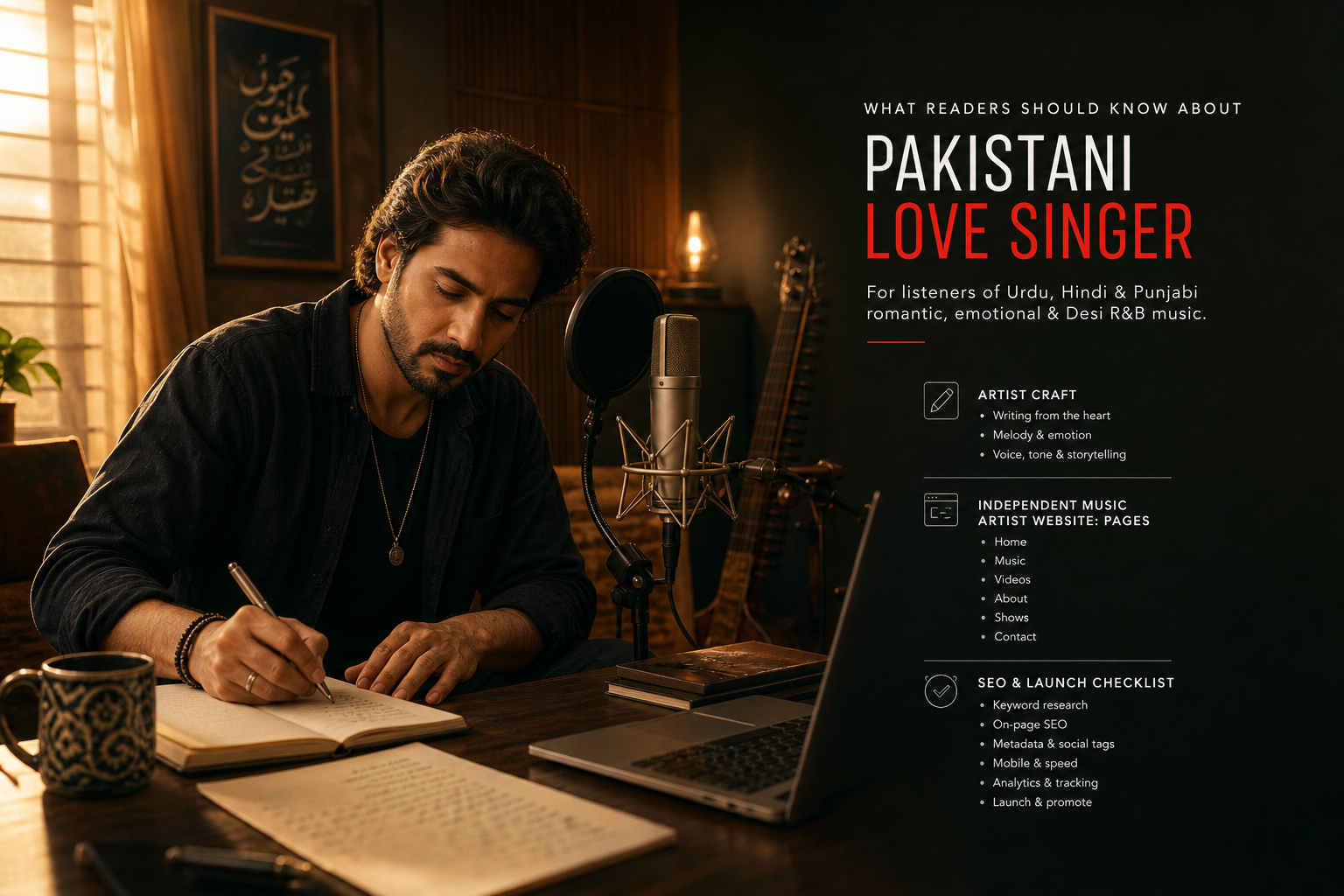
What Readers Should Know About Pakistani Love Singer
What the phrase means for listeners
A Pakistani love singer is usually understood as an artist whose music centers romance, longing, heartbreak, devotion, and emotional confession through Pakistani or South Asian musical language. For listeners of Urdu, Hindi, Punjabi, Desi R&B, and pop, the phrase is less about nationality alone and more about feeling: the way a vocal phrase bends around a painful word, how a chorus holds back instead of exploding, or how a lyric can sound intimate even when the production is modern.
That is why the search can be confusing. Some people type it because they want a playlist-ready romantic singer. Others want an artist who writes in Urdu or Punjabi. Some are looking for a Pakistani voice with a contemporary R&B or pop sensibility rather than a purely classical or film-style sound. On Farro’s official website, the useful answer is to treat “pakistani love singer” as a listening doorway: a way to understand songs, language choices, vocal emotion, and the story behind each release.
For example, a listener may arrive after hearing a soft romantic hook and want more music with that same emotional temperature. The practical move is not only to search for “love songs,” because that can flatten the difference between a bright wedding-style track, a private heartbreak song, and a late-night Desi R&B record. Instead, listen for three things: the language of the lyric, the emotional state of the vocal, and the production around the voice. A Punjabi line can carry direct ache; an Urdu phrase can feel reflective and poetic; a stripped mix can make the singer sound closer, while a polished pop arrangement can make the same lyric feel cinematic.
Why generic singer pages often miss the point
Many pages about singers answer a broad identity question: who the artist is, where they are from, or what songs they have released. That can be useful, but it does not fully answer what a listener means when they search for a Pakistani love singer. The better answer connects the artist’s releases to the listener’s situation: “I want something romantic but not generic,” “I want Urdu or Punjabi emotion,” or “I want a South Asian love song that still feels current.”
There is also a reason to stay honest here. No competitor page bodies are being used to claim that other artists lack certain information, and no rankings or awards are being invented. The more reliable approach is to build from first-party context: Farro is positioned around Pakistani and Indian music, including Urdu, Hindi and Punjabi romantic, emotional, Desi R&B and pop sounds. Pages such as Musafir, DIL DUKHDA AE, Na Samajh, and Dil.exe by Farro give listeners specific entry points rather than a vague artist label.
That distinction matters for fans and for songwriters. A fan wants to know where to start. A bilingual songwriter wants to understand how romantic meaning changes when a line moves between Urdu, Punjabi, Hindi, and English-influenced pop phrasing. A producer wants to hear how the vocal sits in the track. The phrase “Pakistani love singer” is useful only when it points to those real listening decisions.
How to listen beyond the label
If you are exploring this sound as a fan, start with the mood before the category. Romantic music can be tender, wounded, devotional, nostalgic, or quietly unresolved. Two songs may both be love songs, but one may feel like a confession while another feels like a memory. That difference is often carried by the vocal delivery: breath, restraint, ornament, and the way the singer lands on emotionally loaded words.
Say the verse feels calm but the chorus suddenly turns sharper. That may not mean the singer is “over-singing”; it may be the emotional architecture of the song. A love song about missing someone often needs a controlled verse so the chorus can reveal the ache. In Desi R&B and pop, this contrast can be even more subtle: a low vocal, a delayed harmony, or a beat that leaves space can make the lyric feel more vulnerable than a louder arrangement would.
Language also shapes how the emotion lands. Urdu often gives romance a reflective or poetic frame; Punjabi can bring immediacy, earthiness, and direct emotional force; Hindi can feel familiar to many South Asian listeners through film and pop memory. These are not fixed rules, and individual songs can break them, but they help explain why listeners search for regional-language love music rather than just “romantic pop.” For writers, Farro’s Urdu–Punjabi Songwriting for Love Songs is a useful next read because it focuses on the craft of writing love songs across those language textures.
Where Farro fits for Urdu, Punjabi, and Desi R&B listeners
Farro’s site is built as more than a static artist profile: it gives listeners a path into music, releases, updates, and the story behind the sound. That matters for this topic because a Pakistani love singer is not only defined by a biography. The work has to show how love, memory, and heartbreak are handled in actual songs.
If you want a romantic entry point, Khusbū-e-Ishq (The Fragrance of Love) is clearly framed around love in its title and meaning. If you are drawn to resilience, distance, or unresolved feeling, Rabb Jaane (God Knows I’m Still Here) gives a different emotional doorway. Those titles alone should not be treated as a complete interpretation of the songs, but they do show how Farro’s catalogue can be approached through feeling, language, and atmosphere.
For independent artists, the lesson is practical: do not make listeners guess what emotional world they are entering. A release page can do more than list a track. It can explain the mood, the language choices, the vocal intention, and what kind of listener might connect with it. Farro’s release-focused pages and Updates section support that kind of discovery without needing inflated claims or manufactured comparisons.
Practical ways to find the right Pakistani love song for your mood
Start by naming the feeling more precisely than “romantic.” If you want softness, look for songs where the vocal sits close and the production leaves room. If you want heartbreak, listen for tension in the chorus and words that circle absence, regret, or waiting. If you want a modern Desi R&B feel, pay attention to the groove, vocal layering, and whether the beat supports intimacy rather than overpowering the singer.
A practical listening path could look like this:
-
Choose one emotional lane first: longing, devotion, heartbreak, apology, memory, or reunion.
-
Notice the language of the hook. Urdu, Punjabi, Hindi, and English-influenced phrasing each change the emotional color.
-
Listen to the first chorus twice: once for the melody, once for the vocal tone and space around it.
-
Read the release page or artist notes when available, because the story behind the sound can clarify what the song is trying to hold.
For example, if a chorus sounds beautiful but you cannot explain why it hurts, listen to what happens right before it. Does the pre-chorus pull the vocal back? Does the beat drop out for a word or phrase? Does the singer hold a note slightly longer than expected? These details are often where romantic South Asian pop becomes emotionally specific rather than just pleasant.
Common mistakes when judging a love singer
The first mistake is treating every romantic song as the same kind of love song. A track about devotion asks for a different vocal posture than a track about betrayal. If you judge both only by how catchy they are, you may miss the craft. A restrained vocal can be the right choice when the song is about grief or distance; a more open, melodic chorus may suit confession or hope.
The second mistake is ignoring language because you do not understand every word. Many listeners connect to Urdu or Punjabi love songs through tone first, then meaning. That is not a weakness; it is how music often works across cultures. Still, if a page provides meanings, context, or listening notes, use them. You may discover that the emotional center of the song is not simply “love,” but waiting, pride, surrender, or the pain of not being understood.
The third mistake is assuming a Pakistani love singer must sound traditional. Some artists lean classical, some lean film, some lean indie, some lean R&B or pop. Farro’s positioning sits in the space where Pakistani and Indian musical language can meet contemporary production. That makes the listening question more interesting: not “Is this traditional or modern?” but “How does the song use language, melody, and production to make emotion feel believable?”
Questions people ask about Pakistani love singers
Is a Pakistani love singer different from a general romantic singer?
Yes, in the way listeners usually use the phrase. It often points to romantic music shaped by Pakistani or South Asian language, vocal emotion, and cultural memory, rather than romance as a generic pop category.
Do I need to understand Urdu or Punjabi to enjoy the songs?
No. Many listeners connect first through melody, tone, and atmosphere. Understanding the words can deepen the experience, but the vocal delivery and arrangement can communicate a great deal before translation.
What should bilingual songwriters learn from this style?
They should pay attention to where each language carries the strongest emotional weight. A hook, a repeated phrase, or a single regional word can change the whole feeling of a love song when used with care.
Your next move with Farro
If you came here searching for a Pakistani love singer, do not stop at the label. Listen for the kind of love being expressed, the language carrying it, and the production choices that frame the voice. Start with Farro’s release pages, follow new material through Updates, and use the songwriting resources if you are building your own bilingual or regional-language love songs.
To explore the music, videos, latest releases, and the story behind the sound, visit Farro.
