
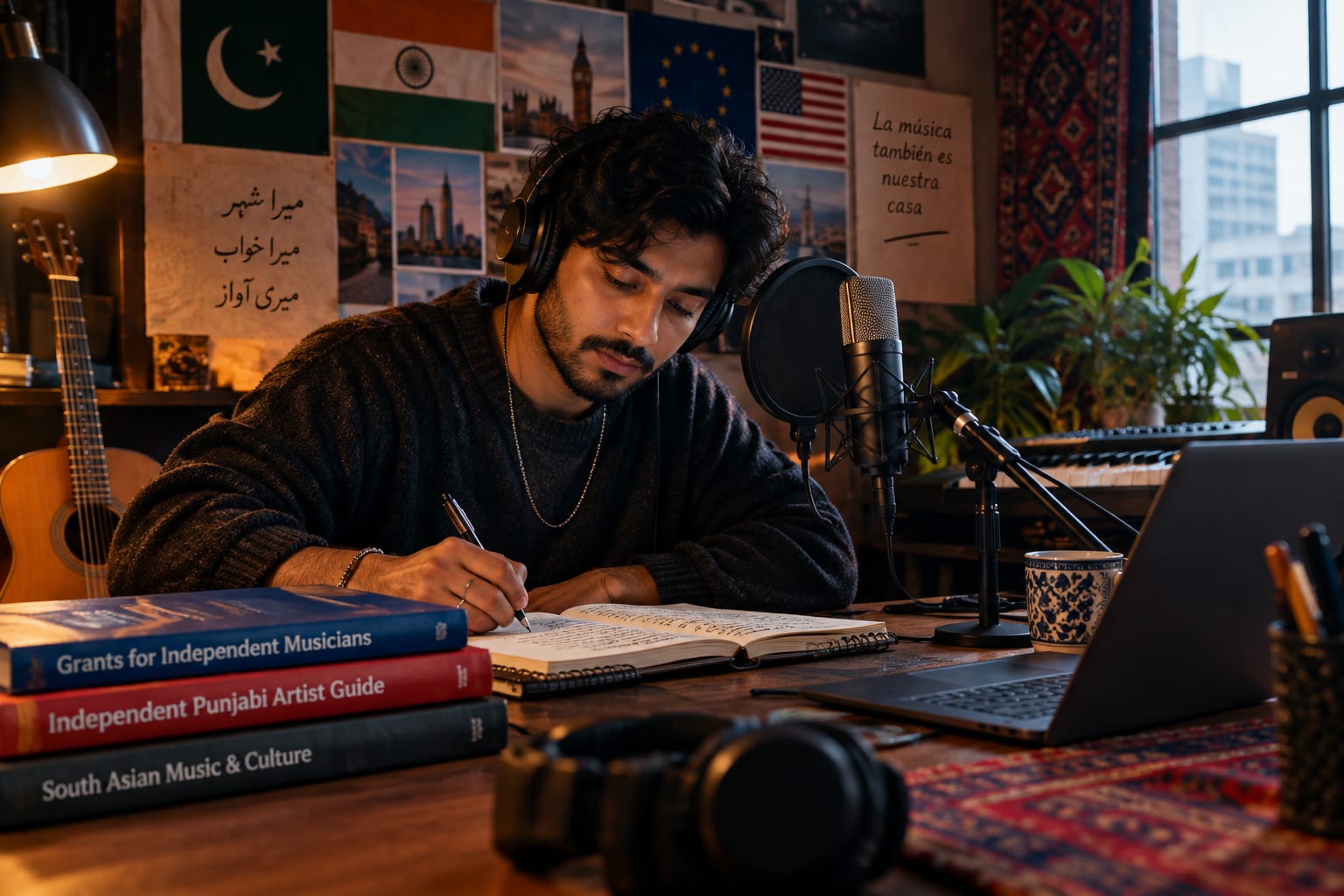
Desi Independent Artists: Patterns Worth Stealing for Your Own Work
When people hear the words “Desi independent artist,” they sometimes imagine a musician making songs at home, uploading them to Spotify and hoping one of them goes viral.
That is part of the picture, but it is not what independence really means to me.
As Farro, I make music around Urdu and Punjabi expression while working with modern production, songwriting and digital releases. I am not trying to fit neatly into one traditional genre, and I am not waiting for a major label to decide whether my music deserves to exist.
That is where this conversation about desi independent artists becomes interesting.
Independence gives us freedom, but it also gives us responsibility. We can decide what language to sing in, what a record should sound like, when to release it and how we want to present ourselves. At the same time, nobody automatically brings us an audience. Nobody guarantees that a good song will be discovered. And nobody builds an artistic identity for us.
So this article is not another motivational guide telling independent musicians to “post consistently” and “believe in yourself.” I want to look at what being a Desi independent artist actually means today, what is changing in Pakistan and South Asian music, what I have learned through Farro, and what I think matters if you are trying to build something that lasts.
What Is a Desi Independent Artist?
Let us clear this up first.
“Independent” does not describe a sound.
An independent artist can make Urdu pop, Punjabi R&B, hip-hop, rock, electronic music, acoustic songs, alternative pop, folk-influenced music or something that refuses to sit comfortably inside any of those categories.
To me, independence is mainly about control.
Who makes the creative decisions?
Who decides which songs get released?
Who owns or controls the recordings?
Who chooses the collaborators?
Who decides whether a Punjabi lyric stays Punjabi instead of being changed because somebody thinks English will be easier to market?
An artist can work with producers, distributors, managers, publishers and even labels while still protecting meaningful creative independence. So I do not think the useful question is simply, “Are you signed or unsigned?”
The better question is: how much control do you have over the music and identity you are building?
Pakistan’s Independent Music Audience Is No Longer Tiny
There is actual evidence that the listening environment around Pakistani music has changed.
Spotify reported in 2026 that listening on the platform in Pakistan had grown by more than 750% since its local launch. More importantly for this discussion, streams of Pakistani artists had increased more than sevenfold since 2021, while the number of Pakistani artists available on Spotify had grown by nearly 75%.
Those numbers do not mean every independent artist suddenly has an easy career.
They mean something more useful: listeners are actively exploring Pakistani music, and considerably more Pakistani musicians now have access to the same digital listening environment.
Spotify’s Pakistani Indie playlists also show how wide the word “indie” has become. The scene includes pop, hip-hop, electronic music, fusion, rock, regional influences and artists who move between several of those sounds.
That matters because an independent Pakistani artist no longer needs to ask, “Which established genre am I allowed to enter?”
We can increasingly ask, “What kind of artist am I actually trying to become?”
Independent Does Not Mean Amateur
This is one distinction I care about.
Independent should never become an excuse for unfinished work.
I can record independently. I can release independently. I can make creative decisions without a large company standing behind me.
But the listener does not owe me lower standards because I am independent.
If the vocal is poorly recorded, the listener hears it.
If the mix is confusing, the listener hears it.
If the artwork looks careless, they see it.
If I release five songs that sound like five completely unrelated artists, people may enjoy individual tracks but struggle to understand who Farro is.
Independence gives me control over the standard. It does not remove the standard.
The Biggest Advantage We Have: We Can Sound Like Ourselves
A major commercial system often looks for things it already understands.
Independent music can take a different route.
I do not need to decide that I am only an Urdu singer, only a Punjabi singer, only a pop artist or only an R&B artist before I write the song.
If a verse feels right in Urdu, I can write it in Urdu.
If Punjabi gives a particular line more weight, I can use Punjabi.
If contemporary pop production works underneath it, I can use that.
If another record needs more space, darker production or an R&B influence, I can explore that too.
But freedom creates another challenge: if everything is possible, what connects the songs?
That is where artistic identity becomes more important than genre.
Your Identity Is Not Your Genre
This took me some time to understand.
Two songs do not need identical drums, instruments or tempos to belong to the same artist.
What connects them can be something deeper.
Maybe it is the way you write about relationships.
Maybe it is the melodic movement in your voice.
Maybe it is the balance between Urdu and Punjabi.
Maybe your productions repeatedly feel intimate, melancholic or cinematic.
Maybe your lyrics avoid explaining everything and leave emotional space for the listener.
Those repeated instincts slowly become an identity.
For Farro, that is more interesting to me than forcing every release into one genre label.
I want somebody eventually to hear a song and recognize something familiar before they even read the artist name.
That is much harder than choosing a genre.
It is also much more valuable.
Language Is One of Our Biggest Advantages
South Asian independent artists have access to something extremely powerful: languages with different emotional textures.
Urdu does not feel identical to Punjabi.
Punjabi does not feel identical to English.
And I do not think we should treat one language as the “local” version and English as the “international” version.
A particular Urdu expression may communicate vulnerability better.
A Punjabi line may hit harder.
An English phrase may give a chorus the clean landing it needs.
The decision should begin with the song.
This is one reason contemporary Pakistani music has become interesting to me. Younger artists increasingly move between languages and global production styles without behaving as though those things contradict each other.
We should use that freedom carefully rather than turning code-switching itself into another trend.
If three languages appear in a song because the artist genuinely speaks and writes that way, it can feel natural.
If they appear only because somebody thinks multilingual songs perform better, listeners can often feel the difference.
Look at What Is Already Happening Around Us
The current Pakistani landscape gives independent artists plenty to study.
Hasan Raheem shows how conversational delivery and contemporary production can create a recognizable personality without relying on traditional pop theatrics.
Abdul Hannan’s rise demonstrated how intimate contemporary songwriting can travel far beyond a small indie audience.
Artists and producers across Pakistani pop, hip-hop and alternative music are moving between genres rather than waiting for somebody to define a new category for them.
Spotify’s own Pakistani Indie ecosystem has featured artists across indie-pop, fusion, hip-hop, electronic music, Sufi-influenced work and experimental styles.
There are also people such as Natasha Noorani and Zahra Paracha whose contribution extends beyond releasing songs. Work around platforms such as Lahore Music Meet demonstrates another side of independence: building spaces where other artists can be heard.
That is important.
An independent scene is not created by one successful singer.
It needs writers, producers, musicians, engineers, photographers, designers, promoters, small venues, festivals, listeners and people willing to create infrastructure where none existed before.
What I Would Learn From Successful Desi Independent Artists
I would not begin by copying their sound.
I would study their decisions.
They Finish Music
An unfinished masterpiece has no audience.
This sounds obvious, but independent artists can spend months endlessly improving songs that never leave the hard drive.
At some point, the record has to become a release.
They Build a Catalogue
One song can introduce an artist.
A catalogue explains the artist.
If somebody discovers one Farro song and likes it, I want there to be another song to hear, another lyric to connect with and another part of the musical world to explore.
Every finished release gives the next listener more context.
They Develop Recognizable Choices
This does not mean every song sounds identical.
It means certain creative instincts begin repeating naturally: writing style, melodic phrasing, emotional subjects, visual language, vocal character or production taste.
Recognition grows from repetition with variation.
They Collaborate Without Disappearing
Collaboration can make an independent record dramatically better.
A producer may hear something I cannot hear anymore after listening to my demo fifty times.
A musician may introduce a texture I would never have played myself.
A mixing engineer can solve problems I cannot solve while simultaneously being the writer, singer and producer.
But collaboration should strengthen the artist rather than erase them.
When the song is finished, I still want to recognize myself inside it.
The Hard Part: Independence Means You Become More Than the Musician
This is the side of independent music that inspirational posts usually skip.
Making the song is only one job.
After that, somebody has to prepare the artwork.
Somebody has to organize distribution.
Metadata has to be correct.
Lyrics need to be prepared.
Short-form video needs to be created.
The website needs updating.
Social platforms need content.
Audience data needs to be understood.
Previous releases need to remain discoverable.
And somehow, while doing all of that, you are supposed to remain creative enough to write the next song.
I know this tension directly through Farro.
Independent artists often become songwriter, performer, producer, editor, marketer and project manager at the same time.
The danger is obvious: you can become so busy operating the artist that you stop being the artist.
Do Not Let Marketing Become the Music
Marketing matters.
I am not going to pretend otherwise.
A beautiful song nobody can discover has a distribution problem.
But there is another extreme where every musical decision begins with content strategy.
“Will this make a Reel?”
“Can this line become a TikTok sound?”
“Should the intro be shorter because people scroll quickly?”
Those questions can be useful after a song exists.
I do not want them deciding what I am allowed to write.
The song should create the marketing material more often than the marketing plan creates the song.
What Should an Independent Artist Measure?
Streaming numbers matter, but I do not think one number can tell me whether I am building something meaningful.
I would look for several signals together.
- Are new people discovering the music?
- Do listeners return after the first play?
- Are people saving songs?
- Are they exploring older releases?
- Which songs make people follow the artist?
- Which cities or countries are responding?
- Are listeners sharing particular songs without being asked?
- Is the catalogue becoming stronger over time?
Ten thousand accidental plays and one thousand people who genuinely want the next song are not necessarily the same kind of progress.
Numbers need context.
The Diaspora Changes the Opportunity
Urdu and Punjabi independent music does not have to stop at the borders of Pakistan or India.
South Asian listeners live across the UK, Europe, North America, the Middle East, Australia and many other markets.
For an artist like Farro, that matters.
I can make music connected to Urdu and Punjabi culture while living and working in Europe. Those things do not cancel each other out.
In fact, diaspora life can create its own artistic perspective.
You can carry one culture emotionally while experiencing another one every day.
You hear languages differently.
You remember places differently.
You experience distance, belonging and nostalgia differently.
Those are not marketing categories.
They are songwriting material.
Stop Trying to Look Bigger Than You Are
This is one mistake I think independent artists should avoid.
There is pressure online to appear established before you are established.
Huge-looking artwork.
Artificial engagement.
Generic “global artist” language.
Follower counts treated as identity.
I would rather see a smaller artist with a clear voice than an artist pretending to be a corporation.
Being independent means the listener can sometimes get closer to the actual person making the music.
That can be an advantage.
Use it.
Another Mistake: Releasing Random Songs Instead of Building an Artist
A release strategy should not simply mean choosing dates.
Each release should add something to the picture.
If my previous song introduced a particular emotional side of Farro, what does the next one reveal?
Does it deepen that world?
Does it deliberately challenge it?
Does the artwork still feel connected?
If a new listener finds the latest track and visits the previous releases, do they discover an artist or just a folder containing unrelated songs?
This does not require every release to look or sound identical.
It requires intention.
Do Not Chase Every Trend
Independent artists are especially vulnerable to this because trends appear to offer shortcuts.
A particular drum pattern becomes popular.
Everybody uses it.
A vocal processing style becomes popular.
Everybody copies it.
A visual style performs well.
Suddenly every cover looks the same.
There is nothing wrong with learning from current music.
I do it too.
The problem begins when removing the trend leaves nothing recognizable underneath.
I want Farro’s music to be contemporary, but I do not want “contemporary” to become the entire identity.
A Better Way to Think About Success
I do not think every independent artist needs the same definition of success.
For one artist, success may eventually mean touring.
For another, it may mean making a sustainable income from recordings, writing and production.
Someone else may want a smaller but deeply engaged audience.
Somebody may eventually want a major-label partnership while retaining creative control.
The important part is knowing what you are building towards.
Otherwise every new metric becomes capable of making you feel unsuccessful.
A song can receive fewer streams than the previous release and still be artistically important.
A song can also receive large numbers and teach you almost nothing about whether those listeners will care about the next release.
Independent artists need enough patience to distinguish attention from audience.
What Farro Is Trying to Build
For me, Farro is not simply a collection of songs uploaded under one artist name.
I want it to become a recognizable world around Urdu and Punjabi songwriting, contemporary production and emotionally direct music.
That requires more than one release.
It requires repetition.
It requires experimentation.
Some songs will work better than others.
Some production decisions will age better than others.
Some ideas that sound brilliant in the studio may not connect once released.
That is part of building independently.
The important thing is that each finished piece gives me information for the next one.
I would rather build that identity through real releases than spend years designing the perfect theoretical version of Farro.
If You Are Starting as a Desi Independent Artist
I would keep the beginning much simpler than most guides make it.
Finish one song that actually represents you.
Make the recording good enough that poor production does not distract from the writing.
Give the release artwork that belongs to the same emotional world.
Prepare the metadata properly.
Release it.
Talk about why you made it.
Watch what listeners respond to.
Then make another song.
Do not spend six months designing a perfect “artist brand” when nobody—including you—knows yet what your music becomes after five finished releases.
Some parts of an artist’s identity can be planned.
Other parts have to be discovered by doing the work.
Frequently Asked Questions About Desi Independent Artists
What does “Desi independent artist” mean?
It generally describes a South Asian artist creating music with meaningful creative independence rather than being defined entirely by a major commercial system. It does not refer to one genre. Desi independent artists can work across pop, R&B, hip-hop, electronic music, folk, rock and many other styles.
Do independent artists need a record label?
Not necessarily. Digital distribution and streaming platforms allow artists to release music without a traditional major-label deal. Labels and other partners can still provide useful resources, expertise and reach, so independence should not be treated as an ideological requirement. The right structure depends on the artist’s goals and the terms of the partnership.
Can Urdu and Punjabi independent music reach listeners outside South Asia?
Yes. Streaming has made language-specific music easier to discover internationally, and the South Asian diaspora creates an existing audience across many countries. Language can shape the audience, but it does not automatically confine music to one territory.
Should a new artist release singles or an album?
There is no universal answer. For an artist who is still discovering their sound and building an audience, individual releases can provide faster feedback and more opportunities for discovery. An album becomes more meaningful when the artist has enough material and a strong reason for those songs to exist together.
Is social media more important than the music?
No, but discovery matters. Social media can help people encounter the music, while the song has to give them a reason to stay. A strong content strategy cannot permanently compensate for music listeners do not want to hear again.
How does an independent artist build a real audience?
There is no single formula. Strong songs, consistent releases, clear artistic identity, collaborations, live opportunities, useful platform data and genuine communication with listeners can all contribute. The useful objective is not simply accumulating views but gradually turning discovery into repeat listening.
What Independence Means to Me
The biggest advantage of being an independent artist is not that I can do everything alone.
I do not want to do everything alone.
I want good collaborators. I want better musicians around me. I want producers, engineers, filmmakers and creative people who can improve the work.
The advantage is that collaboration does not have to require surrendering the reason I started making the music.
I can learn from R&B without becoming somebody else.
I can use modern pop production without abandoning Urdu.
I can write in Punjabi without allowing the language to automatically dictate one traditional musical style.
I can live in Europe and still make music connected to South Asian experience.
And I can change direction when the work teaches me something new.
That is the version of independence I find valuable.
Not doing everything yourself. Building something that still sounds like you after everybody else has contributed.
Related Reading on Farro
- Pakistani Music in 2026
- Grants for Independent Musicians
- Independent Punjabi Artist Guide
- How to Write Meaningful Lyrics Without Explaining Everything
For more songwriting, production and independent music resources grounded in Farro’s real-world Urdu and Punjabi music journey, visit Farro Music.
Limitations and honest caveats
This guide cannot guarantee outcomes for every artist, market, or release plan. Treat the steps as a practical framework: adapt them to your capacity, rights situation, and goals, and verify platform or legal requirements for your region before acting.