
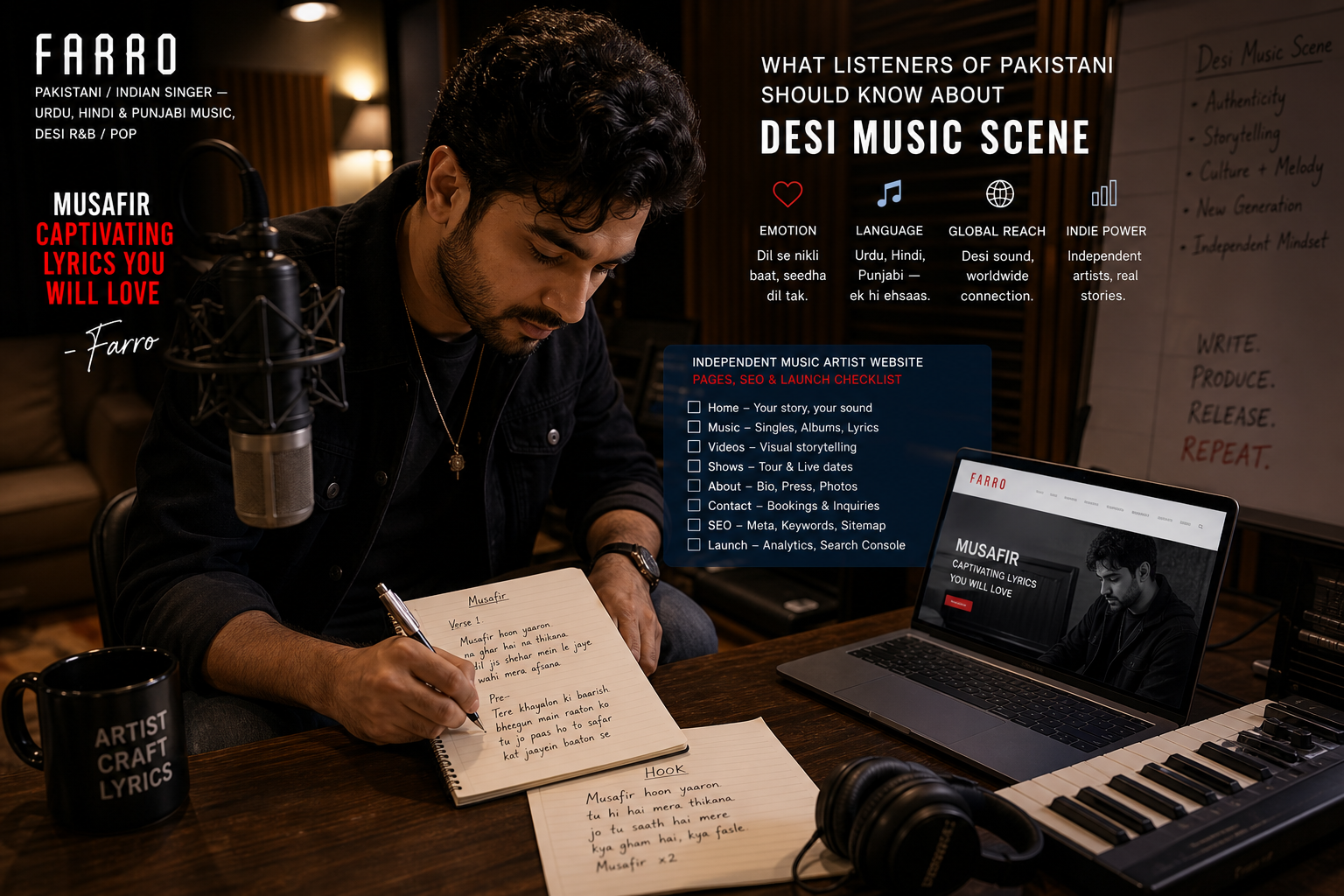
What Listeners of Pakistani Should Know About Desi Music Scene
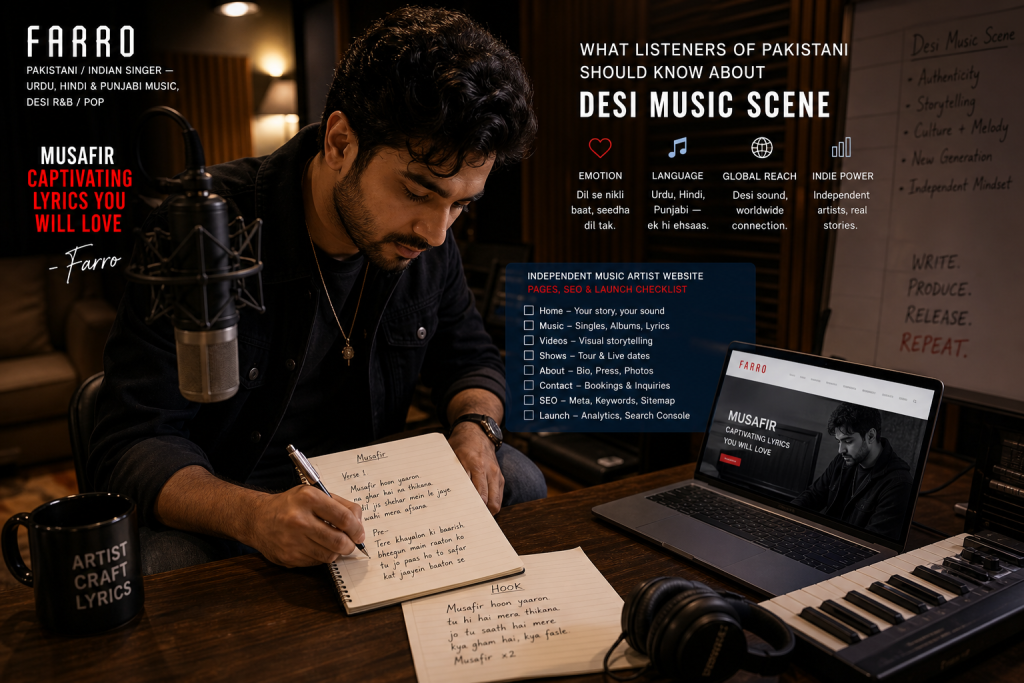
What the desi music scene means when you are actually listening
The desi music scene is not one sound; it is the shared space where Pakistani and Indian listeners move between Urdu, Hindi, Punjabi, South Asian pop, indie, romantic ballads, Desi R&B, film-influenced melodies, and internet-born releases. For a listener, the practical question is not “What genre is this?” but “What feeling, language, and rhythm is this song using to reach me?”
That matters because many songs in this space do not behave like a neat Western pop category. A track can carry the smooth drums and vocal layering of R&B, the emotional directness of a ghazal-influenced line, the conversational pull of Punjabi, and the structure of modern pop. Listeners often feel the blend before they know how to name it.
Farro sits in that overlap as an independent music artist and producer working around Urdu, Hindi, Punjabi, Desi R&B and pop textures. On Farro’s official site, the useful way to read the desi music scene is through songs, lyrics, releases, and the story behind the sound rather than through a single fixed label.
South Asian pop is broader than a playlist label
South Asian pop is best understood as a flexible listening language. It can include polished hooks, intimate bedroom-pop production, Punjabi indie love songs, Urdu romantic writing, and Hindi phrases that feel instantly familiar to listeners across borders. The phrase becomes useful when it helps you notice how a song is built.
For example, a Desi R&B track may keep the beat minimal so the vocal melody feels close and late-night. A Punjabi indie love song may lean on a direct phrase that lands quickly in the chorus. An Urdu romantic song may stretch a vowel or use a softer consonant pattern so the emotion feels suspended rather than rushed. These are not just language choices; they shape melody, pacing, and vocal delivery.
If you want a wider map of where Pakistani music is heading, Farro’s guide to The New Sound of Pakistan is a useful next read because it treats the scene as a living mix of artists and sounds rather than a single formula.
What it means for Pakistani and Indian listeners
For Pakistani and Indian listeners, the desi music scene often carries memory as much as entertainment. A line may remind someone of a city, a family phrase, a film song, a wedding playlist, a private heartbreak, or the kind of late-night message that never gets sent. That emotional recognition is part of why Urdu, Hindi and Punjabi songs can travel across different listener groups even when the production style is modern.
The scene also gives listeners permission to enjoy hybrid identity without treating it as a compromise. A song does not have to choose between being “traditional” and “current.” It can use a clean pop arrangement while still relying on the emotional weight of a familiar word. It can sound global in production but local in the way the hook turns.
This is where fans and artists often meet. Fans want songs that feel emotionally true, not just culturally tagged. Songwriters want lines that carry meaning without becoming stiff. Producers want arrangements that leave space for language to breathe. When those pieces align, the song feels natural even if it blends several influences.
Why Urdu, Hindi and Punjabi change the shape of a pop song
Language changes pop writing because every language carries its own weight, rhythm, and emotional temperature. Urdu often gives a writer room for softness, longing, and poetic restraint. Hindi can feel conversational, cinematic, or direct depending on the phrase. Punjabi can bring urgency, warmth, bite, or sweetness with very few words. None of these descriptions are absolute, but they explain why translation alone rarely produces the same song.
Say the verse is in English-style phrasing, with short clipped lines, but the chorus moves into Punjabi. The chorus may need more open space because the emotional punch arrives through pronunciation and repetition. If the writer forces too many syllables into the line, the hook becomes crowded. If the producer leaves a pocket before the last word, the same line can suddenly feel bigger.
Urdu and Hindi can create a different challenge. A beautiful phrase may read well on paper but feel heavy when sung at a faster tempo. The fix is not always to simplify the meaning; sometimes it is to move one word earlier, hold a vowel longer, or let the melody answer the line instead of adding another lyric.
Farro’s Urdu Punjabi Songwriting resource is relevant here because bilingual and regional-language songwriting depends on singability, not just vocabulary. The line has to survive the melody.
Choose the emotional lane before the rhyme
One common mistake in desi pop writing is chasing a clever rhyme before deciding what the song is emotionally doing. A song about regret, distance, devotion, and nostalgia may all sound romantic on the surface, but they need different word choices. If the emotional lane is unclear, the lyrics can become pretty without being memorable.
For listeners, this is a useful way to understand why some songs stay with you. A strong romantic song usually knows whether it is pleading, remembering, confessing, waiting, or letting go. The production, vocal tone, and lyric images then support that lane. If the beat sounds celebratory but the words are written like a private apology, the contrast must feel intentional; otherwise the song may feel confused.
For songwriters, choose the emotional lane before the rhyme scheme. Write the plain emotional sentence first: the person stayed, left, changed, waited, or could not say what they meant. Then decide which language carries that feeling best. A Punjabi line might make the confession more direct. An Urdu phrase might make the same feeling more restrained. A Hindi line might make it feel conversational and immediate.
Farro’s release page for Musafir is one place on the site where listeners can connect a specific song world with the wider Farro catalogue, without needing to reduce the music to one genre label.
Prosody rules that keep bilingual lines singable
Prosody is the fit between words and music. In bilingual or regional-language pop, it is often the difference between a line that feels effortless and a line that sounds translated. The rule is simple to state but hard to execute: the natural stress of the words should land where the melody wants emotional emphasis.
If a bilingual line switches language in the middle, the switch should have a musical reason. It might sharpen the hook, make the emotion more intimate, or create a phrase that listeners can repeat. Switching languages only to signal identity can weaken the song if the line does not sing well.
- Keep the hook easy to repeat. A beautiful phrase loses power if listeners cannot remember its shape.
- Do not overload the chorus with explanation. Let the verse carry detail and let the chorus carry the emotional turn.
- Check the vowel sounds at the highest notes. Some words look strong on the page but tighten the vocal when sung.
- Use repetition carefully. In Punjabi and Urdu romantic writing, repetition can deepen feeling, but too much can make the song static.
- Let silence do some work. A pause before a key word can make the lyric feel more honest than another decorative phrase.
A practical test is to sing the line without the beat. If it still has a natural pulse, it is probably closer to working. If you have to force the syllables into place, the listener will hear that tension even if they cannot name it.
What new artists and curious listeners can learn from the current Pakistani scene
The current Pakistani independent space is useful because it shows how much can happen outside one dominant format. Listeners are finding songs through artist sites, short clips, streaming platforms, live sessions, and social sharing. Artists are building identities through singles, visuals, lyrics, and direct storytelling rather than waiting for one traditional gatekeeper to define them.
For a new artist, the lesson is not to copy the surface of a trend. The better lesson is to become clear about your emotional world, your language choices, and the production style that supports both. If your strongest writing is intimate, a crowded arrangement may hide it. If your hook depends on Punjabi energy, the drums may need to leave room for the vocal bounce. If your song is built around grief or longing, the mix should not flatten the vocal into the background.
For listeners, the takeaway is to listen past the label. Ask what the song is doing with language, how the chorus earns its return, and whether the production supports the emotion. That makes the desi music scene easier to navigate because you are not relying only on genre tags.
Independent artists who are building their own online presence can also use Farro’s Independent Music Artist Website checklist to think about pages, SEO, and launch basics in a music-specific way.
What does the desi music scene include?
It includes a wide mix of South Asian sounds: Pakistani and Indian pop, Urdu and Hindi romantic songs, Punjabi indie music, Desi R&B, film-influenced melodies, independent releases, and bilingual songwriting. The borders are flexible, so the most useful way to listen is by noticing language, emotion, rhythm, and production choices together.
How should someone get started as a listener?
Start with the feeling you already like: heartbreak, soft romance, late-night R&B, upbeat Punjabi hooks, or poetic Urdu lines. Then follow artists, songs, and lyric styles that match that feeling. This is more useful than starting with a rigid genre label because desi pop often blends several traditions in one track.
What mistakes should new bilingual songwriters avoid?
Avoid switching languages only for effect, forcing rhymes that damage the natural sentence, and overfilling the chorus with too many ideas. A bilingual hook should feel singable first. If the language switch does not improve the melody, the emotion, or the listener’s memory of the song, it probably needs revision.
Your next move with Farro
The most useful way to understand the desi music scene is to listen actively: notice the language, the emotional lane, the hook shape, and the production space around the vocal. Once you hear those choices, Urdu, Hindi, Punjabi, Desi R&B and South Asian pop stop feeling like separate boxes and start sounding like connected tools.
To explore that connection through Farro’s music, releases, and artist world, visit Farro. If you are listening for a specific emotional entry point, you can also explore DIL DUKHDA AE and compare how language, melody, and mood work together inside a release rather than as abstract genre terms.
