
How Farro Handles Pakistani Music Scene in Pakistani Work
What the Pakistani music scene means now
The Pakistani music scene is not one sound, one city, or one mood. For listeners of Urdu, Hindi, Punjabi, romantic, emotional, and Desi R&B music, it means a moving mix of independent artists, pop singers, live performers, diaspora audiences, heartbreak songwriting, Punjabi romance, and cross-border listening habits. Farro handles this scene by treating it as a real listening culture, not just a list of famous names: the song language, vocal emotion, production style, and audience context all matter.
That distinction is useful because many listeners arrive at “Pakistani music scene” with different expectations. Some want new Pakistani singers to follow. Some want to understand why Urdu and Punjabi songs feel emotionally different from mainstream Bollywood love songs. Some are independent artists trying to place their own sound somewhere between Desi pop, R&B, acoustic ballad writing, and regional-language storytelling.
A practical way to understand the scene is to listen across three layers:
- The voice: Is the performance intimate, polished, raw, classical-leaning, pop-facing, or late-night and conversational?
- The language: Does the song lean into Urdu poetry, Punjabi directness, Hindi accessibility, English hooks, or a bilingual blend?
- The setting: Does the track feel built for headphones, stage performance, short-form discovery, weddings, heartbreak playlists, or diaspora concerts?
Once you hear those layers, the scene becomes easier to navigate. A soft Urdu chorus, a Punjabi romantic hook, and a Desi R&B vocal may sit close together emotionally, but they do different jobs for the listener.
The New Sound of Pakistan is a listening map, not just a ranking
Farro’s existing guide, The New Sound of Pakistan, is best read as a map of where Pakistani music is moving in 2026. The value is not only in knowing which artists are being discussed; it is in noticing what their rise says about the wider scene.
For a fan, that means using artist discovery as a way to build better playlists. Instead of searching only for “top Pakistani singers,” try grouping songs by feeling: late-night longing, clean pop romance, Punjabi warmth, soft heartbreak, danceable independence, or stripped vocal performance. This is how many listeners actually experience the music. They do not think in neat industry categories; they think, “I want something that feels like a message I never sent,” or “I want a Punjabi song that sounds romantic without sounding old-fashioned.”
Listen for where the hook enters, how much space the vocal gets, whether the beat supports the emotion or competes with it, and how the language carries the strongest line. A song does not need to explain the whole culture to belong to the Pakistani music scene. It needs a clear emotional center and a sound that understands its audience.
How to use a 15-artist list without flattening the scene
A list of 15 Pakistani artists can be helpful, but only if you avoid treating it as the whole story. The verified Farro guide covers the artist-specific rundown; this article does not invent extra names or biographies beyond that source. The better move is to use the list as an entry point, then listen outward.
Try this approach when exploring Pakistani artists in 2026:
- One hit rarely tells you how an artist writes, sings, or builds a mood.
- Identify the emotional lane. Is the core feeling heartbreak, confidence, nostalgia, flirtation, spiritual ache, soft romance, or youthful escape?
- Notice the language choices. Urdu may bring poetic weight; Punjabi may bring immediacy and warmth; English phrases may open the song to a wider pop or R&B frame.
- Follow collaborators and adjacent sounds. Producers, featured singers, live versions, and acoustic performances often reveal the wider network around the artist.
- Compare the stage version with the recorded version when available. A song that feels minimal in headphones may expand dramatically in a live setting.
This method is especially useful for bilingual and regional-language songwriters. It shifts the question from “Who is popular?” to “What choices are making this song connect?” That is where the learning begins.
A practical comparison: what to listen for in Pakistani artists in 2026
| Listening lane | What to notice | Why it matters |
| Urdu emotional pop | Melody shape, poetic phrasing, softness in delivery | Often carries heartbreak and longing through restraint rather than vocal force |
| Punjabi romance | Hook clarity, warmth, rhythm, direct address | Connects quickly because the language can feel immediate and conversational |
| Desi R&B | Vocal texture, space, groove, late-night atmosphere | Works well for intimate listening and modern heartbreak songs |
| Indie pop | Production identity, chorus lift, personality | Shows how Pakistani music is moving beyond one mainstream template |
| Live vocal performance | Breath control, mic distance, stage confidence | Reveals whether a song can survive outside the studio version |
For example, say a verse sounds delicate and close, but the chorus becomes sharp and crowded. That is not only a mixing issue; it changes the emotional meaning. A heartbreak song can lose its intimacy if the vocal is pushed too hard or the arrangement fills every space. This is why Farro’s broader resources on performance, such as Live Vocal Mic Placement Tips, matter for artists who want the recorded feeling to carry into a live room.
Pakistani music in 2026 is bigger than one genre
The most common mistake is describing Pakistani music as if it belongs to one lane: classical influence, Coke Studio-style fusion, indie pop, Punjabi hits, or sad Urdu songs. Those lanes exist, but they do not contain the whole scene. In 2026, the useful picture is broader: Pakistani music sits across local identity, internet discovery, diaspora listening, bilingual songwriting, and genre-blending production.
That matters because the listener experience is no longer limited by national borders or a single broadcast channel. A fan in Lahore, Karachi, Delhi, Dubai, Toronto, or London may discover the same song for completely different reasons: a romantic lyric, a wedding clip, a late-night playlist, a short video, or a live performance announcement. The research brief also shows search interest around phrases such as Pakistani concerts in London and Pakistani indie artists, which points to a wider listening context without proving any larger trend on its own.
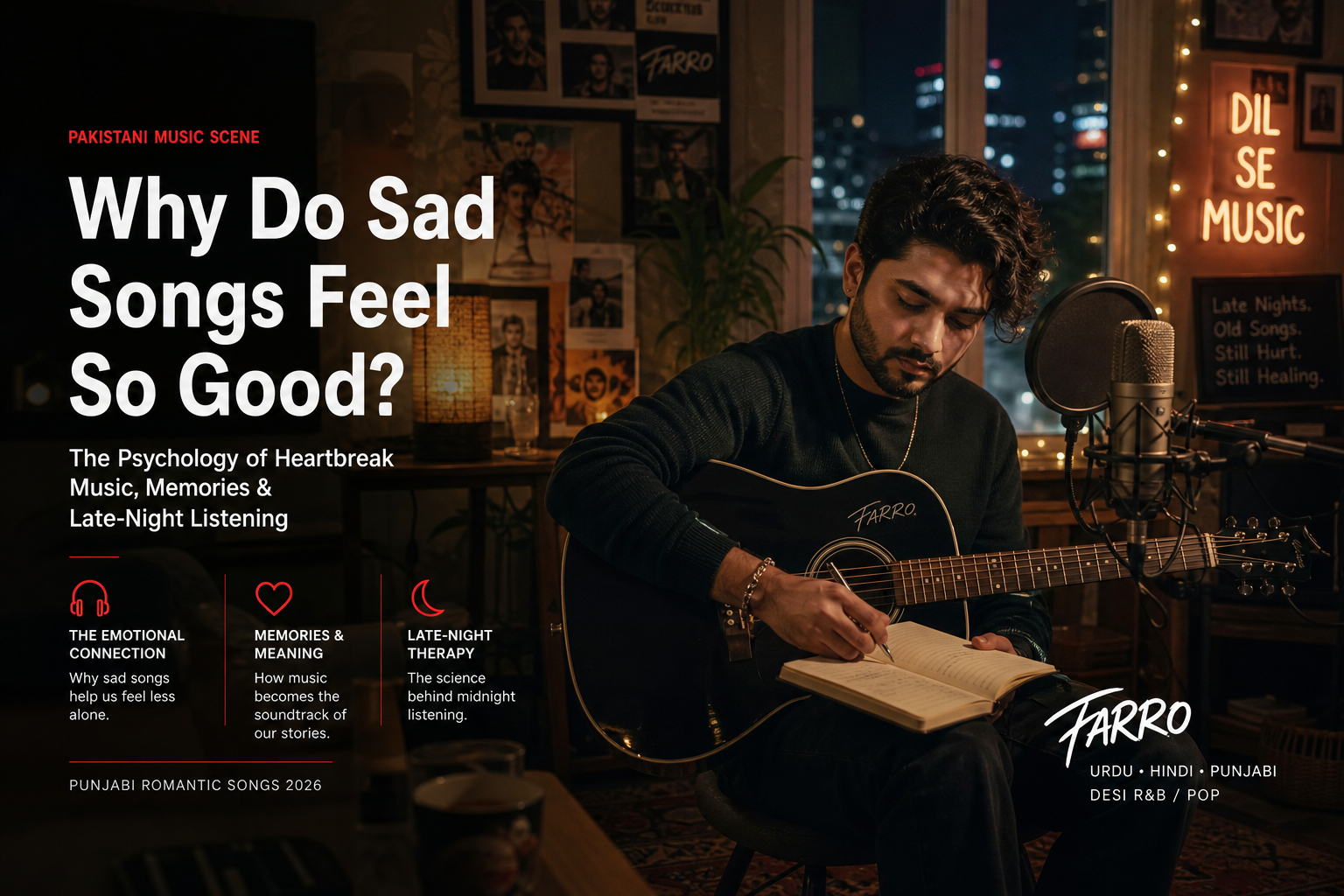
Farro’s own positioning sits naturally in this space: Urdu, Hindi, Punjabi, Desi R&B, pop, emotional songwriting, and the story behind every sound. That is why related guides such as Why Do Sad Songs Feel So Good? and Punjabi Romantic Songs 2026 are not side topics. They help explain why listeners return to certain songs: not just because of genre, but because of memory, language, romance, and mood.
What these artists tell new musicians about the industry
The lesson for new Pakistani and Indian independent artists is not “copy what is trending.” The stronger lesson is that listeners reward a recognizable emotional world. If your music sits in Urdu, Hindi, Punjabi, or a bilingual blend, the words need to feel chosen, not merely translated. A line that sounds natural in Urdu may become flat if forced into English. A Punjabi hook can feel powerful because it is direct, but it still needs melodic discipline. A Desi R&B track can feel modern, but only if the vocal has enough identity to avoid becoming generic atmosphere.
There are also practical limits to what any artist list can tell you. Those decisions require listening back to your own work with clear criteria.
For artists, a useful self-check is simple:
- Can a listener describe the emotion after one chorus? If not, the song may be well-produced but unclear.
- Does the language choice serve the strongest line? Do not switch languages only to sound international; switch because the feeling lands better.
- Does the vocal sit in the right emotional distance? Some songs need closeness; others need a more open, stage-ready delivery.
- Is there a release plan beyond uploading? Farro’s guide on Building A Release Plan For Independent Artists is a useful next read when the song is ready but the rollout is still vague.
For fans, the same points make listening richer. You start hearing why one song feels private and another feels communal, why one Punjabi romantic track becomes addictive, and why one Urdu heartbreak song stays with you after midnight.
What does “Pakistani music scene” mean for listeners of Pakistani and Indian music?
It usually means the full listening culture around Pakistani artists: new singers, indie music, Urdu and Punjabi songwriting, pop production, emotional ballads, live performance, and diaspora discovery. It is not limited to one genre or one generation of artists.
Who are some important Pakistani artists to know in 2026?
Farro’s dedicated guide to Pakistani artists shaping music in 2026 is the right place for the artist-by-artist list. Use it as a starting point, then listen across each artist’s deeper catalogue rather than stopping at one popular track.
How should a new listener discover more Pakistani artists?
If you like emotional Urdu songs, explore adjacent Desi R&B and indie pop rather than jumping randomly between unrelated tracks.
What mistakes should new artists avoid when learning from the scene?
Avoid copying surface details: a soft vocal, a Punjabi phrase, a moody beat, or a bilingual hook. Study the deeper craft instead: why the lyric lands, how the vocal is placed, and whether the production leaves room for the emotion.
Your next move with Farro
If you are a listener, start with the music itself: read Farro’s The New Sound of Pakistan, then build a playlist around feeling rather than popularity alone. Put one Urdu heartbreak track beside one Punjabi romantic song and one Desi R&B-leaning track. Notice what changes in the vocal, the lyric, and the production.
If you are an independent artist or songwriter, use the Pakistani music scene as a study field, not a template to copy. Choose the emotional lane you understand best, write in the language that carries the feeling honestly, and test whether the song still works when stripped down to voice, melody, and one clear idea.
To keep exploring Farro’s music, videos, latest releases, and the story behind every sound, visit Farro.
