
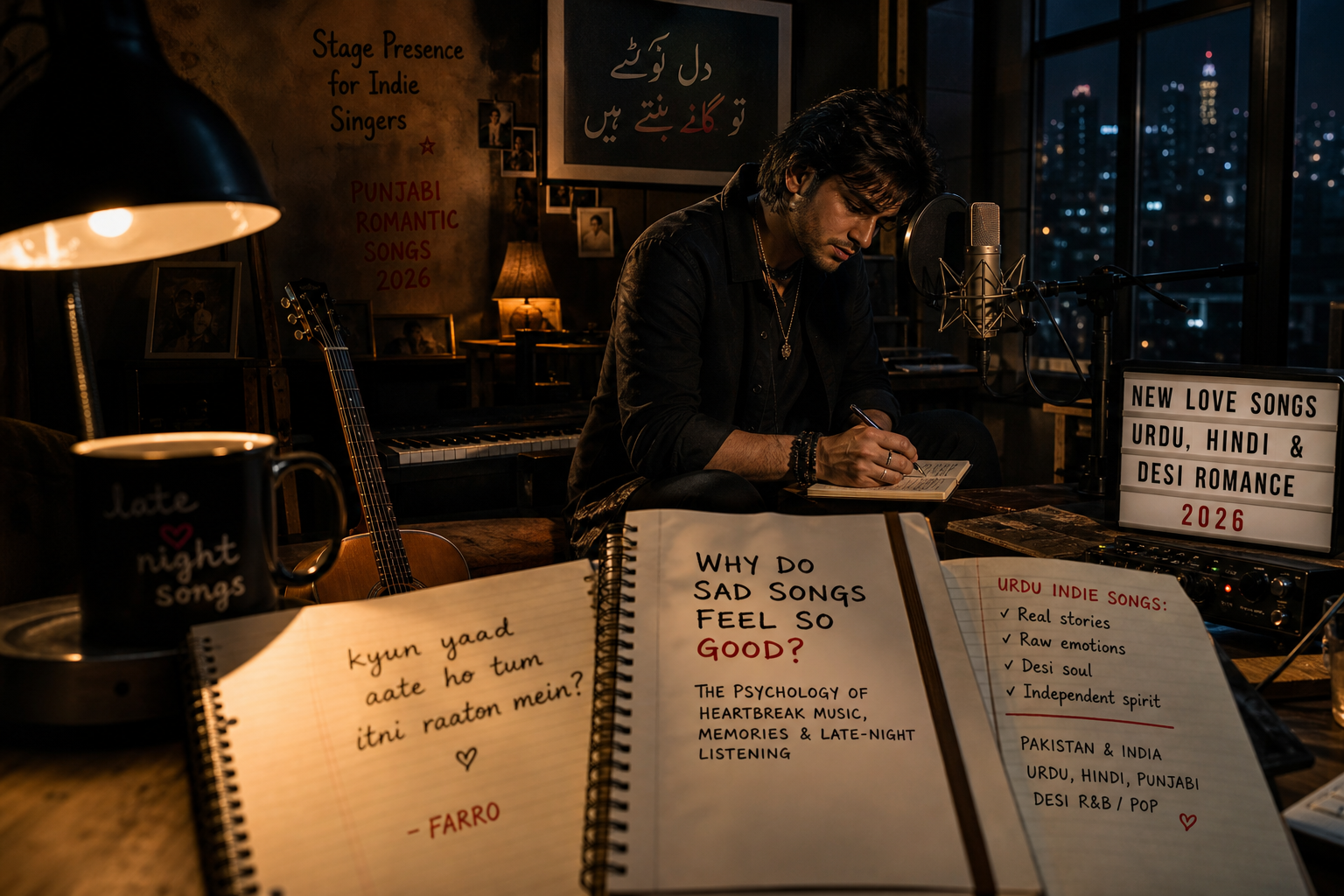
Strengthen the existing page “Bollywood Love Songs: Urdu &
What “Urdu indie songs” means in real listening terms
Urdu indie songs are independent or indie-leaning tracks where Urdu carries the emotional weight, even if the production also borrows from Hindi pop, Punjabi melody, Desi R&B, acoustic songwriting, lo-fi textures, or film-song tradition. For Pakistani and Indian listeners, the phrase usually does not mean one strict genre. It means a mood: intimate vocals, conversational lyrics, less polished drama than mainstream film music, and a feeling that the song could sit with you during a late drive, a quiet room, or a half-finished memory.
That is why the category can feel confusing. A listener may search for “urdu indie songs” and find playlists, band lists, romantic ballads, Punjabi hooks, or platform charts. Some of those results are useful, but they often skip the basic definition. The better way to hear the category is to ask three questions: who controls the sound, what language holds the feeling, and what listening situation does the song serve?
On Farro, that matters because the audience is already close to Urdu, Hindi, Punjabi, romantic, emotional, and Desi R&B music. The point is not to separate every song into a rigid box. The point is to help listeners and songwriters understand why a track feels independent, why Urdu changes the emotional temperature, and why a Punjabi or Hindi phrase may still belong naturally inside the same listening world.
How Urdu, Hindi, and Punjabi overlap without becoming the same thing
Urdu indie songs often live in a multilingual listening culture. A chorus may feel close to Hindi pop, a hook may lean Punjabi, and the emotional vocabulary may still be recognisably Urdu. For listeners in Pakistan and India, that overlap is normal. Families, films, streaming playlists, wedding music, radio memory, and social media clips have all trained people to move between languages without treating every switch as a category error.
Still, the differences matter. Urdu often brings softness, formality, longing, and poetic distance. Punjabi often brings directness, earthiness, rhythm, and physical release. Hindi pop can sit between film tradition and everyday speech. An indie song may use all three, but the emotional centre changes depending on which language carries the confession, the hook, or the final line.
For example, say a song has an Urdu verse that describes waiting, a Hindi pre-chorus that makes the thought more conversational, and a Punjabi refrain that opens the melody into something communal. A listener may still file it under Urdu indie because the first-person ache belongs to Urdu. Another listener may call it Desi pop because the hook travels beyond one language. Both readings can be fair if the song genuinely moves across those spaces.
This is also where Farro’s adjacent writing can help. If you are listening for romance language and lyric craft, the Bollywood Love Songs: Urdu & Hindi Songwriting Guide gives useful context for how Urdu and Hindi emotional writing often share space without sounding identical.
What listeners should know before building an Urdu indie playlist
A strong Urdu indie playlist should not be built only around language tags. Start with feel, then refine by sound. The same search can lead to acoustic singer-songwriter tracks, R&B slow burns, soft electronic pop, band-led arrangements, and film-adjacent ballads. If you mix them without a listening thread, the playlist may feel random even when every song is technically relevant.
A practical way to begin is to choose one listening purpose:
-
Late-night reflection: look for restrained vocals, spacious production, and lyrics that leave room for silence.
-
Romantic comfort: choose melodic songs with warm chords, clear hooks, and language that feels intimate rather than theatrical.
-
Heartbreak without melodrama: favour songs where the vocal stays close and the arrangement does not overpower the lyric.
-
Desi R&B mood: listen for groove, breathy phrasing, soft percussion, and Urdu or Hindi lines that sit naturally over modern production.
The common mistake is treating “indie” as a guarantee of emotional depth. A song can be independent and still feel generic. Another song can be polished and still carry an indie sensibility if it keeps the vocal personal, avoids over-explaining the feeling, and lets the production serve the lyric. If you are a songwriter, this distinction matters even more: do not add Urdu words as decoration. Let the language decide the phrasing, vowel shape, rhyme pressure, and silence around the line.
For listeners who want the newer romantic side of this world, Farro’s New Love Songs: Urdu, Hindi & Desi Romance in 2026 is a natural companion because it sits closer to current romantic listening than archive-based film nostalgia.
Why a Punjabi hit can still belong in an Urdu-Punjabi conversation
A Punjabi performance can belong in a discussion of Urdu indie songs when it shares the same emotional grammar. This does not mean every Punjabi song should be relabelled as Urdu indie. It means that South Asian listeners often group songs by feeling, not only by dictionary language.
Consider a performance where the vocal delivery is intimate, the melody is soft rather than aggressive, and the theme is longing, apology, distance, or memory. Even if the hook is Punjabi, the song may sit comfortably beside Urdu indie tracks in a playlist because the listening situation is the same. The listener is not asking for a language exam. They are asking for songs that understand a particular kind of emotional quiet.
The reverse is also true. An Urdu song with heavy club production may not satisfy someone searching for indie romance, even if the language matches. Category fit depends on more than vocabulary. It depends on arrangement, vocal distance, lyrical restraint, and the way the song handles feeling.
This is why Punjabi romantic music deserves its own attention rather than being treated as a side note. Farro’s Punjabi Romantic Songs 2026 explores that love-and-longing space more directly, while Urdu indie listening often stays closer to private reflection and late-night emotional detail.
The archive problem: old film songs are not always easy to hear clearly
When listeners trace Urdu, Hindi, and Punjabi romance back through older film music, they can run into a practical problem: access and audio quality are uneven. Songs from the 1940s and 1950s may exist in uploads, collections, or references, but they are not always easy to hear in a clean, consistent way. That affects how new listeners understand them.
Poor transfers can make vocals sound thinner than they originally felt. Surface noise can hide orchestration. Missing context can flatten the difference between a film situation, a ghazal-like expression, and a popular melody. A listener who only knows modern streaming sound may misread older songs as distant or stiff when part of the issue is simply the condition of the available recording.
For Urdu indie listeners, the archive still matters because many modern emotional habits come from older songwriting cultures: the careful address to a beloved, the dignity of heartbreak, the line that suggests more than it says. But the lesson is not to copy old film songs note for note. The lesson is to understand why restraint works. If a modern indie track uses a small melodic phrase, a patient vocal, and one precise image instead of a dramatic speech, it may be carrying forward an older sensibility in a current sound.
The practical correction is simple: when exploring older material, listen across multiple uploads or versions where possible, avoid judging a song only by audio fidelity, and pay attention to lyric shape as much as production. If you are writing, borrow the discipline, not the dust.
What changes when you move into the 1960s Punjabi film catalogue
Moving into 1960s Punjabi film material can feel different because the listening bridge to modern Punjabi romance often becomes easier to sense. Without making a blanket claim about every film or every recording, listeners may notice more familiar melodic directness, clearer rhythmic identity, and performances that sit closer to the social energy people now associate with Punjabi songs.
For someone exploring Urdu indie songs, this shift is useful because it shows how romance can move between private and public emotion. Urdu-leaning indie often thrives on inwardness: the small confession, the withheld line, the vocal that sounds close to the microphone. Punjabi film and romantic traditions can bring a more outward pulse: the feeling is still personal, but it can be sung into a gathering, a journey, or a dramatic exchange.
The best modern Desi pop and R&B often understands both instincts. A verse can be almost whispered, then the hook can open into something people want to sing together. That is why bilingual and regional-language songwriters should not treat Urdu and Punjabi as interchangeable colour. Urdu may carry the wound. Punjabi may carry the release. When the song knows which language is doing which job, the emotional arc becomes clearer.
Mistakes that make Urdu indie songs feel generic
The most common mistake is confusing softness with depth. A quiet guitar, a muted beat, and a few poetic words do not automatically create an Urdu indie feeling. The lyric still needs a lived emotional centre. If the singer sounds detached from the words, the song may become pleasant background music instead of something a listener returns to.
Another mistake is overloading the track with language switches. Urdu, Hindi, and Punjabi can work beautifully together, but only when each switch has a reason. If the verse begins in Urdu, the bridge moves to Hindi, and the hook jumps to Punjabi only to chase reach, the song can lose intimacy. The listener may feel the calculation even if they enjoy the melody.
A third mistake is treating indie as anti-performance. Many independent singers still need strong vocal control, stage presence, and microphone awareness. A close, emotional vocal is not the same as an unsupported vocal. If the recording or live delivery exposes breath problems, harsh consonants, or uneven distance from the mic, the feeling can break. Farro’s resources on live vocal mic placement and stage presence for indie singers are relevant here because intimate music still has to be delivered with intention.
For listeners, the correction is to listen past the surface mood. Ask whether the lyric says something specific, whether the vocal feels emotionally accountable, and whether the production gives the song a shape rather than just an atmosphere.
What do we mean when we say “indie” in this context?
In this context, “indie” usually points to a sound and creative posture more than a strict business category. Listeners often use it for songs that feel personal, less formulaic, and closer to the artist’s own voice, even when the production is polished.
How should a new listener get started?
Start with the mood you want, not with a perfect genre label. Search around Urdu romantic, Desi R&B, Pakistani indie, Hindi-Urdu love songs, and Punjabi romantic tracks, then save the songs that share vocal intimacy and lyrical restraint.
Can an Urdu indie song also be a love song?
Yes. Many Urdu indie songs are love songs, but they often approach romance through hesitation, memory, distance, or quiet confession rather than the larger gestures associated with mainstream film romance.
Why do sad Urdu songs feel especially replayable at night?
Late-night listening gives the vocal more space and makes small lyrical details feel larger. If you want to explore that emotional pull, Farro’s piece on why sad songs feel good connects heartbreak music, memory, and night listening in a practical way.
Your next move with Farro
If you are a listener, build your Urdu indie world around feeling first: intimate vocal, precise lyric, restrained production, and a language choice that actually carries the emotion. If you are a songwriter, test every Urdu, Hindi, or Punjabi line by asking what it does in the song. Does it deepen the confession, sharpen the hook, or change the emotional angle? If it only decorates the track, rewrite it.
Farro sits in the space where Urdu, Hindi, Punjabi, Desi R&B, pop, romance, and late-night feeling meet. For music, videos, latest releases, and the story behind the sound, visit Farro and keep listening with sharper ears.
