
What Listeners of Pakistani Should Know About Urdu Punjabi Music
What Urdu Punjabi music means for Pakistani and Indian listeners
Urdu Punjabi music is not one fixed genre; it is the meeting point between language, emotion, region, and sound. For many Pakistani and Indian listeners, it means songs where Urdu’s poetic softness, Punjabi’s direct emotional force, Hindi film influence, and modern Desi pop or R&B production can sit in the same playlist without feeling separate.
That is why the phrase can point to different things depending on the listener. One person may be searching for old Pakistani Punjabi film songs. Another may want romantic Urdu lyrics with a Punjabi hook. A songwriter may be looking for how to move between languages without making the song feel stitched together. A fan of Farro may be listening for the emotional, bilingual space where South Asian melody meets contemporary pop texture.
The useful way to understand urdu punjabi music is to listen for three layers:
- Language register: Urdu often carries intimacy, longing, and poetic detail; Punjabi often brings immediacy, earthiness, and conversational impact.
- Musical setting: The same lyrical feeling can appear in film music, folk-rooted arrangements, qawwali-influenced phrasing, indie pop, or Desi R&B.
- Audience memory: Older listeners may connect it to cinema and radio-era singers; younger listeners may hear the same emotional grammar through synths, 808s, acoustic guitars, and streaming-era vocals.
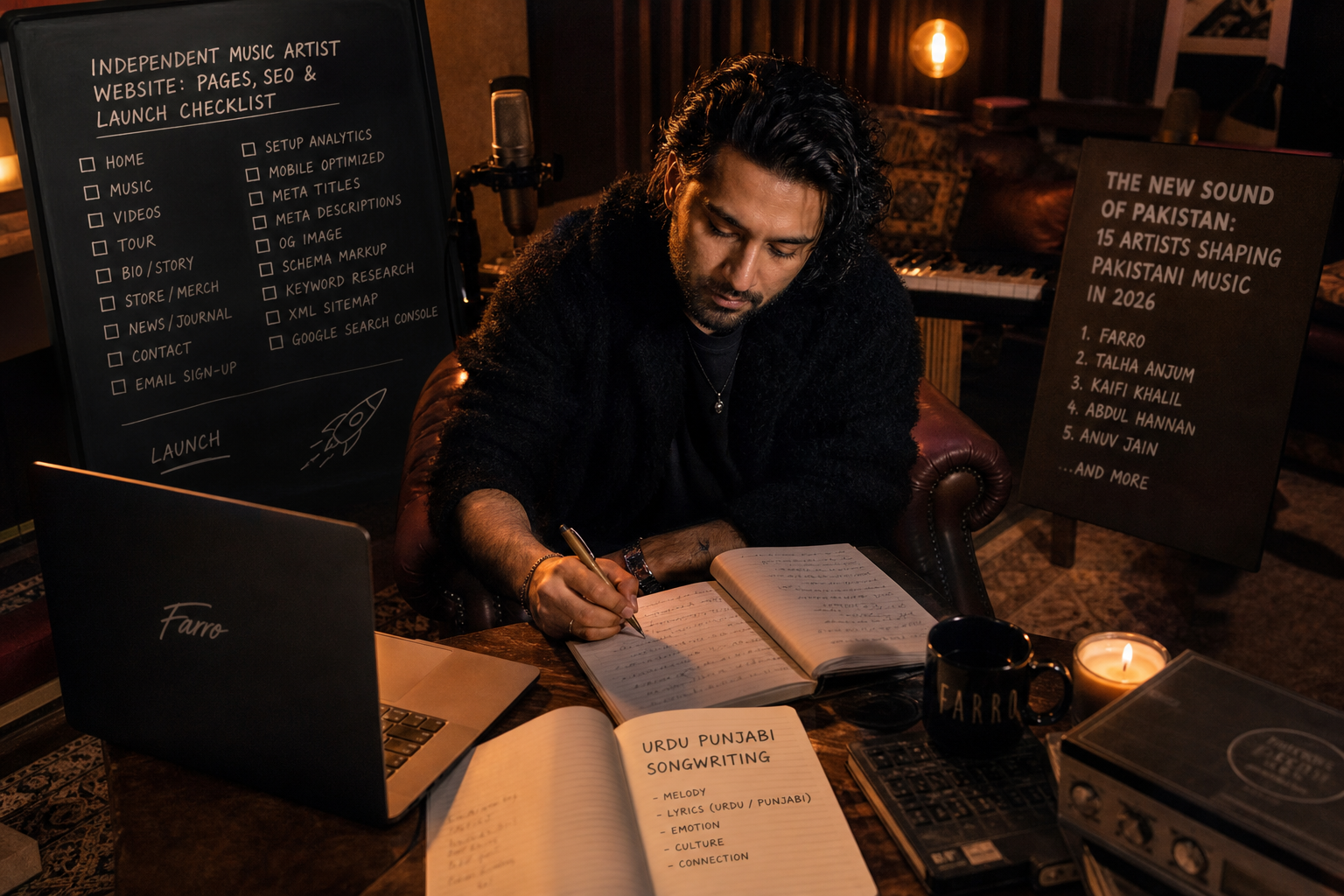
If you are a listener, this helps you search better. If you are a songwriter, it helps you choose language for meaning rather than decoration. Farro’s Urdu Punjabi Songwriting page is the closest next read if you want the creative side of that choice: how words, melody, and cultural feeling work together inside a song.
Why a hit Punjabi performance can still belong in an Urdu Punjabi music conversation
Search results for this topic often surface individual performance pages, including a Dailymotion result titled “Hit Pakistani Punjabi Songs ► Naseebo Lal ► Dil Da Jani ► Tribute To Noor Jahan”. A page like that may be useful if you only want to watch one performance, but it does not explain why the song matters to listeners trying to understand the wider tradition.
Naseebo Lal and Noor Jahan are relevant to this conversation because the Punjabi vocal tradition is not only about vocabulary. It is about delivery: the way a singer stretches a note, leans into pain, sharpens a romantic phrase, or turns a simple line into something that feels lived-in. Even when the lyric is primarily Punjabi, Urdu-speaking listeners often recognize the emotional structure because South Asian love songs share images of separation, memory, devotion, complaint, and return.
For a practical listening exercise, play a Punjabi song and notice where the emotion actually lands. Is it in the first line of the verse, the repeated hook, a vocal cry before the chorus, or a word the singer holds longer than expected? Then compare it with an Urdu romantic track. The language may change, but the emotional architecture may be familiar: a restrained opening, a confession, a swelling refrain, and a final return to the central feeling.
This is where modern Desi R&B and pop enter naturally. A contemporary artist does not need to copy older arrangements to inherit their emotional logic. A sparse beat, a close vocal, and one Punjabi phrase at the right moment can carry the same intensity that an older film arrangement might have built with strings, harmonium, or live percussion.
The archive problem: 1940s and 1950s film songs are not always easy to hear
One reason urdu punjabi music can feel confusing online is that the archive is uneven. Some catalogue-style pages list large bodies of older Punjabi film songs, while only a small number may be easily playable online. The research material for this topic points to a 1940s/1950s grouping described as “411 songs” with “1 online songs.” Treat that kind of figure as a sign of access, not as a complete musical education.
In practical terms, it means a listener may see a title, film name, singer field, music director field, or poet field, but still not be able to hear the recording. That creates a gap between documentation and experience. A song can exist in a film database, memory, or collector culture while remaining hard to verify by listening on common platforms.
For fans, the best approach is to separate three questions:
- Does the song exist in a documented catalogue? A listing can help confirm that a film song is part of the historical record.
- Is the audio available? A title in a database does not mean the recording is streamable or complete.
- Is the credit information complete? Older listings may leave singer, music, or poet details unknown or inconsistent.
This matters because early Pakistani Punjabi film music sits close to questions of language identity, migration, cinema history, and regional taste. A listener coming from modern Urdu pop may hear older Punjabi film songs as rawer or more theatrical. A Punjabi listener may hear idiom and pronunciation that modern crossover songs smooth out. Both responses are valid; they are simply listening from different starting points.
What changes when you move into the 1960s Punjabi film catalogue
The same archive pattern appears in later decades, though with different scale. The research brief notes a 1960s grouping described as “1302 songs” with “3 online songs.” Again, the important lesson is not the exact listening total for every platform; it is the gap between how much music was created and how little may be immediately accessible through ordinary online discovery.
For Pakistani listeners, the 1960s matter because Punjabi cinema had developed a stronger identity, and film songs became part of popular memory beyond the screen. For Indian listeners exploring Pakistani music, this period can reveal how Punjabi expression traveled differently across borders, even when themes of romance, family, longing, and honor remained recognizable.
If you are trying to build a listening path, do not begin by trying to “complete” a decade. Start with one available track or one credited singer, then follow the sound. Notice the rhythm pattern. Notice whether the melody feels closer to folk phrasing or film composition. Notice how the singer handles consonants and open vowels. In Punjabi music, force and tenderness often sit very close together; a line can sound assertive and wounded at the same time.
For independent artists, that listening habit is more useful than copying vintage surface details. A modern bilingual song should not borrow old film flavor as costume. It should understand what the older music solved: how to make a regional phrase feel emotionally universal without sanding away its accent, weight, or cultural memory.
How to read old song lists without treating them as final truth
Catalogue pages such as PakMag’s Punjabi film song database can be valuable starting points for discovery, especially when a listener wants to trace songs by film, decade, singer, or credit. But old song lists should be read carefully. They are reference tools, not always complete listening guides.
The outline phrases “a complete list of 1 online songs from the 1940/50s” and “a complete list of 411 film songs from the 1940s/50” point to two different reader needs. One is about what can actually be heard online. The other is about what is documented as part of the film-song record. Those are not the same thing.
Here is a simple way to use those lists without getting misled:
- Use the list to find names, not to prove popularity. A database entry does not automatically mean the song was a hit, widely remembered, or influential.
- Check whether the audio exists before judging the music. A missing recording tells you about access, not necessarily about the song’s quality.
- Be cautious with incomplete credits. If the singer, composer, or poet is not verified in the available source, do not fill the gap from memory or guesswork.
- Compare old and new listening contexts. A song written for film performance may feel different from a modern headphone-first R&B track, even when both deal with love or heartbreak.
This is also a useful discipline for songwriters. Before using a vintage reference, ask what you are actually borrowing: a melodic contour, a lyrical image, a rhythmic feel, a vocal ornament, or simply nostalgia. The more specific the answer, the less likely the result will feel generic.
Common mistakes listeners and songwriters make with Urdu Punjabi music
The first mistake is treating Urdu and Punjabi as interchangeable “Desi flavor.” They are not interchangeable. Urdu can sound formal, delicate, cinematic, conversational, or street-level depending on diction. Punjabi can sound rustic, urban, playful, devotional, romantic, or defiant. The emotional effect changes with the exact word choice.
The second mistake is assuming that a bilingual song needs equal amounts of both languages. Sometimes one Punjabi phrase in a chorus does more work than a full bilingual verse. Sometimes Urdu carries the verse because the feeling needs detail, while Punjabi lands the hook because the emotion needs impact. Balance should serve the song, not a checklist.
The third mistake is ignoring pronunciation. A listener may forgive a rough mix before they forgive a word that feels emotionally false. If a singer cannot carry the weight of a Punjabi word, the line can sound decorative. If an Urdu phrase is delivered without its softness or phrasing, it can lose the intimacy that made it worth choosing.
The fourth mistake is flattening older music into nostalgia. A Noor Jahan tribute, a Naseebo Lal performance, or an old Punjabi film listing should not be used only as a mood board. Ask what the performance teaches: breath control, melodic patience, direct address, lyrical repetition, or the courage to let a vocal sound imperfectly human.
For listeners who want a modern entry point into Farro’s world, Musafir is a relevant official release page to explore. For broader context on current Pakistani music, The New Sound of Pakistan looks at artists shaping the scene from a contemporary perspective.
What does urdu punjabi music mean in everyday listening?
It usually means music that connects Urdu and Punjabi language feeling, whether through lyrics, vocal style, melody, or audience culture. It can include older Pakistani Punjabi film songs, romantic Urdu-Punjabi crossover tracks, and newer Desi pop or R&B songs that move between languages naturally.
How should a new listener get started?
Start with one emotional thread instead of a huge archive. For example, choose romantic songs, heartbreak songs, or film songs, then compare how Urdu and Punjabi express the same feeling differently. After that, explore singers, decades, and modern artists with a clearer ear.
Who sang songs from the Punjabi film Bulbul from 1955?
The verified material for this article does not confirm the singer information for Bulbul from 1955. If you are using an archive entry, treat any missing singer credit as unverified until you can confirm it from a reliable catalogue or recording source.
What is known about Suchay Moti from 1959 in the supplied material?
The supplied research question names Inayat Hussain Bhatti as singer for Suchay Moti from 1959, but it does not verify the missing music or poet credit. It would be inaccurate to fill that gap without a confirmed source.
What is known about Shehri Babu from 1953 in the supplied material?
The supplied research question names Zubaida Khanum as singer and Rasheed Attray as music credit for Shehri Babu from 1953, while the poet credit remains unverified here. That uncertainty should be preserved rather than guessed.
Your next move with Farro
If you came here as a fan, the main takeaway is simple: listen beyond the label. Urdu Punjabi music is not just a search phrase; it is a way of hearing South Asian emotion across language, memory, and modern production. A song may feel Urdu in its tenderness, Punjabi in its punch, cinematic in its structure, and R&B in its sound design.
If you came here as an independent artist or bilingual songwriter, your next step is more practical: choose the emotional job of each language before you write. Decide where the confession belongs, where the hook should hit, and which words only work in one language because of their sound, cultural weight, or intimacy.
Farro’s official website brings that world into one place through music, releases, videos, and writing around the story behind the sound. Explore the songwriting angle through Urdu Punjabi Songwriting, or visit Farro to move from reading into the music itself.
