
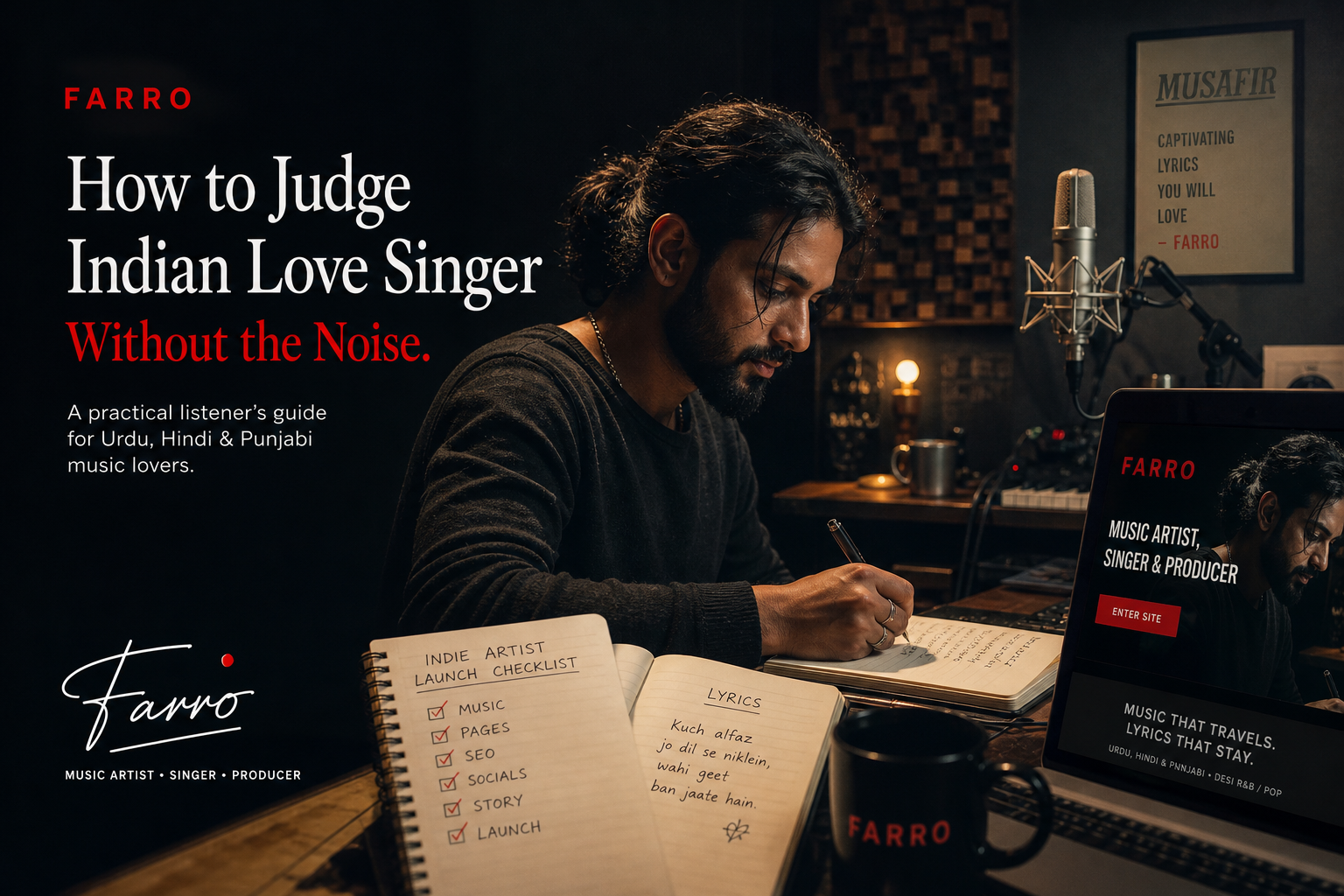
How to Judge Indian Love Singer Without the Noise
What an Indian love singer really means
An indian love singer is best judged by how well the song carries romantic feeling across voice, melody, language, and cultural memory, not simply by whether the artist is from India or sings in Hindi. For Pakistani and Indian listeners, the phrase often points to a wider sound world: Urdu tenderness, Hindi film-influenced melody, Punjabi directness, emotional pop phrasing, and the softer edge of Desi R&B.
That is why the term can feel noisy. One listener may mean a classic romantic vocalist. Another may mean a modern independent artist with late-night synths and confessional lyrics. A songwriter may use the same phrase while looking for craft references: how the hook lands, how the verse speaks, how the chorus opens, and how much room the vocal leaves for feeling.
Farro sits in that South Asian romantic and emotional music space, where Urdu, Hindi, Punjabi, Desi pop, and R&B influences can overlap. If you are trying to judge an artist in this lane, start with the song itself. Does the vocal sound honest before it sounds impressive? Do the words feel natural in the language being used? Does the production support the emotion, or does it drown it?
How to listen past the surface
The easiest mistake is to judge a love singer only by vocal range. Range matters, but romantic music depends just as much on restraint, pronunciation, melodic control, and emotional timing. A high note can impress for five seconds; a believable line can stay with a listener for years.
Use a simple listening check:
- Does the singer make the first line feel lived-in, or does the emotion arrive only in the chorus?
- Can you understand the words without reading along, especially in softer phrases?
- Does the melody give the language room to breathe, or does it force awkward syllables into a Western pop shape?
- When the beat enters, does the feeling deepen, or does the song become generic?
- Does the singer know when to stay plain instead of adding runs everywhere?
For example, a verse may sound clean and intimate, then the chorus may turn brittle because the vocal is pushed too hard. That does not automatically make the singer weak; it tells you where the song’s emotional design breaks. In romantic Urdu, Hindi, and Punjabi music, the best moments are often not the loudest. They are the lines where the singer sounds like they are admitting something they almost did not want to say.
Farro’s official site presents music, videos, releases, and the story behind the sound, so the useful way to read the brand is through craft rather than hype. Songs such as Musafir and Dil.exe by Farro are good places for listeners to pay attention to how titles, mood, and language choices frame romantic feeling before the first full listen is complete.
Why regional-language songwriting changes the standard
When people search around indian love singer, they are often also searching for the mechanics behind the feeling. Farro’s site has existing coverage around songwriting tools for Indian regional languages, and search data provided for that topic shows repeated visibility near the top of results but no recorded clicks in the cited examples. The practical lesson is clear: people are interested in the subject, but the page has to answer the real question quickly and usefully.
For bilingual and regional-language songwriters, tools are not only rhyming aids. They are guardrails for voice. A love lyric written in English logic and then dressed in Urdu, Hindi, or Punjabi can sound correct on paper but emotionally false when sung. The sentence may be grammatical, yet the feeling may not belong to the idiom of the language.
A complete regional-language songwriting process should help with:
- word choice that sounds natural in speech, not just poetic in isolation;
- script decisions, especially when lyrics may be written in Roman letters but heard in Urdu, Hindi, or Punjabi;
- syllable stress, because melody can distort a word if the stress falls in the wrong place;
- emotional register, such as whether the line feels intimate, devotional, cinematic, playful, or heartbroken;
- code-switching, where a shift between languages should feel intentional rather than convenient.
This is why regional-language tools matter to independent artists. They help protect the identity of the song. A Desi R&B track can use modern drums and synth textures, but if the lyric phrasing feels imported without care, the listener hears the gap immediately.
What a useful songwriter’s toolkit should include
A toolkit for judging or writing in this space does not need to be complicated. It needs to catch the problems that listeners actually notice. For an indian love singer, those problems usually appear where language, melody, and production meet.
Start with a lyric draft in the language or blend of languages that the song truly needs. Do not choose Punjabi only because it sounds catchy, Urdu only because it sounds poetic, or Hindi only because it feels broadly familiar. Choose the language because the emotional situation belongs there. A blunt confession may work better in Punjabi. A delicate memory may need Urdu softness. A direct pop hook may sit naturally in Hindi or a bilingual phrase. There is no universal rule, but there should be a reason.
Then test the lyric out loud at singing speed. Many lines look beautiful when read slowly but collapse when placed on a beat. If a key word becomes unclear, the line needs rewriting or the melody needs adjusting. This is especially important in romantic music, where a listener may forgive a simple line but rarely forgives a line that sounds unnatural.
The production toolkit should include a clean vocal space. Romantic South Asian pop and R&B often depend on breath, closeness, and small changes in tone. Too much reverb can turn intimacy into fog. Too much tuning can make heartbreak feel plastic. Too much low-end energy can make the voice fight for attention. The goal is not minimalism for its own sake; the goal is emotional hierarchy. The voice must know where it sits.
Finally, use reference listening carefully. A reference track can help with mood, but it should not decide the song’s identity. If every decision comes from another artist’s palette, the result may be polished but forgettable. The better question is: what feeling is this song responsible for, and which choices make that feeling clearer?
A Farro-friendly workflow for listening and writing
A Farro-friendly workflow means treating the song as a full emotional object: lyric, vocal, beat, title, and release context all working together. This can help fans listen more sharply and help independent artists make better decisions before recording.
- Define the emotional situation first. Is the song about longing, regret, distance, confusion, devotion, or digital-age love? A vague love song often becomes generic because the writer has not chosen the exact wound.
- Pick the language blend after the emotion is clear.
- Write the hook in plain speech before making it poetic. If the core line does not make sense in everyday language, decoration will not fix it.
- Sing the verse quietly. If it only works when performed dramatically, the writing may be leaning too hard on performance.
- Build the production around the vocal. The beat should frame the singer’s feeling, not compete with it.
- Check the title. A title such as Na Samajh sets an emotional expectation before playback, while a release such as DIL DUKHDA AE signals pain directly through its naming. The title is part of the listener’s first interpretation.
For listeners, this workflow becomes a judging method. Instead of asking whether a singer is famous enough, ask whether the song knows what it is feeling. Instead of asking whether the vocal is technically perfect, ask whether the performance makes the language more believable.
Language, script, and cultural nuance
South Asian love songs carry meaning beyond dictionary translation. A word may be technically correct but culturally too formal, too filmi, too casual, or too region-specific for the moment. That is why a singer working across Urdu, Hindi, and Punjabi has to manage more than pronunciation. They have to manage emotional temperature.
Script is part of that challenge. Many listeners encounter lyrics through Romanized text, while the emotional source may belong to Urdu, Hindi, or Punjabi expression. Roman writing can make a song more accessible, but it can also flatten pronunciation if the singer or listener does not already know the sound. For songwriters, this means a lyric sheet should not be the final test. The sung phrase is the test.
There is also a difference between cultural borrowing and cultural fluency. A Punjabi phrase used only for impact can feel decorative. A Hindi line inserted only to widen appeal can sound forced. An Urdu image used without understanding its emotional weight can become melodrama. None of this means artists must stay inside one language. It means the movement between languages should reveal something about the speaker in the song.
This is where Farro’s wider site context around Urdu Punjabi music, the desi music scene, and South Asian pop matters. These are not separate boxes. For many listeners, they are overlapping ways of hearing identity, romance, memory, and modern production in the same track.
Common mistakes when judging an Indian love singer
The first common mistake is confusing polish with feeling. A clean mix, glossy visuals, and strong branding can make a song appear important, but the emotional test still happens in the vocal and writing. If the chorus feels interchangeable with dozens of other songs, polish has not solved the core problem.
The second mistake is treating all South Asian romantic music as one sound. Pakistani, Indian, Urdu, Hindi, Punjabi, indie pop, film-influenced pop, and Desi R&B can overlap, but they are not identical. A listener who expects every love song to behave like a film ballad may miss the quieter power of independent releases. A songwriter who copies only current pop textures may lose the cultural grain that made the song worth writing.
The third mistake is overvaluing translation. If a lyric must be translated to be understood by a broader audience, that is fine. But translation should explain meaning, not replace experience. The original phrasing, vowel shape, and emotional register still carry the song’s body.
The correction is simple: judge the full chain. What is the feeling? Which language carries it best? Does the melody respect that language? Does the singer make the line human? Does the production leave enough space for the answer to reach the listener?
What does “indian love singer” mean for Pakistani and Indian listeners?
It usually means a singer associated with romantic South Asian music, not only an artist with Indian nationality. Listeners may be thinking of Hindi love songs, Urdu emotional phrasing, Punjabi heartbreak, or modern Desi R&B and pop.
How should a new listener get started?
Start with the song’s emotional clarity rather than the artist’s popularity. Listen to the first verse, the chorus, and the vocal tone. If the language feels natural and the production supports the voice, the song is doing meaningful work.
How can independent artists choose tools without losing their voice?
Use tools to check language, structure, rhyme, and clarity, but make final decisions by singing the line out loud. A tool can suggest options; it cannot decide whether a phrase sounds emotionally true in your mouth.
Your next move with Farro
If you are a listener, use this lens on the next romantic track you play: do not ask only whether the singer sounds good. Ask whether the song knows its emotional situation, whether the language fits that feeling, and whether the performance makes the words more believable.
If you are a songwriter, take one unfinished love song and run it through the same check. Rewrite the hook in plain speech, sing it at real tempo, then adjust the language and melody until the line feels natural. That small process will teach you more than chasing a vague idea of what an indian love singer is supposed to sound like.
To explore Farro’s music, releases, and the story behind the sound, visit Farro.
